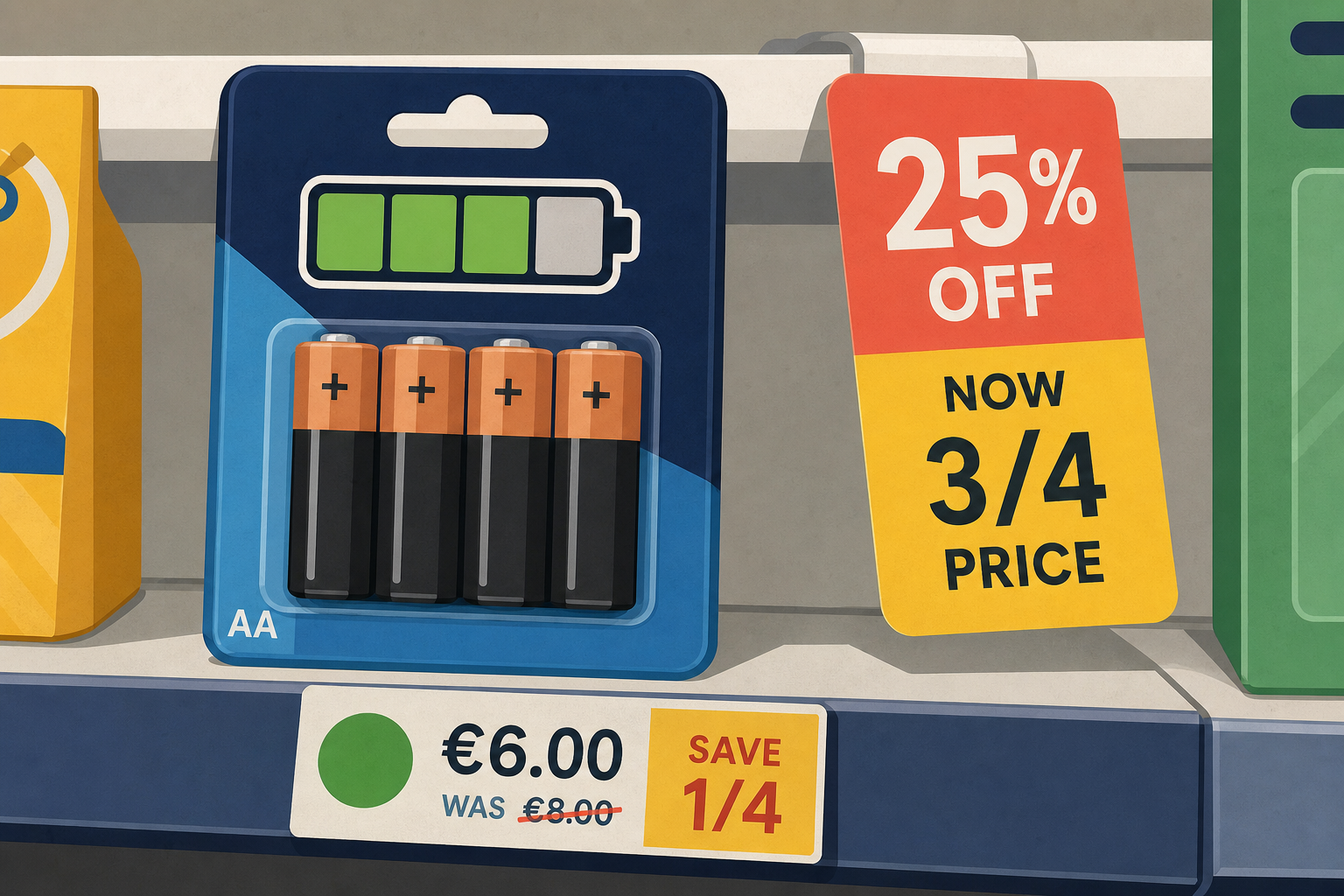
Here are three labels you might see on a shelf, a sale sign and a battery icon: 3/4, 0.75 and 75%.
Are these three the same amount, or three different amounts? Talk it out: how would you prove they mean the same thing?
Take three hands-up answers, not open call-outs. Don't settle the argument yet — let the disagreement sit. Some pupils will say they are the same, some will not be sure the percentage matches. That tension is the hook for the whole lesson.
Each battery shows the same amount of charge written three ways: as a fraction, a decimal and a percentage. Watch how the same fill gets three names, and see which one is trickier than the rest.
1/2 sets the pattern: one half, 0.5, 50%. Get the class saying all three forms together.
1/4: before the reveal ask, if a half is 50%, what's a quarter? Draw out that a quarter is half of a half, so 25 is half of 50. Reading: one quarter, 0.25, 25%.
1/10: stress ten parts out of a hundred so the 10% feels earned. Reading: one tenth, 0.1, 10%.
Between 1/10 and 1/8, pause: name a pupil to predict the 1/8 percentage, then revoice their reasoning.
1/8 is the key one, so slow right down. One eighth is half of a quarter, so half of 25% is 12.5%; the decimal runs to three places, 0.125. The panel only shows whole numbers so it rounds to 13%, but the true reading is 12.5%. The three-place decimal and the and-a-half catch pupils out.
One pupil comes to the board to set the battery slider; everyone else predicts the percentage and reads the three forms aloud with the class. First, an easy anchor to warm up: one fifth is 0.2 and 20%.
Now we work through these fractions in order: 1/5, then 2/5, then 3/5, then 3/4. Each time the pupil sets the fill, we read off the decimal and the percentage together. The fifths build on each other — watch how 2/5 is just double 1/5, and 3/5 adds one more fifth again — and the final 3/4 goes back to a friendly quarter-family value to finish.
This round is for talking it through together — pupils take turns at the board and the class agrees or corrects out loud.
Open by setting 1/5 yourself as the warm-up anchor (0.2, 20%), then hand the slider to pupils for 2/5, 3/5 and 3/4. Before each reveal, ask the class to predict the percentage. The fifths are the reasoning spine — revoice a pupil who spots that 2/5 is just twice 1/5, so 40% is twice 20%. Watch for pupils who read the fraction panel but skip the decimal; make them say all three each time.
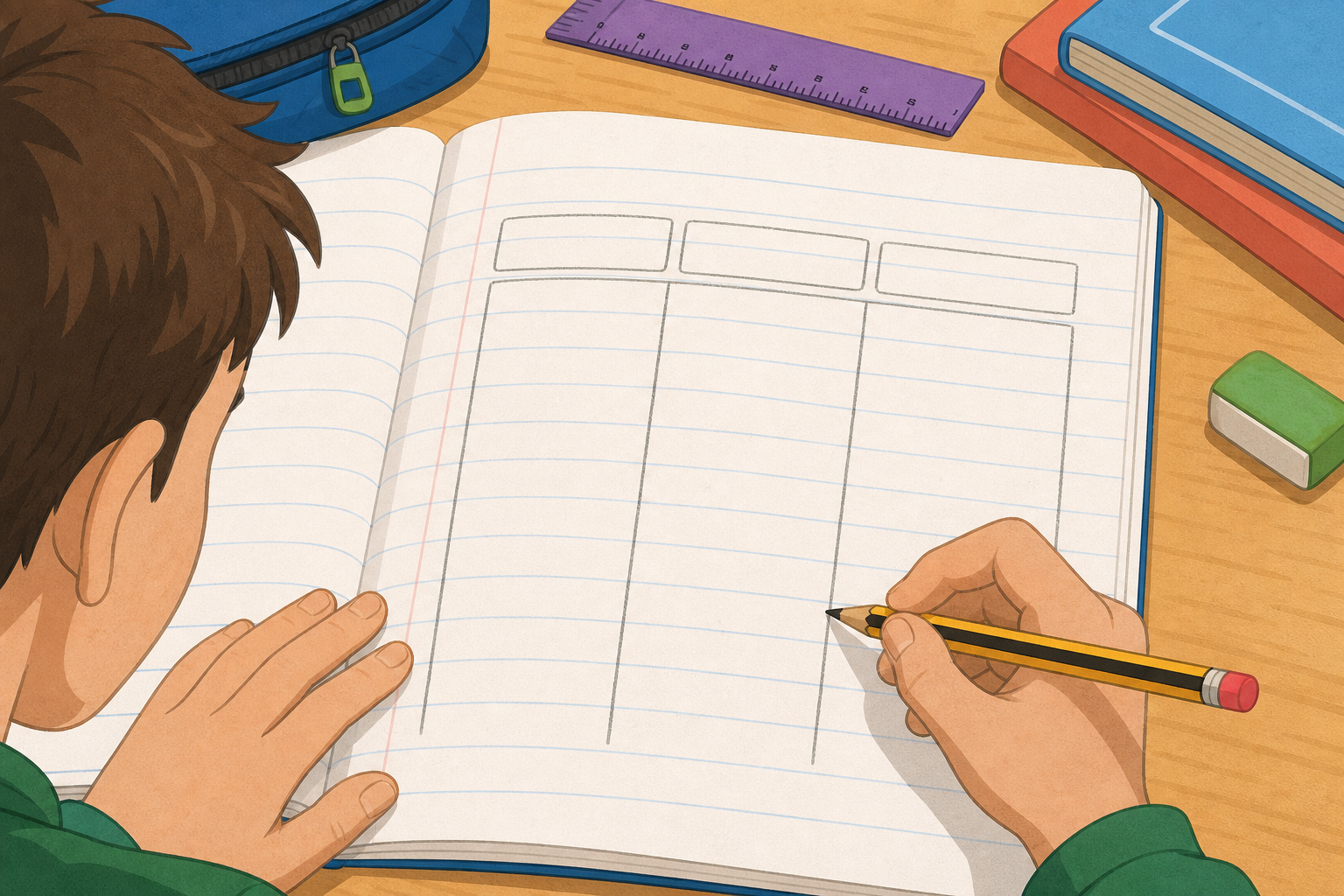
In your maths copy, write each of the amounts we looked at today three ways in a row — fraction, decimal, then percentage — one under the other, to build a short equivalence table. Use these amounts:
Rule three columns first, head them Fraction, Decimal and Percentage, then fill each row. Anchor row to copy from and check the tricky one: 1/8 = 0.125 = 12.5%.
Leave the 1/8 anchor (1/8 = 0.125 = 12.5%) on the board, or keep the step 2 batteries on screen, so a pupil who missed the earlier reveal can copy the trickiest row accurately. Walk the room glancing for the three columns lined up and the 1/8 row written correctly (0.125 and 12.5%) — this is whole-class copybook practice, not marking.
Today we match the slider to a target given in one form, then check the other two forms line up. We work through these in order: make 60%, then make 3/4, then make 0.2, then make 1/8. Each one names one form and asks you to prove the other two match.
These are the practice questions — pupils take turns at the board, check each answer, and the class confirms before moving on. Keep the board work brisk rather than over-explaining.
Each target names one form; before Check, have the class call the other two. The 1/8 target is the hardest — remind the class the true value is 12.5% even though the panel rounds to 13%, so a pupil who answers 12.5% is correct. Revoice the reasoning: eighths are trickier because their decimals run to three places.
You're previewing this lesson. Get full access to this lesson and hundreds more — each one ready to teach, with interactive activities, printable resources and pupil progress tracking built in.