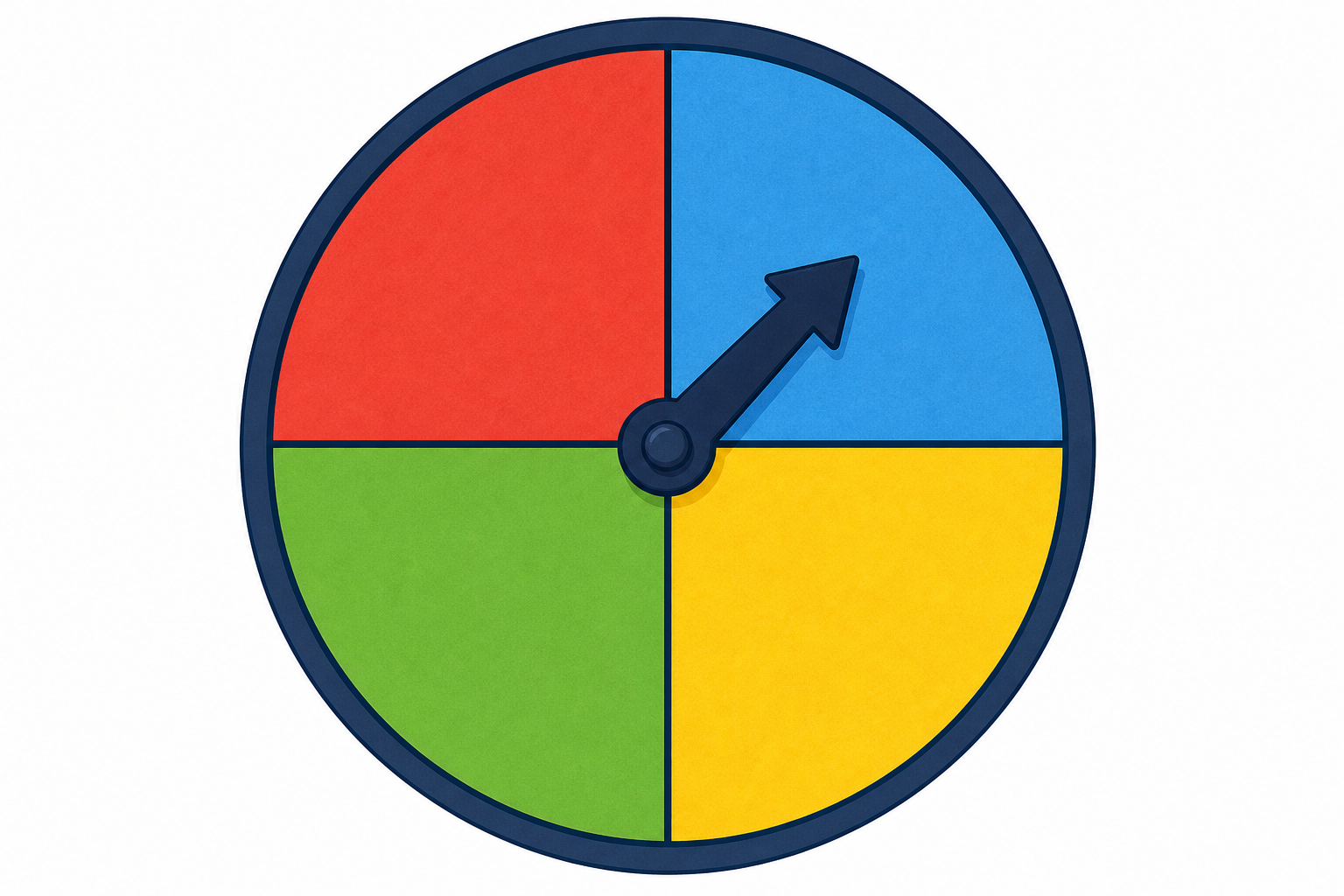
Picture a spinner split into four equal colours: red, blue, green and yellow. If we give it a spin, what is the chance it lands on red? See how many different ways you could write that answer down.
Take three hands-up answers, not open call-outs. Listen for pupils who say one out of four, a quarter, and twenty-five per cent — that spread of forms is exactly the lesson. Do not resolve it yet; hold the three answers up as a puzzle to open with.
Watch three spinners on the board. On each one we work out the chance of a colour by counting the favourable segments (the ones we are asking about — here, the red ones) over the total segments. Then we write that same chance three ways: as a fraction, as a decimal, and as a percentage.
To turn a fraction into a decimal we divide the top number by the bottom number, then multiply by 100 to get the percentage:
So 1/4 = 0.25 = 25%. Look for how a fair spinner shares its chance equally, and be ready to say the third form for the last one before it appears.
First spinner: point to red, then say the count aloud — one favourable, four in total. Work the division on the board: 1 ÷ 4 = 0.25, then × 100 = 25%. Draw out that a quarter, 0.25 and 25% are the same amount.
Before moving on, put a quick question to the class and take two hands-up answers, then revoice one: so how did we turn the quarter into a decimal? Use this same pause between each spinner so the watch beat stays live.
Second spinner: the even numbers are 2, 4 and 6 — three of six. Ask why we simplify 3/6 to 1/2 before converting, then work 1 ÷ 2 = 0.5 on the board.
Third spinner: pause before the decimal and percentage appear and ask the class to predict them. 2/5 = 0.4 = 40% catches pupils who expect a tidy quarter or half. This one is the reason for the whole step — the sequence built from an easy quarter to a fraction that does not sit on a familiar landmark.
In your maths copy, for each spinner outcome write the probability three ways in a row: first as a fraction, then its decimal, then its percentage. Work these three:
Check each row: the three forms should all match the same amount.
Walk the room glancing at whether each row's three forms agree — no marking, this is whole-class copybook practice. Watch for pupils who write 3/6 without simplifying to 1/2, and for the decimal-to-percentage slip (0.4 read as 4%).
Today we work through a fresh spinner together: an eight-segment spinner where three segments are prizes. We find the chance of a prize, then write it as a fraction, a decimal and a percentage.
This time the fraction does not land on a tidy landmark, so we divide the top by the bottom on the board, then multiply by 100 for the percentage.
Write the chance of a prize three ways: as a fraction, a decimal and a percentage.
Keep this reference table beside you as you work:
Then we spin it a few times so you can see the outcomes appear. Some of you will come up to set the spinner and read out the three forms.
Talk this one through together — pupils take turns at the board and the class agrees or corrects out loud.
Set the spinner to eight segments with three prizes: the chance is 3/8 = 0.375 = 37.5%. This is the first probability that needs a thousandths decimal, so work the division 3 ÷ 8 = 0.375 out visibly on the board before revealing the percentage. Let pupils spin a handful of times and note that the results do not have to match 3/8 exactly — that is next lesson's idea. Keep the round moving; the point is fluent conversion, not a long spinning session.
Today we work through these spinner problems together, each a step harder than the last. Take your time on the decimal for the last one:
For each one, set it up on the spinner, then write the chance as a fraction, a decimal and a percentage.
This is the practice round — pupils take turns at the board, check each answer, and the class confirms before moving on. Keep the board work brisk rather than over-explaining. The spinner starts on the 5-section, 1-blue setup; change the segments for each new problem as you go.
The practice set climbs: a tidy fifth (1/5 = 0.2 = 20%), a tenth-based fraction that needs simplifying reasoning (3/10 = 0.3 = 30%), a three-quarters (3/4 = 0.75 = 75%), then the awkward eighth (1/8 = 0.125 = 12.5%). Work 1 ÷ 8 = 0.125 on the board for the last one.
Reverse the direction: we know 1/5 = 0.2, so ask pupils how many blue out of how many segments gives a chance of exactly 0.2. Draw out that there is more than one right answer — 1 blue out of 5, or 2 blue out of 10 both give 0.2 — and ask a pupil to prove theirs converts back to 0.2.
You're previewing this lesson. Get full access to this lesson and hundreds more — each one ready to teach, with interactive activities, printable resources and pupil progress tracking built in.