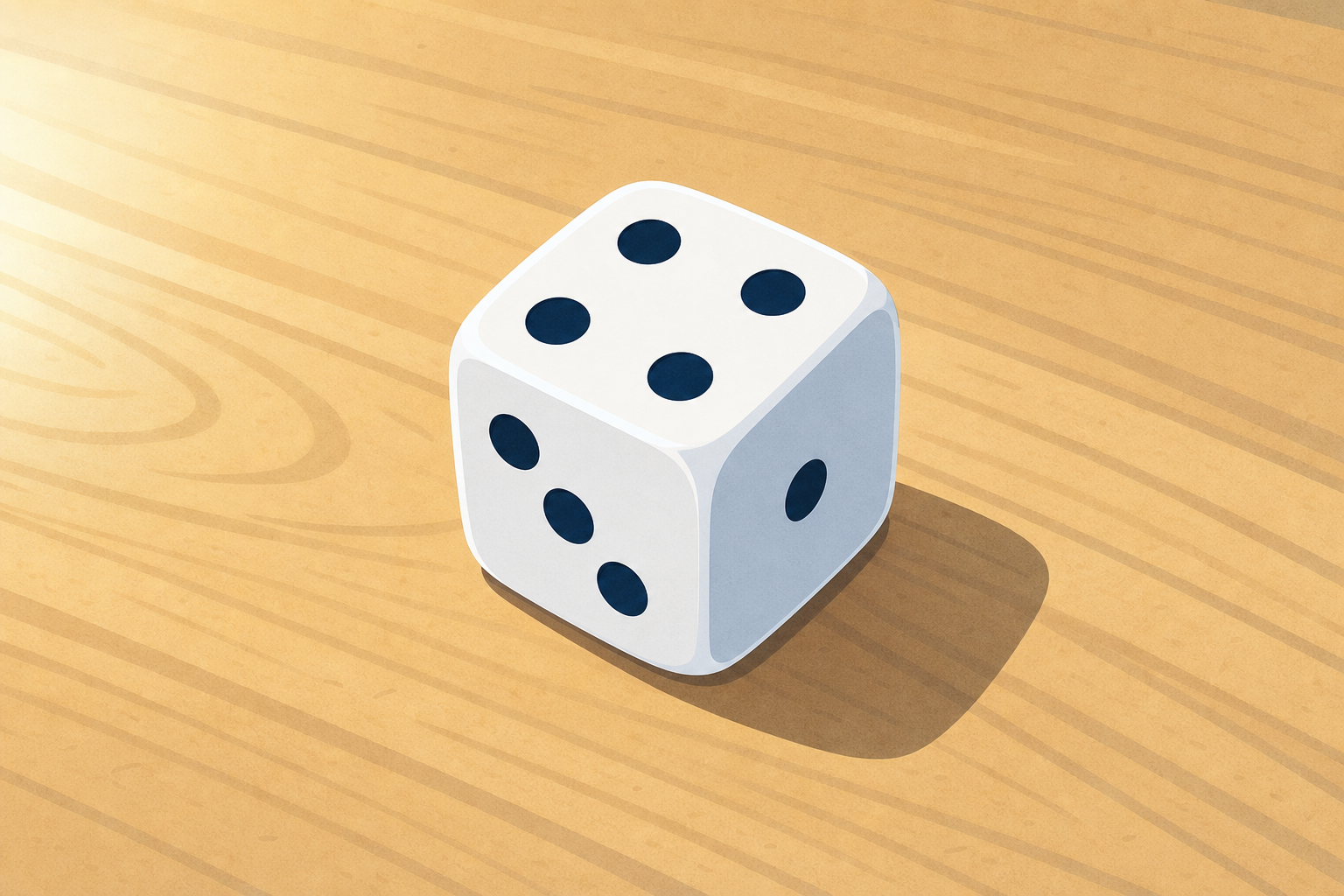
Here is a fair six-sided die. If we roll it 60 times, roughly how many sixes would you expect to see? And a bigger question: will you get exactly that number, every single time?
Take three hands-up answers, not open call-outs. Listen for the reasoning behind 10 (a sixth of 60), and for anyone who is confident they will get exactly 10 every time. Hold that second question open — do not settle it now; the whole lesson answers it.
Theory says a six comes up 1 time in 6, so we predict 10 sixes in 60 rolls. A single roll is unpredictable, theory only tells us the pattern across many rolls, never the result of one throw. Hold that prediction ready. In the next step we roll live and watch the count settle.
Over the first snapshot, name the prediction: ten out of sixty, drawn straight from 1/6. Over the second, make the key point — a single roll tells us nothing; theory speaks about the long run. Do not promise pupils that 60 rolls will land exactly on 10. Ask instead: if we rolled 600 times, would the count of sixes be closer to a sixth or further away? Hold out for a reason, not just a guess.
Today we run the die live and record what happens. We'll roll in batches and watch the histogram build. First 20 rolls. Then on to 40. Then on to 60. Each time, we compare the tally of sixes against our predicted one-in-six. We say aloud whether the experimental fraction is getting closer to a sixth or still bouncing around.
Talk this one through together — pupils take turns at the board and the class agrees or corrects out loud.
Roll in the three named batches (20 → 40 → 60) so the class sees the count settle. After each batch, revoice a pupil's reading: so after 20 rolls we had X sixes, that's roughly a fifth; after 60 it's closer to a sixth. Watch for pupils who expect the count to be exactly a sixth at 20 — that early bounce is the point. Rotate four pupils onto the roll button.
In your maths copy, write your prediction for the number of sixes in 60 rolls, then record the experimental tally from the board. Now write the experimental probability two ways: as a fraction (sixes out of total rolls) and as a percentage. Underneath, write one line saying how close it came to the theoretical one sixth.
Walk the room glancing at the fraction and the percentage conversion — this is whole-class copybook practice, not marking. Watch for pupils writing the fraction the wrong way up (total over sixes); prompt them back to favourable over total.
Today's review puzzle has five clues — cracking one unlocks the next. Each clue uses a different skill from this whole data and chance module. Work each clue in order; write every answer clearly before you move on.
One pupil records at the board while the class checks each answer before the next clue is revealed.
Board puzzle is fully specified above — no inventing data. Talk it through together; pupils take turns at the board, class confirms before moving on. Keep board work brisk.
Worked answers (reveal only after class agrees each step):
Clues rise in difficulty: clue 1 is a straight pie-chart read; clue 4 needs the fraction-to-percentage step; clue 5 is the pull-together stretch. Every clue answer is used exactly once. Slip to watch: fraction upside down on clue 4 (prompt favourable over total); adding the five scores but forgetting to divide on clue 2. If the class stalls on clue 1, give "one quarter of sixty" as a free start so everyone can enter. Fast finishers set the next clue on the board rather than call the answer early.
You're previewing this lesson. Get full access to this lesson and hundreds more — each one ready to teach, with interactive activities, printable resources and pupil progress tracking built in.