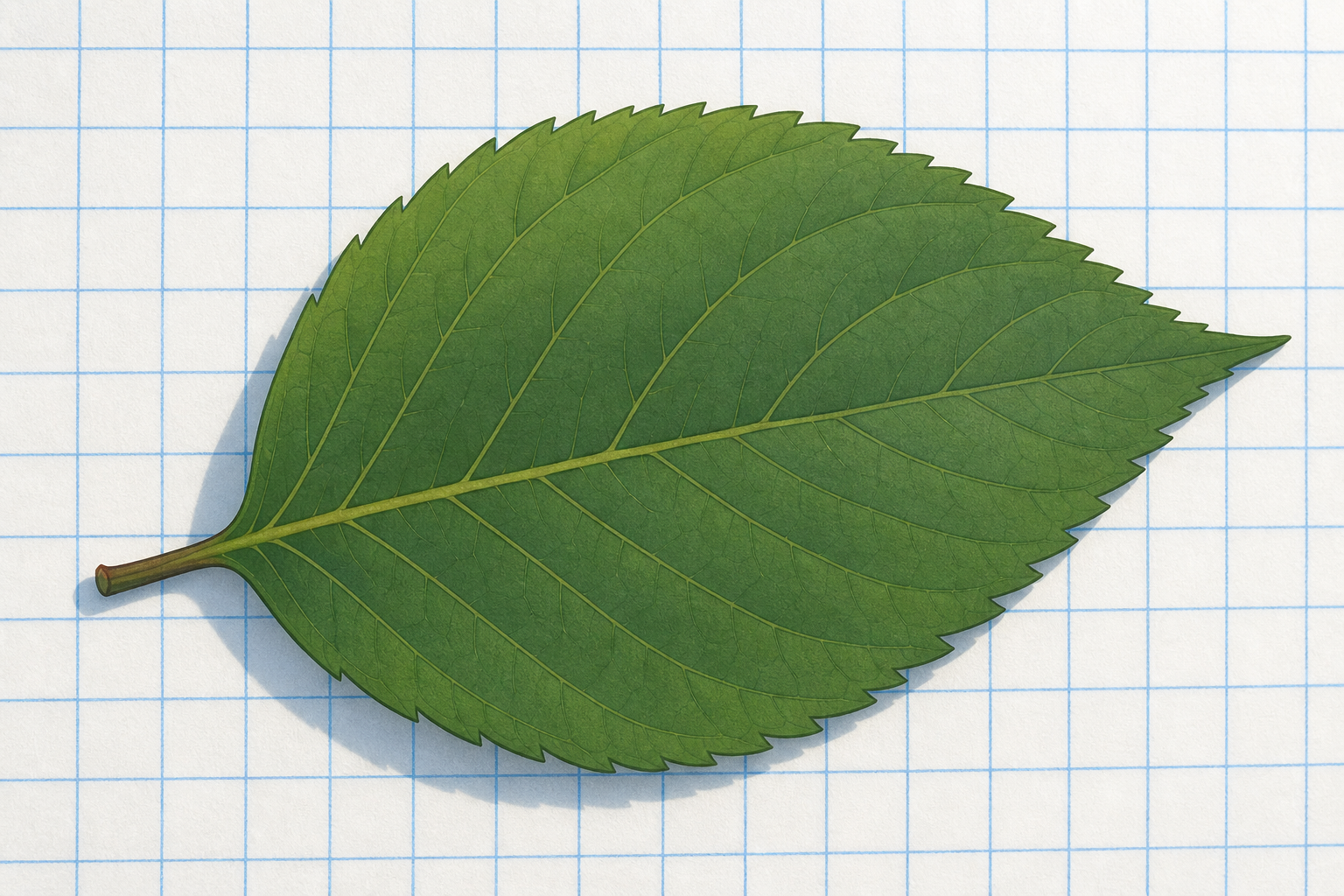
Look at the leaf on the grid of centimetre squares. Its edges curve in and out, with no straight sides at all.
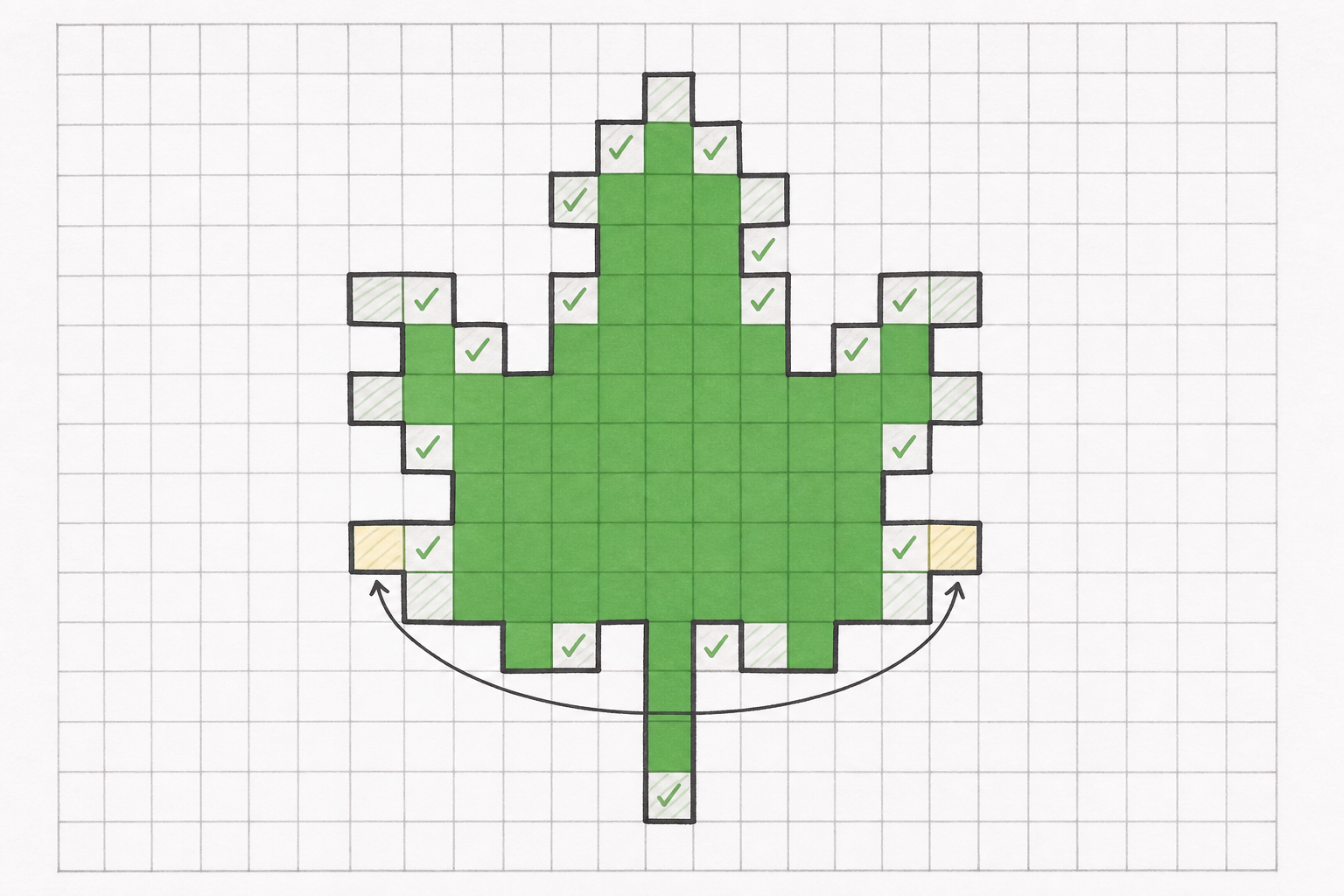
How could we work out the area of something with no straight edges? Length times breadth won't help us here.
Take two or three hands-up ideas, not open call-outs. Someone will usually say count the squares — that is exactly where we are heading.
Do not resolve it yet; the counting method is built in the next step.
We have a leaf drawn on a grid of squares. First we will count the squares the leaf covers completely — the certain ones. Then we will look at the squares along the curved edge and work out which of those to count. Watch how we decide what to do with a part-covered square.
Point to the fully-covered squares first, count them aloud, hold out so pupils catch any you skip.
The edge rule: count a part-square only if the leaf covers more than half of it, ignore less than half.
Point to one barely clipped — ask, does it count? Then one clearly more than half — that one counts.
Make the balance explicit: a big-part square counted whole takes a bit too much, a small-part square dropped leaves a bit out, they roughly cancel.
Alternative for the edge: trace two roughly-half squares and pair them — this one and that one make one whole together.
Ask pupils to predict a rough total before you announce it.
Note: the on-screen shape tool draws straight edges only, so this runs on the annotated leaf diagram, not the shape tool.
Today we estimate the area of one leaf together. First we count every whole square inside the outline. Then we go round the curved edge and decide each part-square with the more-than-half rule. Last we pair up any leftover half-squares to make wholes.
This is the practice round — talk it through together, with pupils taking turns to point at squares on the board while the class agrees or corrects out loud.
Split the job into two tallies: whole squares first (write the running count on the board), then part-squares. Insist the class calls out for each edge square: more than half — does it count? Then pair the halves aloud.
The estimate lands close to, not exactly on, whatever an individual pupil expected — say so: two people who count carefully can still land a square or two apart, and both are fair estimates.
In your maths copy, trace an irregular shape onto squared paper. Then make two columns and tally them:
Add them together and write your area estimate in cm².
Walk the room glancing at how pupils split their two columns — this is whole-class copybook practice, not marking. Watch for pupils counting every clipped square instead of only the more-than-half ones.
Work on your own squared paper at your desk. Estimate the area of three irregular shapes, each one wigglier than the last. For every shape: count the whole squares, pair up the part-squares to make whole squares, and record your total estimate in cm².
Pupils work each shape on their own squared paper at their desks while you circulate. Keep it brisk; the class confirms each shape's estimate aloud at the end.
The printed stone and leaf templates are the canonical kit here — they print onto squared paper so every pupil has the same outline. A real stone or a real leaf is a nice optional upgrade if you happen to have them, but nothing needs to be brought in; the pupil's own hand is always to hand.
Watch for two slips: counting a barely-clipped square as whole, and forgetting to pair the halves. The stretch is the key beat — when a pupil re-counts and gets a slightly different total, that is the evidence that this is an estimate. Bring one such case to the whole class.
You're previewing this lesson. Get full access to this lesson and hundreds more — each one ready to teach, with interactive activities, printable resources and pupil progress tracking built in.