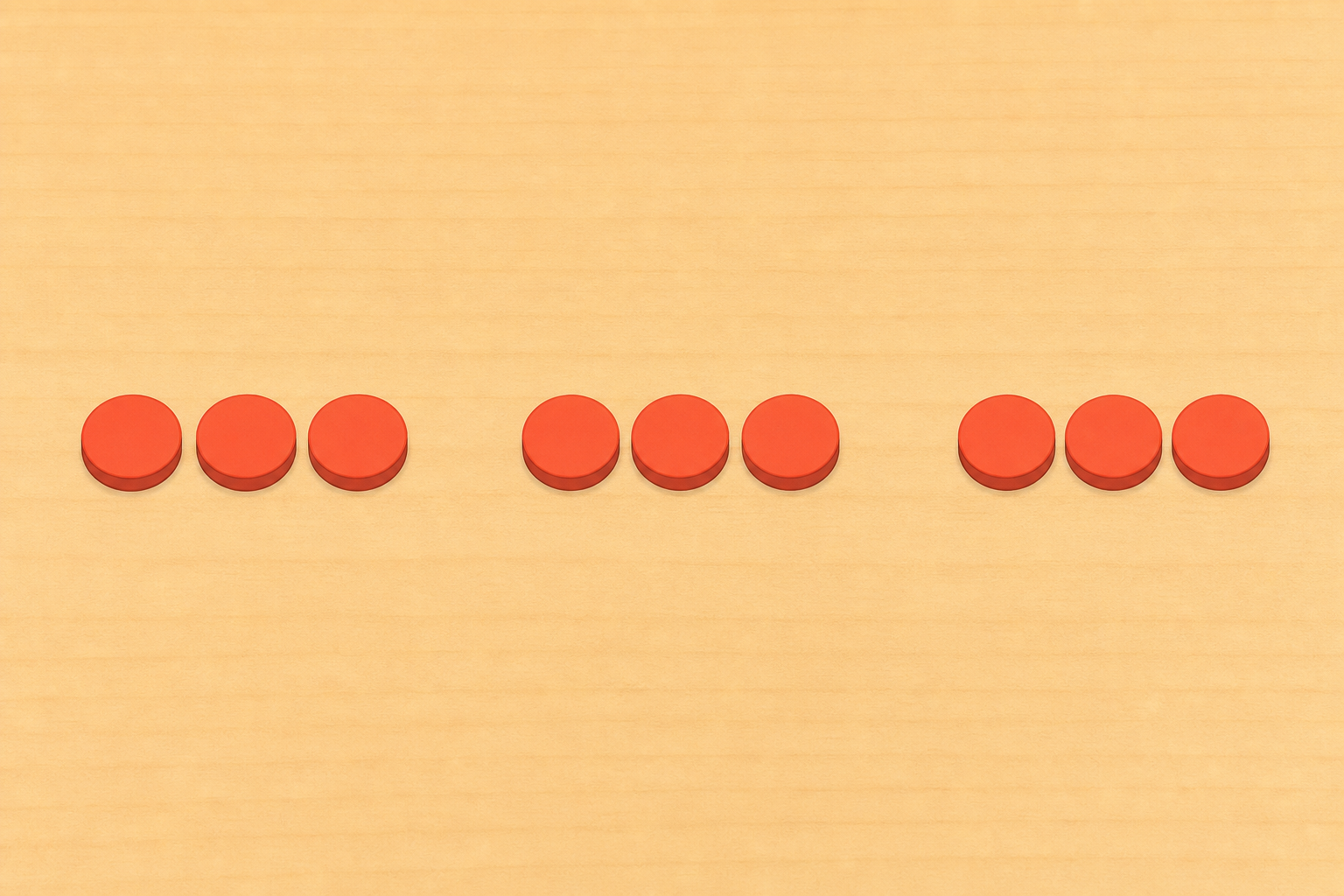
Look at these two ways of writing an amount: 3 + 3 + 3 and 3 × 3. Are they two ways of writing the same amount, or two different amounts?
Take three hands-up answers, not open call-outs. Don't confirm yet — hold the question open; the balance in the next step settles it.
Watch the balance beam. On the left pan sits a repeated addition; on the right sits a multiplication. When both sides are worth the same, the beam sits level.
This next pair uses different numbers, but both sides are still worth the same. Say what each side is worth, then check the beam agrees with you.
First pair: point at the four 2s, then the total. Four lots of two — how many times did we add?
Second pair: five and five is two fives.
Third pair: get the class to say what each side is worth — hold out for 18 — then have them point to the level beam to confirm. This is the one where equal value, not equal appearance, keeps it level.
We start on the beam below: 4 + 4 is set on the left, and together we build the matching multiplication on the right to level it. Then we work these three on the board the same way:
Each time, level the beam.
Do the first pair (4 + 4) on the interactive together; the class agrees or corrects out loud. Then draw the other three on the board and level each the same way.
Each time, ask how many lots before anyone builds — that count is the number of groups, and it comes first in the multiplication (3 lots of 4 is written 3 × 4). Watch for a pupil who counts the value on the pan instead of the number of lots; steer them back to "how many times did we add it?"
In your maths copy, write each repeated addition as a multiplication, then write the equals sentence in full:
Write the multiplication and the total. Count the groups first: for example, 6 + 6 = 2 × 6 = 12.
Walk the room glancing at whether the multiplication reads groups-first — three lots of four is written 3 × 4, not 4 × 3 — this is whole-class copybook practice, not marking. If a pupil reverses the order, remind them to count the groups first, then say how many in each group.
Build and match these equivalent pairs with counters:
This is the practice round — pupils take turns at the board, check each answer, and the class confirms before moving on. Keep the board work brisk rather than over-explaining.
The rows-of-counters picture makes "how many lots" visible — the number of rows is the first number in the multiplication. Steer any pupil who is unsure back to counting the rows. On the stretch pair, the group-count answer is 5 × 5; some pupils will offer other pairs that total 25, which is a good talking point.
You're previewing this lesson. Get full access to this lesson and hundreds more — each one ready to teach, with interactive activities, printable resources and pupil progress tracking built in.