1 - Getting Started ~5 mins
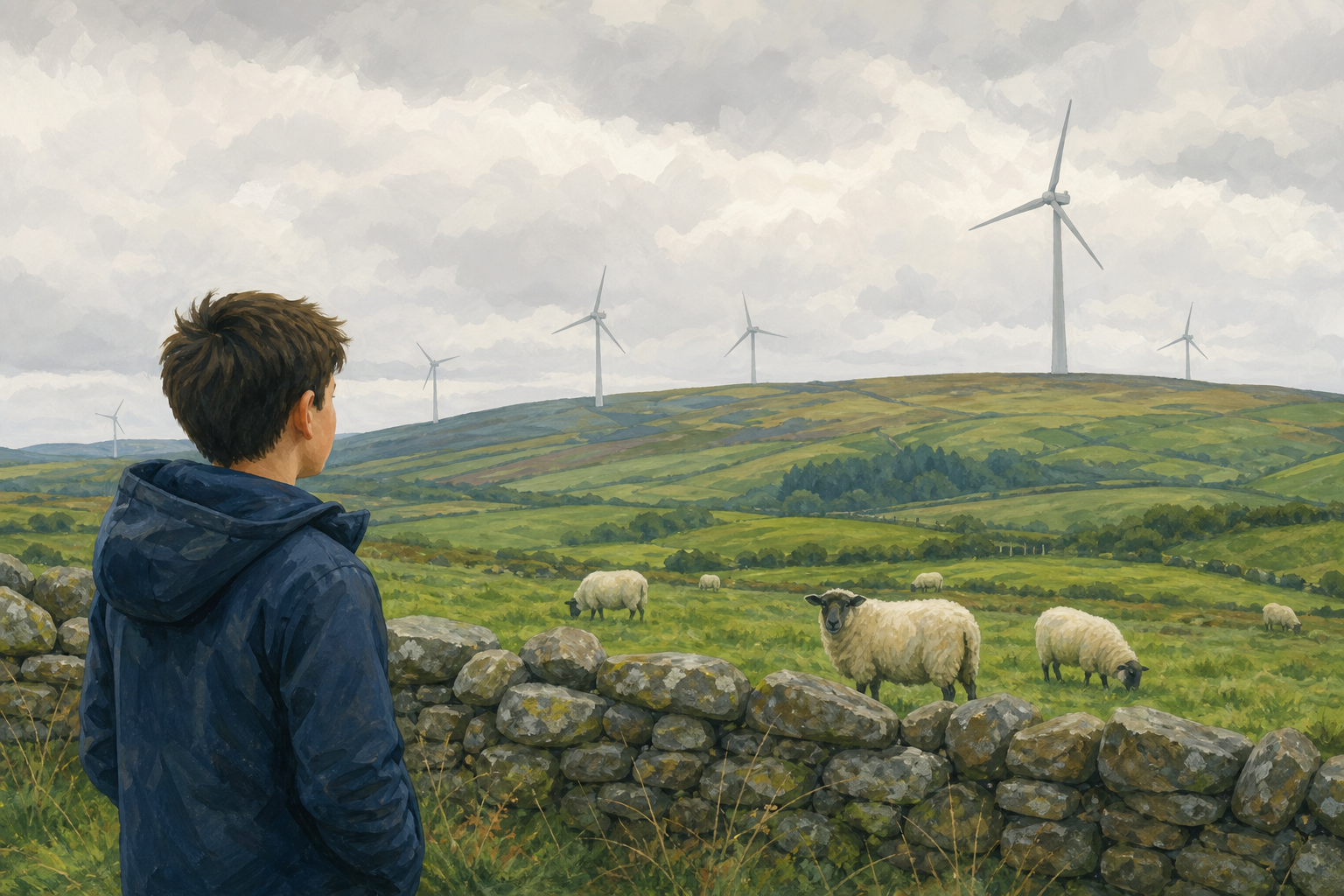 What powers the lights in this classroom right now? Hands up: wind, the sun, gas, peat, or something else?
Today we sort Irish energy sources and rank how sustainable they are. We also build a wind catcher and weigh the good and hard parts of a wind farm near a town.
Keep this light. Do not hand out cards or name renewable and non-renewable yet. Take three or four quick guesses about classroom electricity, then move on. Have the energy-source cards ready face-down for the next steps, and one sample wind catcher out of sight until the build.
Prior ideas to listen for: children often say electricity "comes from the plug" and stop there. Gently push: the plug is the end of a longer chain.
2 - Energy That Keeps Coming Back ~6 mins
Look at this card first: wind. Wind keeps coming back on Irish hills. That makes it renewable: energy nature replaces quickly enough that we will not run out.
For a long time many Irish homes burned turf from the bog; now more of our electricity comes from wind on hills and coasts.
Non-renewable is the opposite: the source will run out because nature cannot replace it quickly. We will meet peat from a bog as one example.
Which word fits wind on an Irish hill: renewable or non-renewable?
Surface wind as a worked example before naming both terms. Do not put all three definitions on the board at once. Keep the IWB to the short lines above; leave sustainability for the ranking step as a simple lens, not a third term to memorise here.
Model one full think-aloud with the wind card before any sorting:
- I wonder: is wind renewable or non-renewable?
- I predict: renewable, because the wind keeps coming back.
- I check the card: turbines use moving air; the wind is not used up.
- I place it: renewable.
- I think: wind fits renewable because nature replaces it quickly.
That is the pattern groups will use for every card in the next step.
| Concept | Why it matters | Example |
|---|---|---|
| Renewable energy — energy from a source that nature replaces quickly enough that we will not run out of it | If a source keeps coming back, Ireland can keep using it for electricity and heat without emptying it | Wind on an Irish hillside keeps turning turbines day after day |
| Non-renewable energy — energy from a source that will run out because nature cannot replace it quickly | Once these sources are burned or used up, they are gone for a very long time | Peat from a bog takes thousands of years to form; burning it uses up something nature cannot quickly replace |
| Sustainability — using energy in a way that can keep going without using up resources or harming the planet for people who come after us | Our energy choices today shape the air, land and options left for the next generation | Choosing wind power rather than burning peat so future classes still have clean options |
Bridge (say lightly, do not board the full definition yet): later we will also ask how carefully we use each source so it can keep going for people after us. That ranking idea is sustainability.
Misconception to head off: children sometimes say renewable means "good" and non-renewable means "bad". Renewable and non-renewable answer "will it run out?". Sustainability also asks about land, wildlife, noise and fairness. A renewable source can still have drawbacks (a wind farm needs careful siting).
Nature of STEM: for generations many Irish homes burned turf from the bog. Ireland has been shifting toward renewable sources such as wind on hills and coasts. Scientists and engineers keep improving how we capture and share that energy. The short pupil-facing turf-to-wind line on the board is the light version of this story; expand orally if time allows.
3 - Sort: Renewable or Not ~7 mins
Five energy sources appear on the board: wind, sun, hydro (river water), peat (turf), and natural gas.
For each one we will hear a short clue first, then decide: renewable or non-renewable? Call out your answer and why before we check.
Before we clear the board, jot the five source names into the two columns on your Investigation Journal page: renewable or non-renewable (names only).
Renewable or non-renewable?
Drive the sorting-tree interactive in challenge mode on the IWB. Name the five cards exactly as they appear: wind, sun, hydro (river water), peat (turf), natural gas. The branching question is: Can nature replace it within a human lifetime?
Before each "call out why": show or read the short clue line from that card so every pupil has the same evidence (especially for natural gas and peat). Then ask for a prediction, place the card, and reveal.
Correct placements:
- wind → renewable
- sun → renewable
- hydro (river water) → renewable
- peat (turf) → non-renewable (forms over thousands of years)
- natural gas → non-renewable
Fold the watchers in: Do you agree? What word on the card convinced you?
Capture before clear (required): in the last minute, each pupil jots the five source names into the renewable / non-renewable columns on the SortingGrid page (names only). Reasons can be finished in the later recording step. Keep this jot so step 8 is finishing, not reconstructing the sort from memory. If the board is about to switch to sustainability zones, this paper record is the backup.
If the interactive is unavailable: hold up each printed energy-source card and sort into two labelled hoops or desk zones (Renewable / Non-renewable). Read the card text aloud before the class votes. Still do the names-only journal jot.
Energy-source card texts (print one set per group)
Print these five cards. Each card is short enough for a 4th-class reader.
- Wind. Wind turbines use moving air to make electricity. The wind keeps coming back, so we do not use it up. Many Irish hills and coasts have wind turbines.
- Sun. Solar panels turn sunlight into electricity. The sun rises every day. More Irish roofs and farms are adding panels.
- Hydro (river water). Moving river water turns turbines to make electricity. Rain helps refill the rivers. Ireland has hydroelectric stations on some rivers.
- Peat (turf). Peat from bogs was burned for heat and electricity for generations in Ireland. Peat takes thousands of years to form, so once it is burned it is gone for a very long time. Ireland has been moving away from burning peat for electricity.
- Natural gas. Gas from underground is burned in power stations to make electricity and heat. Once it is used, it is gone. Ireland uses gas and also brings some in from other places.
4 - Rank by Sustainability ~7 mins
We will use a simple idea called sustainability: choosing energy so it can keep going for people after us.
Renewable answers "will it run out?". These zones also ask about land, air and wildlife.
In your group, place the five cards into three zones:
- more sustainable
- in the middle
- less sustainable
Example reason: Wind here because it keeps coming back.
When you talk, try starters like: It keeps coming back… / It will run out… / It can harm land or air… Agree out loud. There is no single right order.
In the last minute only, jot the five source names into the three zones on your Investigation Journal page (names only).
Hand each group one set of the five energy-source cards (full texts in the previous step), the three-zone labels (or mark three desk zones with sticky notes), and their SortingGrid Investigation Journal page. Three-zone placement is the default task for the class. A full 1–5 line is only a stretch for groups who finish early and want a finer order.
Model one contrast on the IWB before groups start (about 60 seconds): hold up wind and peat (turf). Think aloud: wind keeps coming back and does not burn fuel at the turbine, so it sits toward more sustainable when sited carefully; peat takes thousands of years to form and burning it changes the bog and the air, so it sits toward less sustainable. Board only the plain example: Wind here because it keeps coming back. Keep the fuller dual lens in your talk. Revoice once: renewable answers "will it run out?"; the zones also ask about land, air and wildlife — so renewable is not automatically the same as "more sustainable".
Remind them: there is no single official order to mark; the science talk is the point. One solid reason per card is enough.
A common, well-reasoned pattern is wind and sun in more sustainable, hydro near more sustainable or in the middle, natural gas lower, peat (turf) least sustainable, but accept any ranking the group can justify with evidence from the cards.
Listen for:
- running out vs lasting (renewable / non-renewable)
- land use (bogs, hills, rivers)
- air and climate (burning vs not burning)
- wildlife and neighbours (turbines, habitat)
Prompt if stuck: Which one can nature replace fastest? Which one changes a bog or the air the most when we use it?
Capture before clear (required): in the last minute only, each group jots the five source names into the three zones on the SortingGrid page (names only). Reasons and any finishing touches wait for the later recording step. Set the journal page carefully to one side so it is ready after the build and debate. Do not clear zone layouts until that jot is done.
After about five minutes of ranking talk (before the jot if you prefer), cold-call two groups to read one card from their top zone and one from their bottom zone, with one reason each. Do not declare a winner.
5 - Our Class Sustainability Ranking ~5 mins
Now we place the same five sources on the board into three groups: more sustainable, in the middle, and less sustainable.
This is our class argument, not a test. Be ready to say why a card belongs where you put it. We will leave this ranking on the board for later.
How sustainable is each source?
Use free three-zone placement on the IWB with the sorting-classifying interactive activity (not a keyed branching tree). The three groups are more sustainable, in the middle, and less sustainable. Drag or place cards as the class agrees. Nothing is auto-marked — if two groups disagree, park the card in the middle and note both reasons.
Physical board fallback (preferred if the IWB tool still behaves like a scored path): put three zone labels on the board or side wall and stick or hold the printed cards in the agreed zones. Keep that physical ranking visible through the catcher and debate.
Invite one pupil per card to the board while the rest stay involved: Would you put it somewhere else? What evidence would change your mind?
Keep the class ranking visible on the IWB or side board through the catcher and debate so step 8 can copy from it. Pupils may also use the zone names they already jotted on their journal page. The renewable / non-renewable sort lives on the journal jot from step 3 (and optionally on a side strip of two hoops if you kept those cards up).
Optional map link: on the provided Ireland outline map, lightly pencil where the class has met each idea (wind on western hills and coasts, hydro on rivers, peat linked to midland bogs, gas at power stations, sun on roofs). Keep it quick; the map is a talking prop, not a labelling test.
Bridge to the next step: Wind came out high for many of you. Next we build something that lets us feel wind energy turning into movement.
Unlock the full learning experience
You're previewing this lesson. Get full access to this lesson and hundreds more — each one ready to teach, with interactive activities, printable resources and pupil progress tracking built in.
This lesson is copyright of Coding Ireland 2017 - 2025. Unauthorised use, copying or distribution is not allowed.