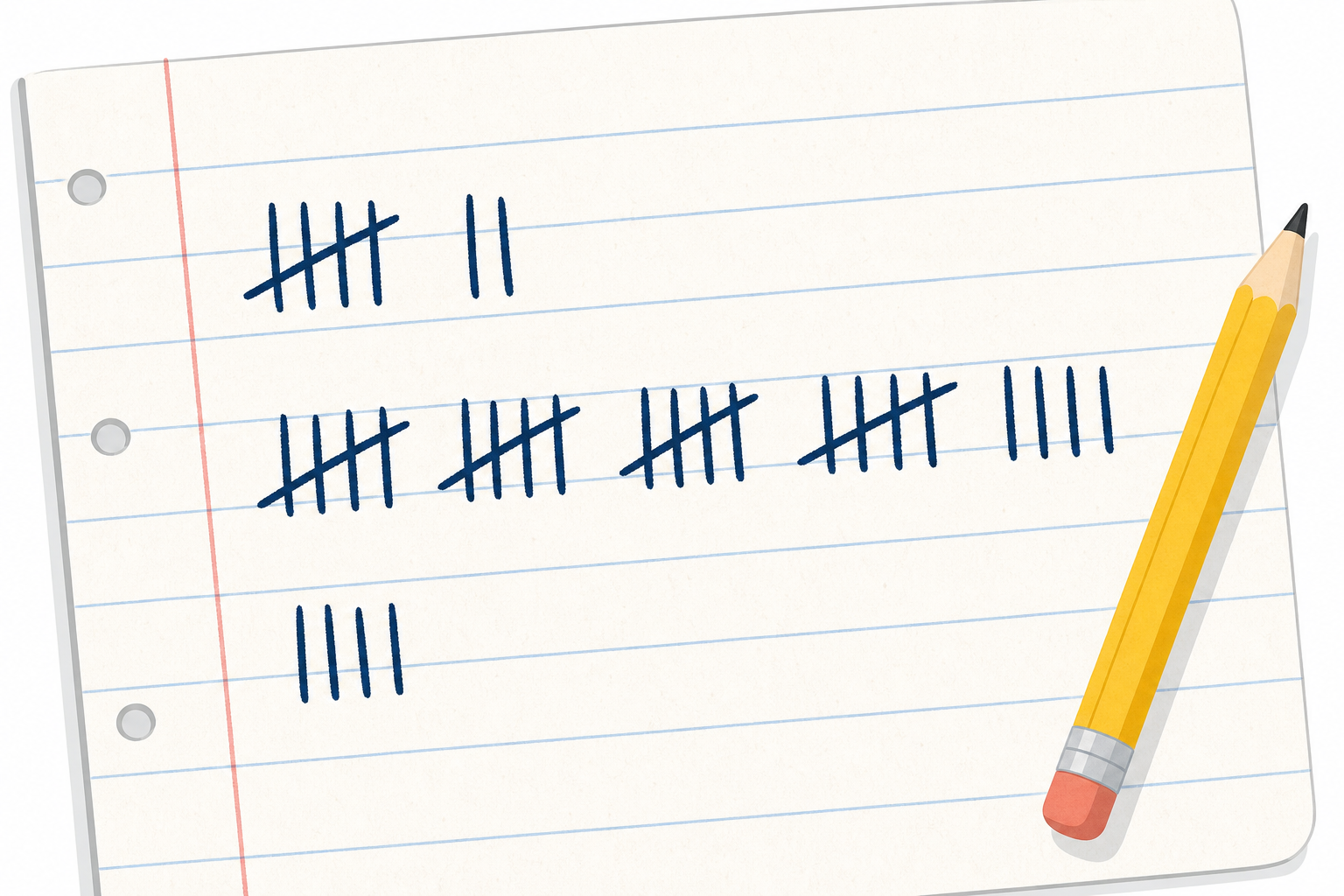
Here is a tally of one thing our class enjoys. Look at it for a moment. What is the very first thing it tells you, just at a glance, before you count anything carefully?
Show the tally on the IWB as pupils settle. Take two or three hands-up answers, not open call-outs.
Listen for the instant read: one row is clearly the tallest. That noticing is the bridge into today's chart work.
Two pieces of maths from our year are on the board, and a third we will do out loud together. First a bar chart of lunch choices for our class and the class next door, then a likelihood line drawn live, then a balance where a letter stands for a hidden number. To read a bar, run your eye from the top straight across to the number on the side. Watch and be ready to say which lunch won, where each event belongs, and what keeps the balance level.
Bar chart: draw the lunch bars on the IWB (sandwich 12, salad 4, plus two others). Finger from top of tallest bar across to the scale. Ask which lunch our class chose most (sandwich, 12). Then how many more chose sandwich than salad (12 - 4 = 8).
Likelihood line: this one is spoken, drawn on the IWB. Line from impossible to certain. Name three events and place each: sun rising certain, rolling a 7 on one die impossible, rain in an Irish winter likely.
Balance: a + 3 = 7. Hold out for why a = 4 works. Read it back, 4 + 3 = 7, and check the right pan is also 7 so the beam is level.
Now we solve four missing-number sentences together on the balance. We slide the unknown until both pans match. Then we read the whole sentence back to check.
The sentences are a + 5 = 9, then b + 4 = 12, then 7 + c = 15, and finally d + d = 10. The last one is special. Both blocks show the very same number d, so when one block changes the other changes with it. That means we need one number that, added to itself, makes 10.
Talk this one through together — no marking yet. Pupils take turns at the board and the class agrees or corrects out loud, so treat every wrong slide as a chance to reason, not a score.
Do a + 5 = 9 first (a = 4). Then b + 4 = 12 (b = 8). Then 7 + c = 15 to show the unknown can sit second in the sum (c = 8). Finally d + d = 10 is the key one. The same letter appears twice, so d = 5 and the wrinkle is that both blocks change together.
Each time, revoice: so what number makes both sides weigh the same? Check by substituting the value back into the whole sentence.
In your maths copy, do three short pieces of today's review:
Read your work back to yourself when you finish.
Walk the room glancing for the likelihood line and one honest line per strand — this is whole-class copybook practice, not marking. Check the likelihood placements: the sun rising sits at certain, rolling a 7 sits at impossible, rain this week sits somewhere in between. Prompt any pupil who is stuck on "impossible" with a nudge toward a real example.
Now we build a few bar charts of our year's favourite activities, one at a time, and read each one back to answer questions. First set each bar to the given height. Then read the finished chart against the scale.
Each card asks its own reading questions after the bars are set. One asks which is least popular and how many chose it, one asks how many chose the most popular, one asks for the total of all bars, and the last mixes least popular with the total. Add every bar carefully when you need a total.
This is the practice round. Pupils take turns at the board and the class confirms each answer before moving on. Keep the board work brisk rather than over-explaining.
For each chart, first set the bars to the given heights. Then run the four reading questions. Start with the least popular bar. Then find its value. Then find the tallest bar's value. Finally add all four bars for the total. Watch for pupils guessing a bar's height instead of reading it against the scale line.
You're previewing this lesson. Get full access to this lesson and hundreds more — each one ready to teach, with interactive activities, printable resources and pupil progress tracking built in.