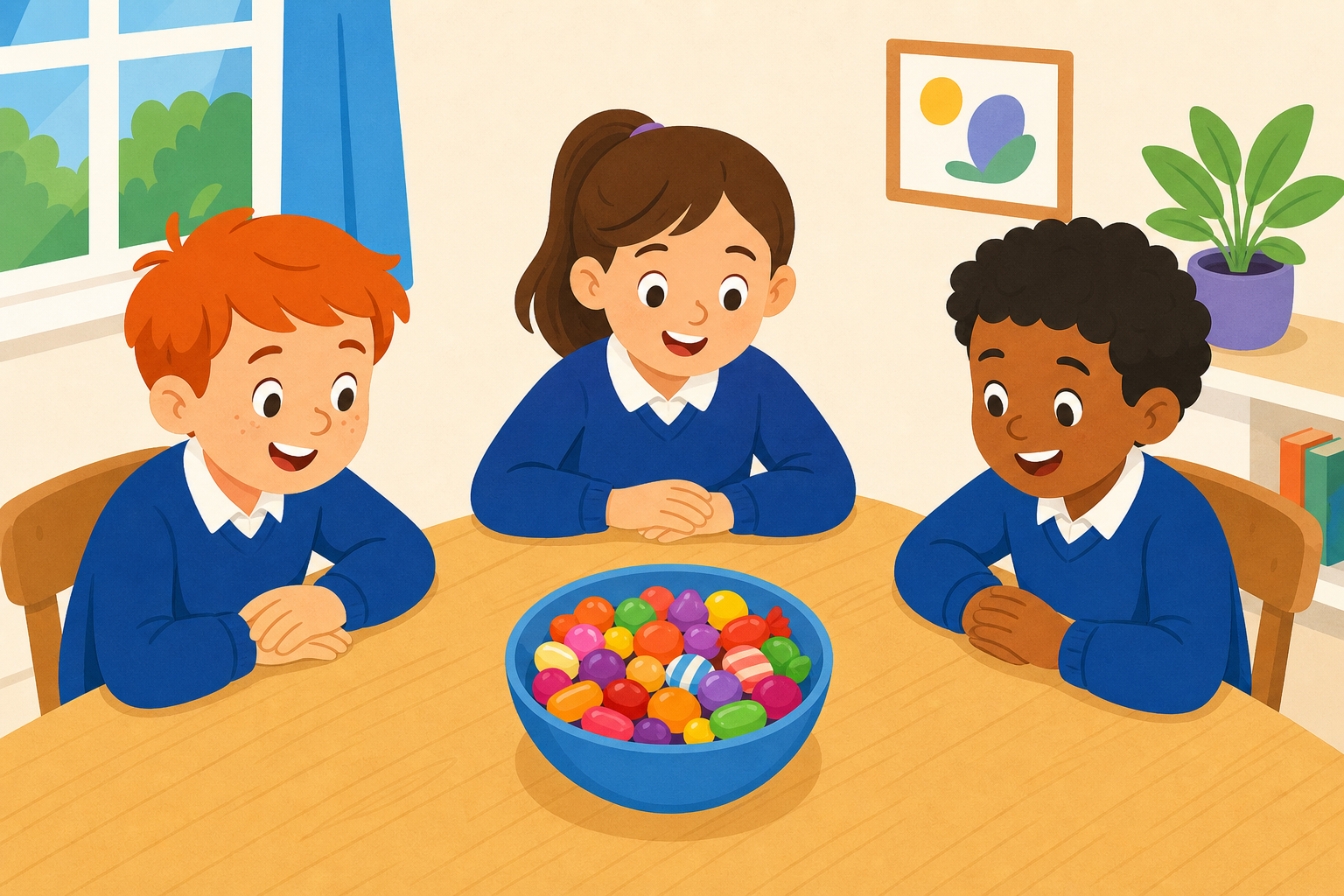
Imagine three friends want to share twelve sweets so nobody feels left out. How would you give them out so that each friend ends up with exactly the same number? Would you hand them all to one friend first, or give one to each in turn?
Take three hands-up answers, not open call-outs. Listen for one each, then go round again — that dealing idea is the whole lesson. Do not settle the answer yet; you build it on the board next.
The interactive deals counters onto plates, one to each in turn, until the pile is empty. Count the rounds together and watch how many each plate ends with. Each time, check that every plate matches.
Deal slowly, one to each plate, so pupils see the sharing action, not a finished answer.
12 shared between 3: count the four rounds, each plate ends on 4, write 12 ÷ 3 = 4 beneath.
15 shared between 5: pause before dealing, take a prediction, more or fewer each than last time? Each finishes on 3, write 15 ÷ 5 = 3.
20 shared between 4: the key one, fewer plates so a bigger share each. Lands on 5 per plate, write 20 ÷ 4 = 5.
Point out every plate matches exactly, that is what makes the share fair.
We share these out together on the board. Each panel shows the counters shared equally between the plates, with the pile emptied. Everyone else counts the rounds aloud and gets ready to read back the division sentence before we write it.
Reveal one panel at a time.
Share 10 between 2: predict first, big share or small? Two plates makes the big share obvious. 10 ÷ 2 = 5.
Share 18 between 3: new dealer; class choruses the count as the counters go down. Read the sentence back before writing. 18 ÷ 3 = 6.
Share 24 between 6: most plates yet, use a turn-and-name prediction so the back rows stay live, then deal and count. 24 ÷ 6 = 4.
Draw out the pattern: more plates, smaller share.
Watch for the pupil dumping counters unevenly, stop, one to each, go round again.
In your maths copy, draw three plates and share twelve counters fairly between them by drawing a dot on each plate, one round at a time, until you have drawn all twelve. Then write the division sentence underneath to show how many each plate gets.
Walk the room glancing for dots dealt evenly across the three plates — this is whole-class copybook practice, not marking. If a copy shows one plate with more, remind them: one to each, then round again.
Today we work through four new sharings together: share 14 between 2, then 16 between 4, then 21 between 3, then 30 between 6. Deal them one at a time on the board and check each answer before we move on. The last one is the trickiest, thirty counters across six plates means the most counters to deal.
These are the practice questions — pupils take turns at the board, check each answer, and the class confirms before moving on. Keep the board work brisk rather than over-explaining.
These are all fresh numbers, not the ones from Try It Together, so pupils cannot recite an answer from memory — they have to deal and count. The practice set rises in difficulty: 14 ÷ 2 = 7 is the easy entry; 30 ÷ 6 = 5 is the trickiest, and it is trickiest because six plates means the most plates per dealing round, not because its answer is the biggest (16 ÷ 4 = 4 has fewer plates even though the numbers look large). Say that plainly if a pupil thinks a bigger answer means a harder share. For each, a pupil deals, the class calls the answer, then press Check to confirm. A fast pupil who is waiting can mouth the next sharing or watch the board — no desk work here.
You're previewing this lesson. Get full access to this lesson and hundreds more — each one ready to teach, with interactive activities, printable resources and pupil progress tracking built in.