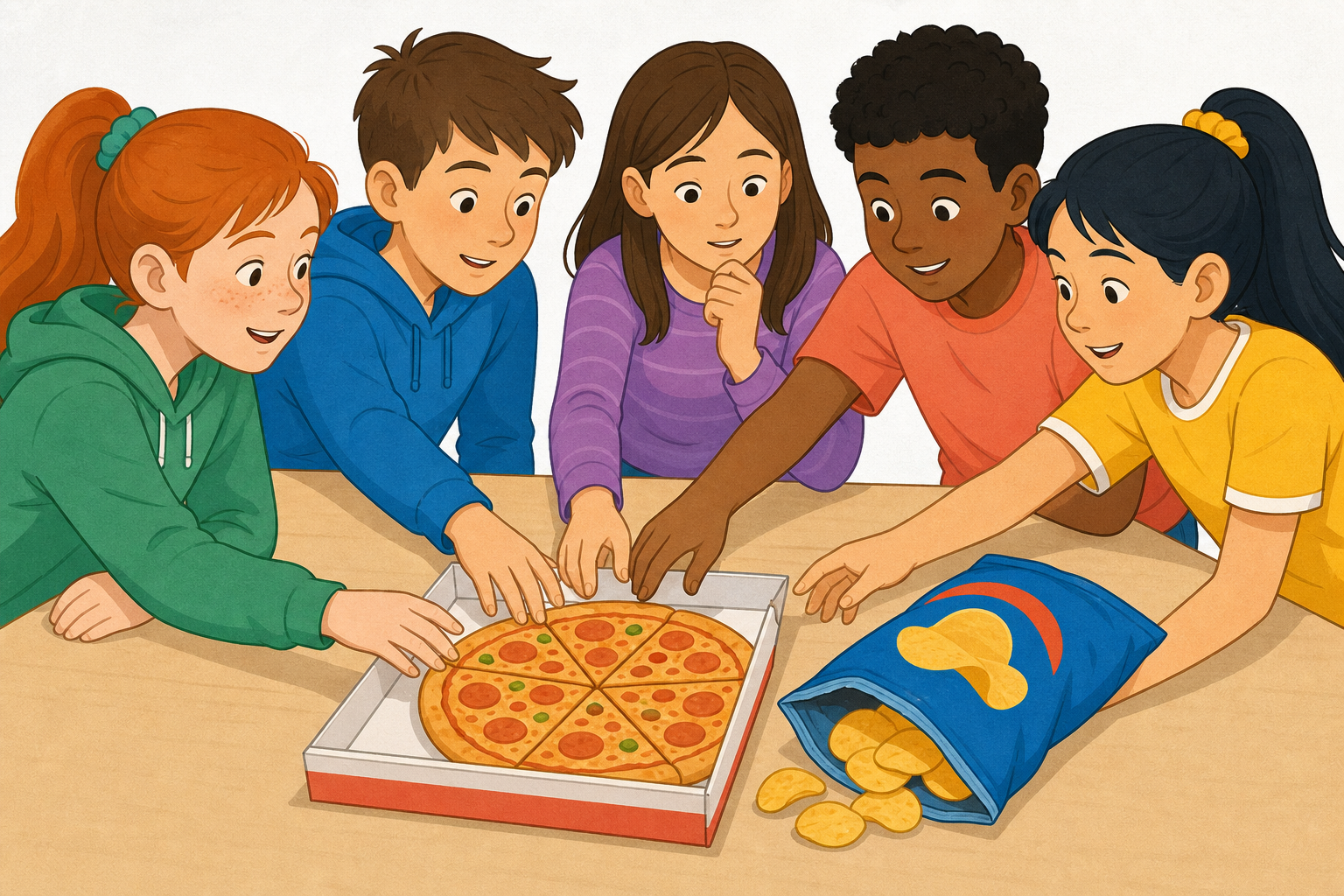
Five friends buy a €15.75 pizza-and-chips deal and agree to split the cost exactly. Hands up: how much should each friend pay, and will it come out evenly?
Display €15.75 as pupils settle. Take three hands-up answers, not open call-outs. Do not confirm anything yet — the wonder is whether it will divide evenly, and that is what the lesson proves.
The interactive shares each amount into equal groups, one example at a time. Watch how each amount splits into equal groups, and see what happens when the last one doesn't share out evenly.
One example at a time; between each, one quick question, hands up, take two.
€15.75 ÷ 5 = €3.15: labour point-above-point; ask why the point sits there, each digit stays in its place-value column.
€9.60 ÷ 8 = €1.20: ask why not €1.2, the trailing zero holds the cent place.
4.5 m ÷ 6 = 0.75 m: length, not money, so the rule isn't just a money trick.
€10.00 ÷ 3: pause. Each gets €3.33; show €3.33 × 3 = €9.99 so they see the leftover 1 cent, which can't split three ways; the situation decides.
Rounding: €1.875 has a third place but money stops at cents, so €1.875 rounds to €1.88 (third digit 5, round up). Do it as a board line. Flag €7.50 ÷ 4 coming in Try It Together.
We work through three shares together on the interactive. Before each reveal, say the answer to yourself, then watch the answer appear and notice that the decimal point stays in the same place-value position as in the amount we started with.
Take a hands-up prediction for each share before the reveal, then the class agrees or corrects aloud.
€18.60 among 6: comes out clean at €3.10 — get them spotting point above point.
€7.50 among 4: this is the pause. Gives €1.875, a third decimal place. Ask what €1.875 means for money, which only goes to two places, and lead them to round to €1.88, as in Watch and Notice. Then check: €1.88 × 4 = €7.52, two cents over, so two friends pay €1.88 and two pay €1.87 to total €7.50 exactly.
3.6 m ribbon into 8: back to a clean length, 0.45 m — leave them confident.
In your maths copy, set out each of these decimal divisions with the decimal point in the answer lined up directly above the point in the amount you are sharing:
Beside each answer, write the unit (€ or m) and one short note on how you handled any leftover.
Walk the room glancing at whether the decimal points are aligned in a straight vertical line — this is whole-class copybook practice, not marking. Every one of these four was worked on screen earlier, so pupils have a demonstration to lean on. Catch anyone writing €1.2 instead of €1.20.
Now we work through these bill-and-bottle shares together, each one a step harder than the last: split a €23.40 bill among 4, share a €14.55 taxi among 5, pour a 2.5 l bottle into 4 equal glasses. Then comes a different kind of question. The last one is not a straight share — it asks how many you can buy and what change you get. You have a €50 note and each item costs €7.25. To answer it you count how many €7.25 items fit inside €50, then work out what is left over as change.
Share real bills and bottles into equal parts, then work out how much you can buy and what change is left.
These are the practice questions — pupils take turns at the board, check each answer, and the class confirms before moving on. Keep the board work brisk rather than over-explaining.
€23.40 ÷ 4 = €5.85 (clean). €14.55 ÷ 5 = €2.91 (clean, but watch the point). 2.5 l ÷ 4 = 0.625 l (the units pause — capacity, three places, which is fine here because litres can carry on past two places). The €50 problem is a different kind of thinking and is now built on screen: it is not an equal share but 'how many fit, then what is left'. Show 6 × €7.25 = €43.50 and €50 − €43.50 = €6.50 on the board so every pupil sees the reasoning, not only the strongest. If time runs short, the €50 change problem can be finished at the start of the next lesson — it is the newest idea and deserves proper build time.
You're previewing this lesson. Get full access to this lesson and hundreds more — each one ready to teach, with interactive activities, printable resources and pupil progress tracking built in.