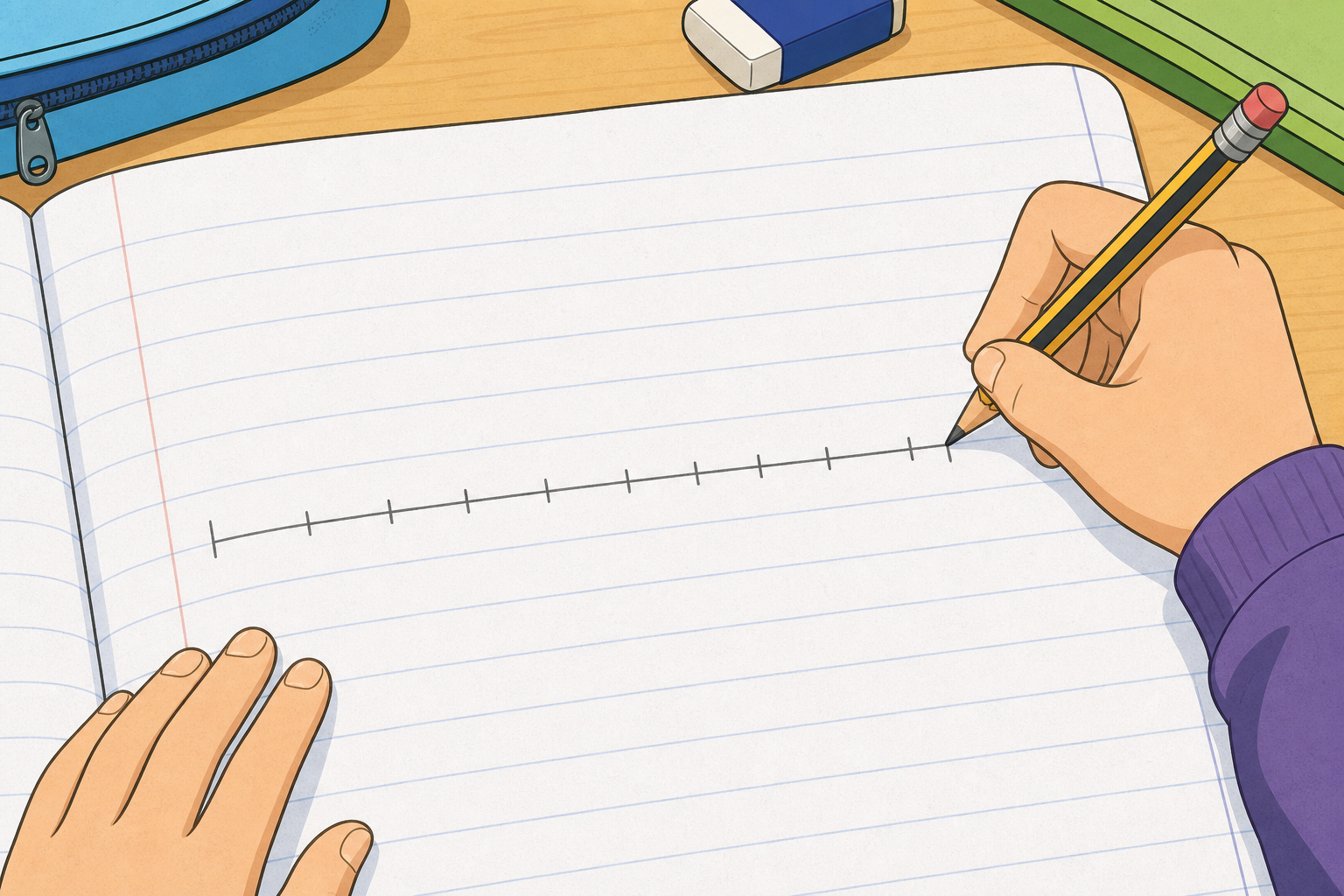
Here is a line with nothing on it but a 0 at one end and a 1 at the other. There are no other marks yet.
Where would you put 0.5 on this line? Point in the air with your finger before anyone says a word.
Draw a bare 0-to-1 line on the IWB (or gesture along the board rail). Give five seconds of quiet think-time, then take three hands-up answers, not open call-outs. Most will point at the middle for 0.5 — good, that anchors the whole lesson: a decimal has a known place, and half is the easiest place to see.
The interactive shows a number line from 0 to 1, marked every 0.1, with a decimal on it. Watch where each marker lands and think about why. Before the last one, decide whether 0.08 is more or less than halfway to 0.1.
0.7 sits on a tenth mark: count the seven steps from 0 aloud with the class. Seven tenths.
0.34 falls between two tenth marks, not on one. Point to the gap between 0.3 and 0.4. A hundredth is ten times smaller than a tenth.
0.08 means eight hundredths, before the first tenth mark since it is less than ten hundredths (0.1). Pose the prediction: more or less than halfway to 0.1? Hold for two or three hands up before revealing. Don't answer it yourself. It is more than halfway, nearly ten hundredths, so it sits close to 0.1.
0.5, 0.50 and 0.500 all land on the same spot, halfway. Same number, extra zeros change nothing. Say the zeros did not move it and let it land. This heads off the longer-means-bigger trap for the rest of the year.
Today we place these decimals on the line together, in this order: first 0.2, then 0.65, then 0.9, and finally 0.04. Each one sits in a slightly trickier spot than the last, so we'll predict where it lands before we drag the marker.
This round is for talking it through together — pupils take turns at the board and the class agrees or corrects out loud.
The order builds: 0.2 sits neatly on a tenth mark (easy start); 0.65 falls exactly between two tenth marks (the halfway-in-the-gap idea); 0.9 is on a mark but near the far end; 0.04 is the pause — it is four hundredths, between 0 and 0.1, and pupils must reason it is under halfway to 0.1. Ask for a prediction before each drag, then let a pupil place the marker and the class read it off. Watch for pupils who read 0.04 as 'nearly a half' — steer them back to which two whole-tenths it lives between.
In your maths copy, sketch a number line from 0 to 1 with a mark every 0.1. Then mark each of these decimals on your line and label each mark with its value:
Walk the room glancing at the tick spacing and whether 0.34 and 0.08 land between marks rather than on them. 0.08 should sit close to the 0.1 mark but before it. This is whole-class copybook practice, not marking.
Today we work through these placements together: place 0.7, then 0.34, then 0.08, and finally find a decimal that sits between 0.4 and 0.45.
For that last one, remember that the gap between 0.4 and 0.5 can be split into smaller hundredth steps: 0.41, 0.42, 0.43 and 0.44 all live in there. Which of those sit before 0.45? Any decimal between 0.4 and 0.45 counts, so think carefully about which two marks it must live between before you drag.
These are the practice questions — pupils take turns at the board, check each answer, and the class confirms before moving on. Keep the board work brisk rather than over-explaining.
The practice set escalates: 0.7 on a tenth mark, 0.34 in a gap, 0.08 close to the first tenth mark, then the open-ended 'between 0.4 and 0.45'. For the last one, any placement inside that range counts — press the class on why it must sit just past 0.4 but before halfway to 0.5, naming 0.41 to 0.44 as fair choices. Use the Check tick as part of the narration: 'yes — that's it'.
You're previewing this lesson. Get full access to this lesson and hundreds more — each one ready to teach, with interactive activities, printable resources and pupil progress tracking built in.