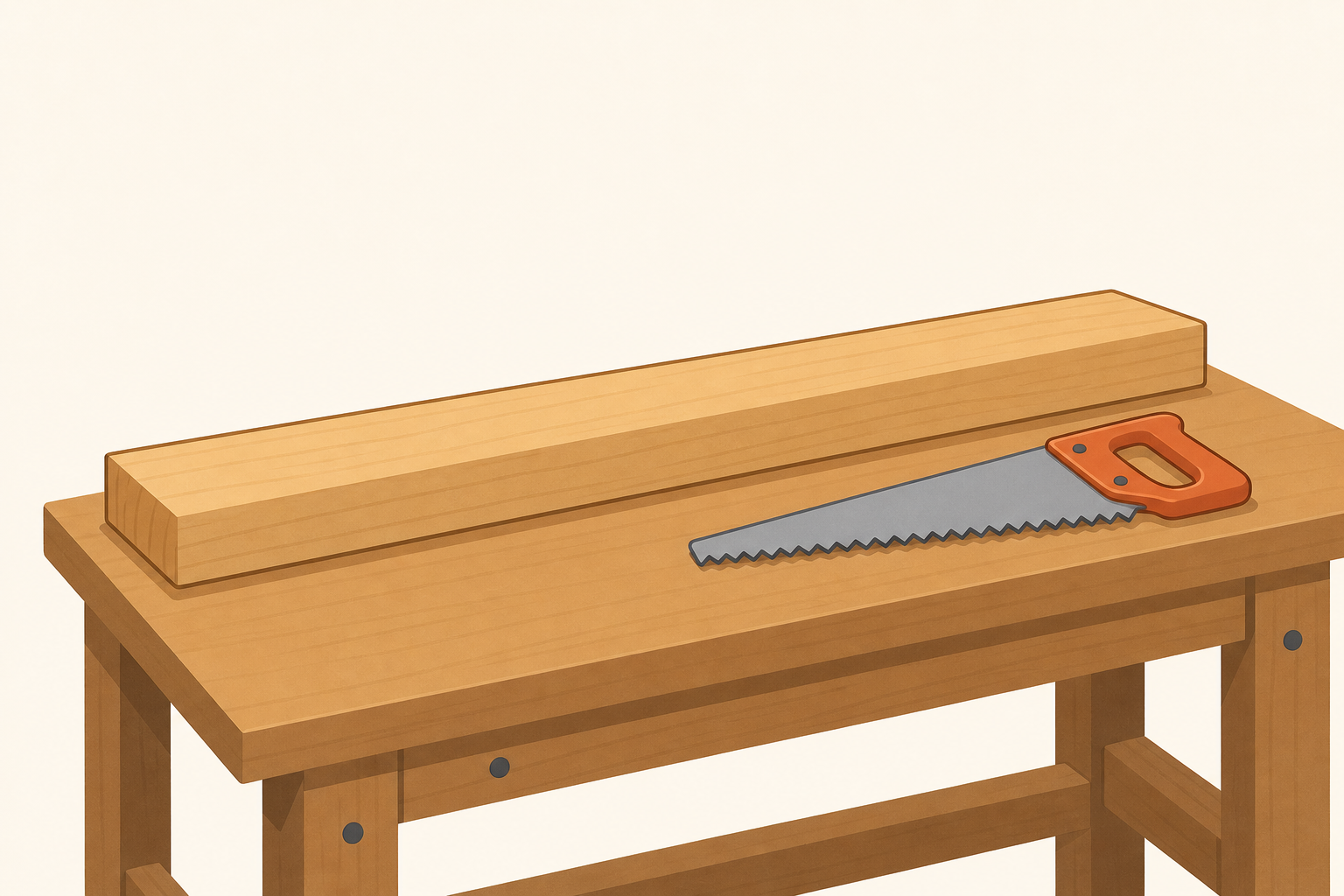
A 2.4 m plank is cut into pieces, each 0.6 m long. How many pieces will you get, and how could you check your answer?
Hold a real metre stick against a long strip or the edge of a desk so pupils see just how long 2.4 m is and how short a 0.6 m piece is before any numbers go up. Then take three hands-up answers, not open call-outs, after five seconds of quiet think-time. Some pupils will reach for a decimal division, others will count up in 0.6s along the metre stick — welcome both, and hold the check for the modelling step.
We will work through four measures problems. None of the measurements land on tidy whole numbers, so watch how we handle decimals and fractions of a unit. For each one, look for two things: which operation the words are asking for, and which unit the answer belongs in.
Work all four slowly; draw out the operation and the unit before revealing each answer.
Piece 1 (plank): 'each piece' plus 'how many' means divide. 2.4 ÷ 0.6 = 4. Hold out for the operation; counting up in 0.6s is a fine check.
Piece 2 (parcels): three the same means multiply. 1.25 × 3 = 3.75 kg. Watch pupils line up the decimal point in 3.75.
Piece 3 (¾ of 2 litres): give this the most time — they do it themselves next. ¾ means three out of four equal parts. Step 1: 2 ÷ 4 = 0.5 litres per quarter. Step 2: 0.5 × 3 = 1.5 litres.
Piece 4 (leftover as a fraction): subtract first to get 1.2 kg left. Then build the fraction visibly: 1.2 over 3, so 1.2 ÷ 3 = ⅖. Say any leftover can be written as a fraction of the whole it came from.
Now we work through these measures problems together, one after another. First: ¾ of a 2 litre carton of juice is poured out — how many litres is that? Remember the two steps we just saw: find one quarter of the 2 litres first, then take three of those quarters. Next: a 5.6 m roll of ribbon is cut into 0.7 m lengths — how many lengths? Last: 4.5 litres of paint is shared equally between 3 rooms — how much paint does each room get? We say the operation aloud before we solve each one.
Talk this one through together — pupils take turns at the board and the class agrees or corrects out loud.
The juice problem is the two-step move we built on the board a moment ago: find one quarter of 2 litres (2 ÷ 4 = 0.5 l), then multiply by 3. Point back to that worked example if anyone stalls. The ribbon and paint problems both come out to clean answers. Revoice every answer with its unit so results that share a number stay distinct: the juice gives 1.5 litres poured out, the ribbon gives eight lengths, and the paint gives 1.5 litres per room — same number, different measure.
In your maths copy (or on the problem sheet), set out one decimal-measure problem and one fraction-measure problem in full. For each, write the given facts, then your working, then the answer with its unit. Box each final answer.
Hand out the Decimal and Fractional Measures Problem Sheet to any pupil working on paper, or have the class use their maths copies. Walk the room glancing for the unit written on each answer and a boxed result — this is whole-class copybook practice, not marking. For the flour problem, watch for pupils dividing the two numbers instead of finding two-thirds; point them back to the board example, where finding a fraction of a whole took two steps (divide by the bottom number, then multiply by the top).
Now we work through this set of measures problems on the interactive, each one a step harder than the last. The last one is the stretch: a bag holds 3 kg of compost, and 1.8 kg of it is used. How many kilograms of compost are left in the bag? After Check, we write that leftover as a fraction of the whole bag together.
This is the practice round — pupils take turns at the board, check each answer, and the class confirms before moving on. Keep the board work brisk rather than over-explaining.
The soup problem gives a decimal answer smaller than one (0.3 l) — flag that dividing can make the number shrink. On the final compost problem, once Check confirms 1.2 kg left, build the fraction step on the board just as in the demo: write 1.2 out of 3, then 1.2 ÷ 3 = ⅖. That fraction step is the ceiling of the task and is worked in maths-talk, not typed.
You're previewing this lesson. Get full access to this lesson and hundreds more — each one ready to teach, with interactive activities, printable resources and pupil progress tracking built in.