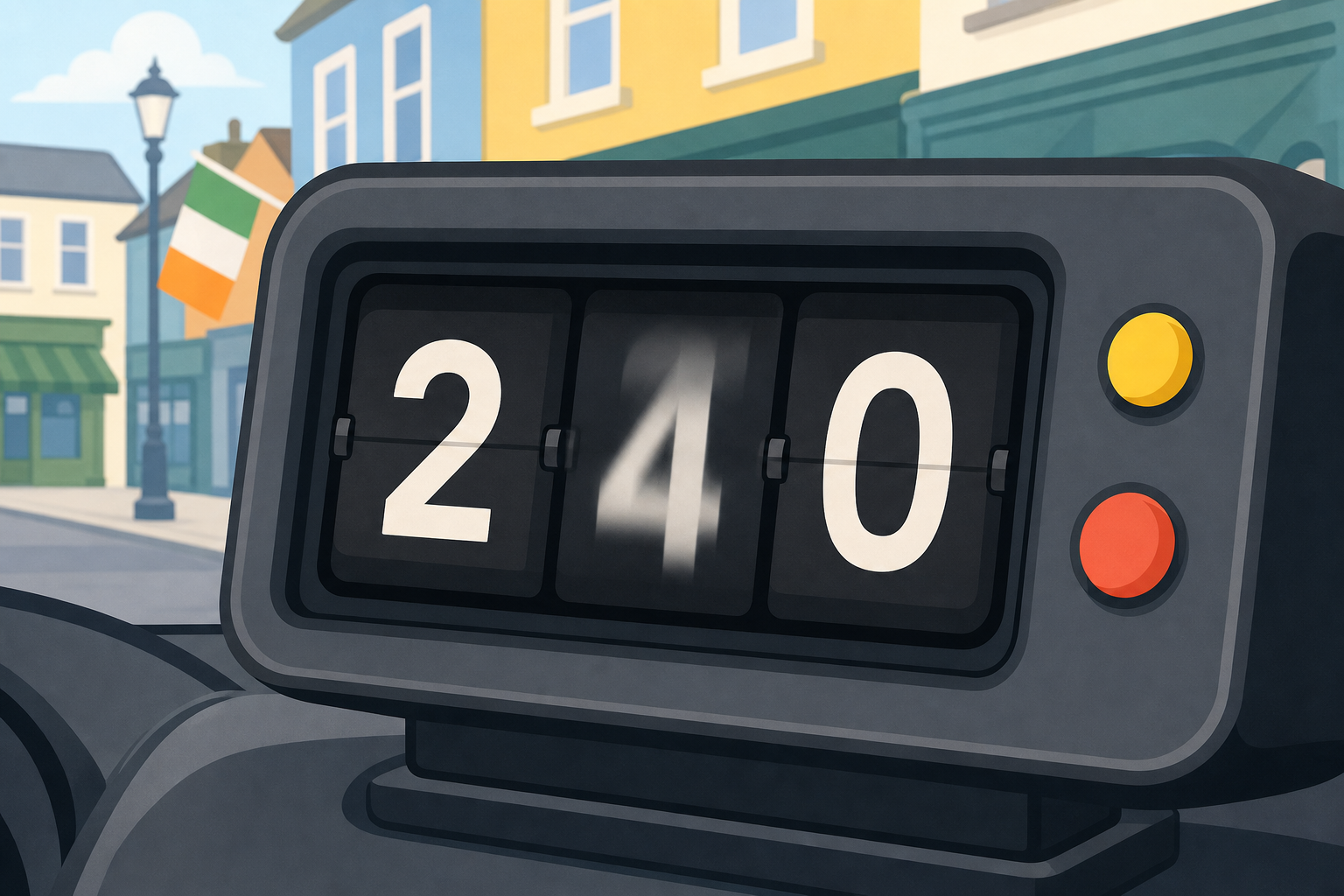
Here is a start number: 240. Let's count on together in tens — 240, 250, 260, 270. As we go, keep your eyes on the number. One part of it keeps changing, but the other parts sit perfectly still. Which part is on the move?
Write 240 on the IWB and count on in tens with the class, pointing at the tens digit as it climbs. Take two or three hands-up answers to which part is changing? before moving on. Keep it quick — this is the hook, not the teaching.
Watch each jump on the number line and read the numbers before and after out loud. Keep your eye on the digits, which one changes, and which ones stay still?
10 more than 234: lands on 244. Point to the tens before and after — only the tens change, 3 to 4; hundreds and units hold.
10 less than 234: back jump, lands on 224. Point to the tens before and after, only the tens drop, 3 down to 2.
100 more than 234: bigger arc reaching further, lands on 334. A different digit moves now — hundreds climb 2 to 3, tens and units hold.
10 more than 290: the roll-over. Tens already a 9. Count slowly: two hundred and ninety, two hundred and… three hundred — 300, not 2900. Nine tens plus one ten is ten tens, and ten tens is one hundred, so tens roll to 0 and hundreds climb 2 to 3.
Today we work these jumps together on the board, all starting from 315, one at a time: 10 more than 315, then 100 more than 315, then 10 less than 315, and finally 1 more than 315.
Before each hop lands, the whole class says out loud together which column you think will change. Then the pupil at the board makes the jump and reads the landing number, and we check whether our prediction was right. The last one is small but sneaky — a jump of just one — so watch the units carefully.
This round is for talking it through together — the whole class predicts the changing column out loud, then a pupil takes a turn at the board to make the jump and read the landing number, and the class agrees or corrects.
Run the number-line-jumps interactive in explore mode. Every jump starts from 315 (the interactive's start point), so nobody has to navigate away first: 315 → 325 (10 more), 315 → 415 (100 more), 315 → 305 (10 less), 315 → 316 (1 more). Have the class predict the changing column before the arc lands each time. The +1 last jump is the key one: with 315 it changes only the units (315 to 316), a neat contrast with the ten-jumps and hundred-jumps that came before. Revoice a strong answer: so a jump of one only touches the units.
In your maths copy, write each of these two start numbers. Beside each one, write its 1 more, its 10 more, and its 100 more. Read each new number aloud after you write it, and check which column changed. Aim to finish both numbers. Remember 290: when the tens are a 9 and you add ten, they roll over into the hundreds.
If you finish both, write the 10 less and 100 less for each as well.
Walk the room, glancing for which digit each pupil changed — no individual marking, this is whole-class copybook practice. Watch for 290: 10 more than 290 rolls the tens past 9, so it becomes 300 — the same roll-over the class watched on the board in Watch and Notice. Prompt any pupil who freezes on 100 more than 290 (390) by asking which single column a hundred-jump changes.
The middle one is the tricky one — the tens are already a 9, so count carefully as they roll over into the hundreds.
Today we work through these reach-the-target jumps together: 100 more than 260, then 10 more than 290, and finally 10 less than 400. The whole class predicts where each jump will land before we check on the board.
These are the practice questions — pupils take turns at the board, check each answer, and the class confirms before moving on. Keep the board work brisk rather than over-explaining.
Run number-line-jumps in challenge mode. The practice set builds: 260 to 360 (a clean hundred-jump — only the hundreds change), 290 to 300 (the roll-over pay-off — nine tens plus one ten is a hundred, so the tens reset to 0 and the hundreds climb from 2 to 3), and 400 to 390 (a ten-jump crossing back over the hundred, so the hundreds drop from 4 to 3 as the tens go from 0 to 9). Ask the class to call the answer, then have the pupil at the board reach it and press Check for the ✓.
You're previewing this lesson. Get full access to this lesson and hundreds more — each one ready to teach, with interactive activities, printable resources and pupil progress tracking built in.