1 - Getting Started ~5 mins
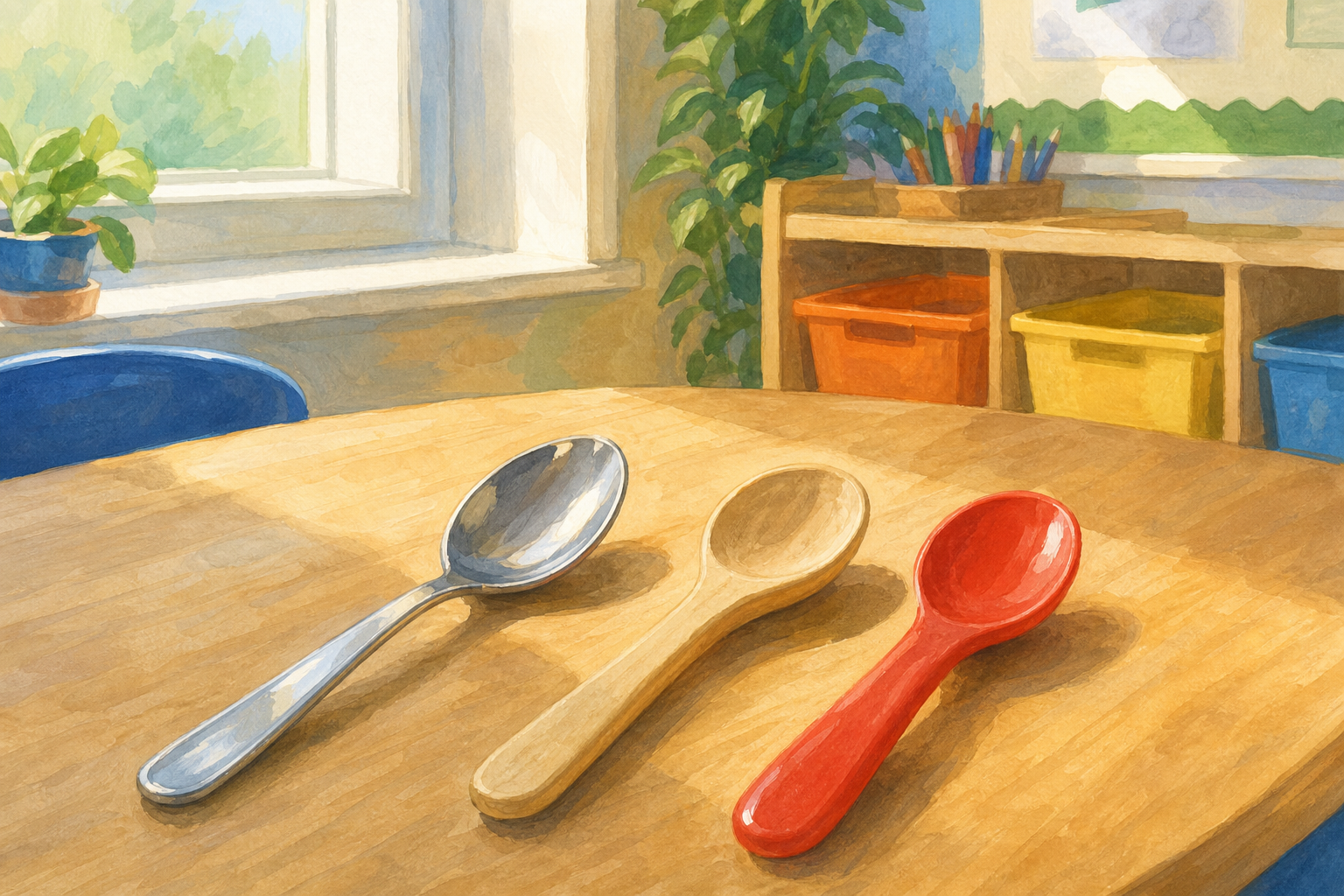 Imagine a pot of soup bubbling on the hob. Why is the handle plastic or wood, not bare metal? Hands up: which spoon do you think will stay cooler longest in warm water, metal, wood or plastic?
Hold up one metal, one wooden and one plastic spoon so the class can see them. Do not put them in water yet. Take a quick show of hands for each material and jot the tallies on the board. Keep the hook light: curiosity only, no method and no vocabulary table yet.
Key question: Why might a cook want a handle that stays cool?
Have the warm-water jug ready off to the side but do not pour until the experiment step.
2 - Heat That Travels Fast, Heat That Travels Slowly ~6 mins
 A heat conductor lets heat travel through it quickly, like a metal pan on the hob.
A heat insulator lets heat travel through only slowly, like a wooden pot handle or an oven glove.
Look around the room: point to something that should be a conductor, then something that should be an insulator. Why might a pan be metal but its handle wood?
| Concept | Why it matters | Example |
|---|---|---|
| Heat conductor — a material that lets heat travel through it quickly | Metal pans heat food fast, but a bare metal handle can burn your hand | A metal pan on the hob carries heat into the food quickly |
| Heat insulator — a material that lets heat travel through it only slowly | Insulators keep hands safe on pot handles and help Irish homes stay warm with less energy | Oven gloves, wooden handles and attic insulation slow heat so less energy is wasted |
This step only: two short definitions, then the room point-and-apply. Do not run the full inquiry frame, misconception mini-lesson or Irish-homes STEM talk here — those land later (prediction/plan and evidence steps).
Leave middle value for the recording step when three trial readings are in front of the class.
If a pupil blurts a misconception now ("metal makes heat", "wood never gets heat"), one-line revoice only: metal feels cold because it takes heat from your skin quickly; heat still moves through wood, just more slowly. Save the fuller check for the evidence talk.
3 - Our Question and Prediction ~5 mins
Our class question: which spoon handle warms fastest in warm water, metal, wood or plastic? In your group, say your prediction and one reason. Predictions are the start of the science, not a test to get right.
Use think-pair-share, then take three or four group predictions aloud. Accept every prediction without correcting it. Push gently for a reason: Why do you think that?
Model the inquiry structure aloud here (blank prediction, no spoon results or times): I wonder which spoon handle warms first. I predict ___ because ___ (leave the blanks open; fill them only after groups have shared, or say "I might pick metal because metal pans heat food quickly — other groups may have different reasons"). I test: same cups, same warm water poured by me, spoons in to the same depth; one pupil is the judge and times how long until each handle feels warm under the same fingertip. I observe carefully and write each reading. I think about which material let heat travel fastest: that will be our best conductor, and the slowest will be our best insulator of the three. Do not state a ranking or sample times before groups predict and test.
Look-fors: groups name the material they expect to win; at least one reason links to everyday experience (a metal pan, a wooden spoon, a plastic cup of tea).
Write the agreed class question on the board exactly as the class frames it. Keep the water unpoured until the experiment step.
4 - Plan How We Will Measure ~8 mins
Your group designs a fair test. On the board is our default path:
- Change: only the spoon material (metal, wood or plastic).
- Measure: time until the handle feels warm (same judge, same fingertip, stopwatch).
- Keep the same: cups, water amount, water warmth, spoon depth, and who judges.
- Three trials for each material so we can choose a middle reading later.
On your results table page, write three short lines before any water is poured: Change / Measure / Keep the same.
Before the lesson
- Print the Investigation Journal pages (DataTable and ResultsAndConclusion), one set per pupil or pair. The DataTable page should have space at the top (or a method box) for a short plan; if the printable is grid-only, pupils write the plan in three labelled lines above the grid: Change / Measure / Keep the same.
- Set out per group: one metal, one wooden and one plastic spoon of similar size; three identical cups (so all three materials can run in the same round); a stopwatch or classroom timer.
- Spoon match check: prefer handles of roughly similar length and thickness. If only a very thick wooden spoon is available, note that thickness may slow warming and trust the class pattern across groups rather than one outlier.
- Prepare enough warm (hand-safe) water for three full jug-pass rounds: a large class jug plus a kettle top-up kept warm (not hot) so starting warmth stays comparable. Never boiling.
- Thermometers are optional extension only (teacher aside, not on the IWB). The class default is fingertip-and-timer. Only if a group already has digital probes may you offer temperature after a fixed wait; if readings barely differ, switch them back to time-to-feel-warm. Do not present thermometers as a pupil choice on screen.
Default path on the board (do not stack options)
One named judge per group uses the same fingertip on each handle and times how long until it feels clearly warm. Same judge, same finger, same water for every spoon.
Stop-rule to agree now (say it once, do not over-load the board): if a handle is not clearly warm by an agreed time (e.g. 60 seconds), record that time and note "not warm yet". Ranking still works.
If groups invent a third sensible measure, allow it only if it stays fair and safe — keep this as a quiet teacher decision, not a class menu.
Fair-test checklist to draw out (already named on screen)
- Change: the spoon material only (metal, wood, plastic).
- Measure: time in seconds until the handle feels warm (class default).
- Keep the same: cup type, water amount, water warmth, how deep the spoon sits, starting handle coolness, who judges, and timing method.
Do not introduce "middle value" yet. Ask only for three trials per material so the class can choose a middle reading later when the board model runs.
Key questions: What would make this unfair? Why do we need three trials?
Differentiation: less confident groups use the fingertip-and-timer method with a simple table already ruled up; confident groups may add a fourth material from the tray (e.g. a silicone spatula) if time allows after three fair trials — teacher offer only.
5 - Test the Spoons ~16 mins
Run the fair test your group planned. The teacher pours the warm water. Do three trials for each spoon. Keep everything the same except the material. Note each reading carefully. Next we will pick a middle reading from our three trials.
You pour all warm water. Water must be warm to the touch, never hot. Pupils do not carry jugs of warm water between tables.
Hard pour-and-start rhythm (run this without reverse-engineering):
- Set: groups place metal, wood and plastic spoons beside three identical empty cups; name the judge; timers ready.
- Pour pass (brisk, once per round): walk the room once and pour the same amount into every group's three cups. Do not stop for chat mid-pass.
- Start cue: when the last cup is poured, call "Spoons in — go!" so every group starts that round together.
- Groups run trial 1 (all three materials in the same round). Then one jug pass for round 2, then round 3. Top up from the warm kettle before each pass so starting warmth stays comparable.
One-line recovery if warmth drifts: if water has cooled noticeably, empty and replace from the warm jug/kettle, then re-run that single material once. Trust the class ranking pattern more than any one muddy number.
Stop-rule during the run: if a handle is not clearly warm by the agreed stop time (e.g. 60 s), record that time and write "not warm yet". That still supports ranking (longer time or not-warm-yet = poorer conductor / better insulator).
Expected pattern (for you only, after results): metal handle usually warms first (best conductor); plastic often next; wood stays cool longest (best insulator of the three). Exact times vary with water warmth and spoon thickness. Trust the ranking more than any one number.
If results look muddled: check that the judge is using the same fingertip and the same "feels warm" rule; check spoon depth; check that metal spoons were not left in longer between trials. One clean re-run of a single material is fine. If any thermometer groups get almost identical readings, switch them to time-to-feel-warm.
Safety during the run: wipe spills at once; no tasting; stop anyone tipping cups. Pupils who should not handle warm cups can be timers or recorders.
Circulate and ask: Are you still only changing the material? Is your judge the same person each time?
Do not use the label "middle value" yet; say you will choose a middle reading from the three trials in the next step.
Unlock the full learning experience
You're previewing this lesson. Get full access to this lesson and hundreds more — each one ready to teach, with interactive activities, printable resources and pupil progress tracking built in.
This lesson is copyright of Coding Ireland 2017 - 2025. Unauthorised use, copying or distribution is not allowed.