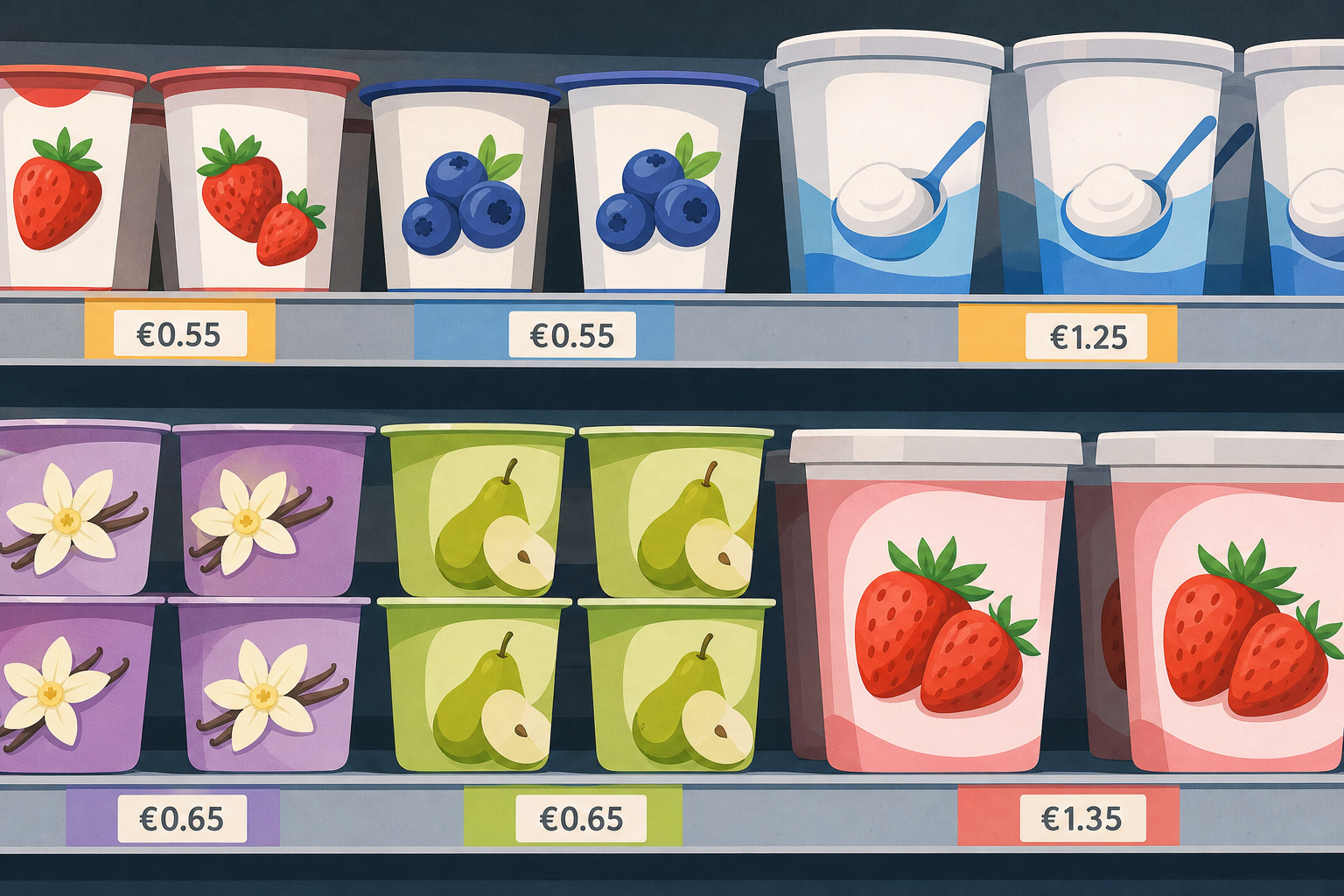
Two shelf tags for the same yoghurts: Lidl has a 6-pack for €2.40, and Tesco has an 8-pack for €3.20. Which one is better value?
Hands up: what would you need to work out before you could be sure?
Take three hands-up answers, not open call-outs. Listen for anyone who compares the total prices (€2.40 vs €3.20) rather than the price of one pot — that is the exact trap this lesson unpicks, so let it sit rather than correcting it now.
Three comparisons on the board. For each one, watch how we get to the price of one before we decide anything. The first one is a surprise: two very different yoghurt tags.
Next is a lunch deal. One shop sells 4 sandwiches for €6.00. The other sells 6 of the same sandwich for €8.40. We divide each total price by its pack size to find the cost of one sandwich, then compare those two single prices to see which pack is better value.
This next one is sold by weight, so counting items will not help. We line both packs up on the same measure: the price of one 100 g piece. The 1 kg block is ten 100 g pieces, and the 250 g block is two-and-a-half 100 g pieces. Watch which pack costs less for the same 100 g, even though one looks dearer at first.
First tag (yoghurts): ask which looks better before the class looks at the interactive. Let a few pupils back the cheaper-looking €2.40 pack, then show both land on 40c (€2.40 ÷ 6 and €3.20 ÷ 8). Point: total price alone cannot decide it.
Middle tag (lunch) is the full worked method. Write both divisions on the board with the class before checking the interactive: €6.00 ÷ 4 = €1.50 per sandwich; €8.40 ÷ 6 = €1.40 per sandwich. The 6-pack wins by 10c per sandwich. Watch for pupils dividing price by price, or subtracting totals, instead of price ÷ pack size.
Third tag (weight): compare the price of one 100 g piece. A 1 kg block is ten 100 g pieces and a 250 g block is two-and-a-half. Pause on the two divisions (€4.50 ÷ 10 = 45c; €1.20 ÷ 2.5 = 48c). The dearer-looking block is actually cheaper for the same 100 g. Ask why equal 100 g pieces make the packs fair to compare.
Today we work this one together on the board: €3.60 for 3 chocolate bars against €4.80 for 4 of the same bar. We work out the price of one bar for each pack, then tap to reveal the per-unit prices and see how they compare.
Talk this one through together — pupils take turns at the board and the class agrees or corrects out loud.
Have the class predict the per-bar price before anyone taps reveal (€3.60 ÷ 3 = €1.20; €4.80 ÷ 4 = €1.20 — a tie, which surprises pupils who expect the bigger pack to always win). Watch for pupils dividing price by price instead of price by size.
In your maths copy, work out the price of one for each pack on its own line. Show the division for both tags, then circle the better deal. For the water, work out the price of one litre.
Walk the room glancing for two clear division lines per comparison and a circle round the cheaper per-unit price — this is whole-class copybook practice, not marking. Prompt any pupil who divides the two prices by each other to divide price by pack size instead.
Today we work through these four shop comparisons, each one a little harder than the last. For each tag pair, predict the winner before we tap reveal:
This is the practice round — pupils take turns at the board, check each answer, and the class confirms before moving on. Keep the board work brisk rather than over-explaining.
The eggs and juice fall cleanly. For the pasta, cut both packs into 100 g pieces first (500 g is five 100 g pieces, 1 kg is ten): 90c ÷ 5 = 18c per 100 g against €1.70 ÷ 10 = 17c per 100 g, so the big pack wins narrowly. The kitchen roll is the closest of the counted items: 80c per roll vs 70c per roll — have the class predict before revealing, as the smaller pack tempts them.
You're previewing this lesson. Get full access to this lesson and hundreds more — each one ready to teach, with interactive activities, printable resources and pupil progress tracking built in.