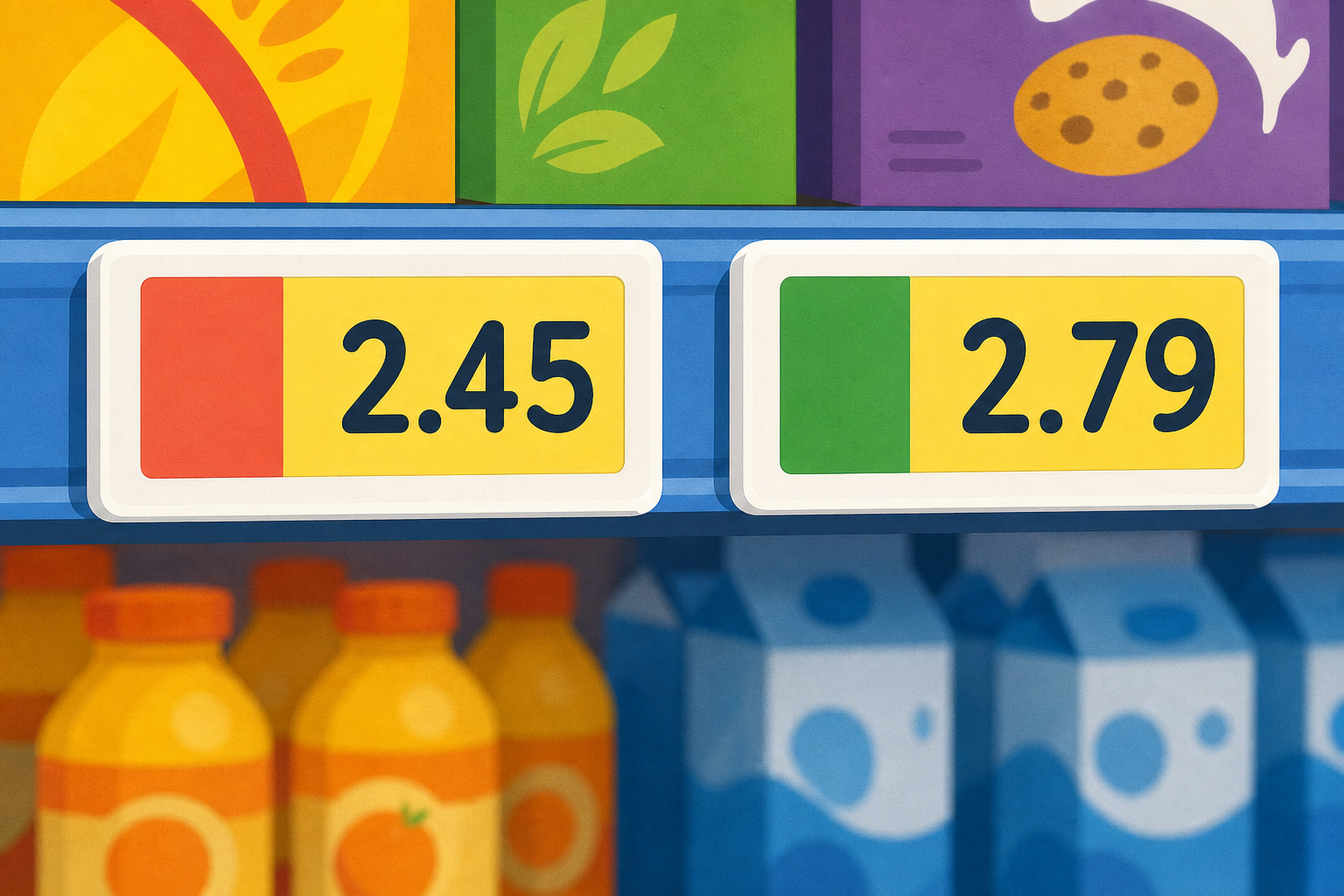
Two price tags are on the shelf: one reads €0.30 and the other reads €0.03. Is this a spot-my-mistake? Have a look: are these two prices the same amount of money, or is one of them dearer?
And here is a trickier one to keep in your head: 0.25 and 0.5. One of these has more digits after the point. Does that automatically make it the bigger number? Hands up when you have a hunch.
Take three hands-up answers on the €0.30 vs €0.03 pair, not open call-outs. Give five seconds of quiet think-time before any hands go up. Do not settle the 0.25 vs 0.5 question yet — leave it hanging; the whole lesson pays it off, and we revisit it in the wrap.
Two fraction strips at a time, each shaded to show one decimal. The longer the shaded part, the bigger the decimal. Look at each pair and decide which reaches further.
0.7 vs 0.4: tenths decide it straight away, 0.7 is more. Rule to keep saying: read tenths first, only check hundredths if the tenths tie.
0.25 vs 0.5: hold this one, hands up on which reaches further before the reveal. 0.25 stops short of halfway, so it is less than 0.5. Say aloud that more digits did not win.
0.6 vs 0.60: run a finger along both shaded edges so they see them land at the same place. The extra zero adds nothing, 0.6 equals 0.60.
0.45 vs 0.4: both tie at 4 tenths, so look to hundredths, the 5 extra hundredths push 0.45 a little further, so it is more.
Today we work through these together on the fraction strips, shading each decimal and reading which reaches further. We start easy and build: first 0.2 against 0.5, then 0.7 against 0.4, then the tie-breaker 0.4 against 0.45 where the tenths are equal, and finally 0.05 against 0.5 — the tricky one, so we say each aloud before we check it.
This round is for talking it through together — pupils take turns at the board and the class agrees or corrects out loud.
In your maths copy, write these three pairs one under the other and put the correct sign between each pair — more than, less than, or equals:
Underline the digit that decided each one, and think about the last pair carefully before you choose your sign.
Walk the room glancing at which digit pupils underline — this is whole-class copybook practice, not marking. Watch for pupils writing "less than" for 0.7 vs 0.25 because 25 looks big; nudge them back to the tenths. The 0.6 and 0.60 pair should get an equals-style answer (neither is more) — accept "same" and revoice it in the wrap.
Today we order these sets of decimals from smallest to largest, shading each on the strips to check. We build up: first just two, then three, then the tricky set with 0.05 hiding among the tenths, and finally a mixed set of four.
These are the practice questions — pupils take turns at the board, check each answer, and the class confirms before moving on. Keep the board work brisk rather than over-explaining.
You're previewing this lesson. Get full access to this lesson and hundreds more — each one ready to teach, with interactive activities, printable resources and pupil progress tracking built in.