1 - Getting Started ~5 mins
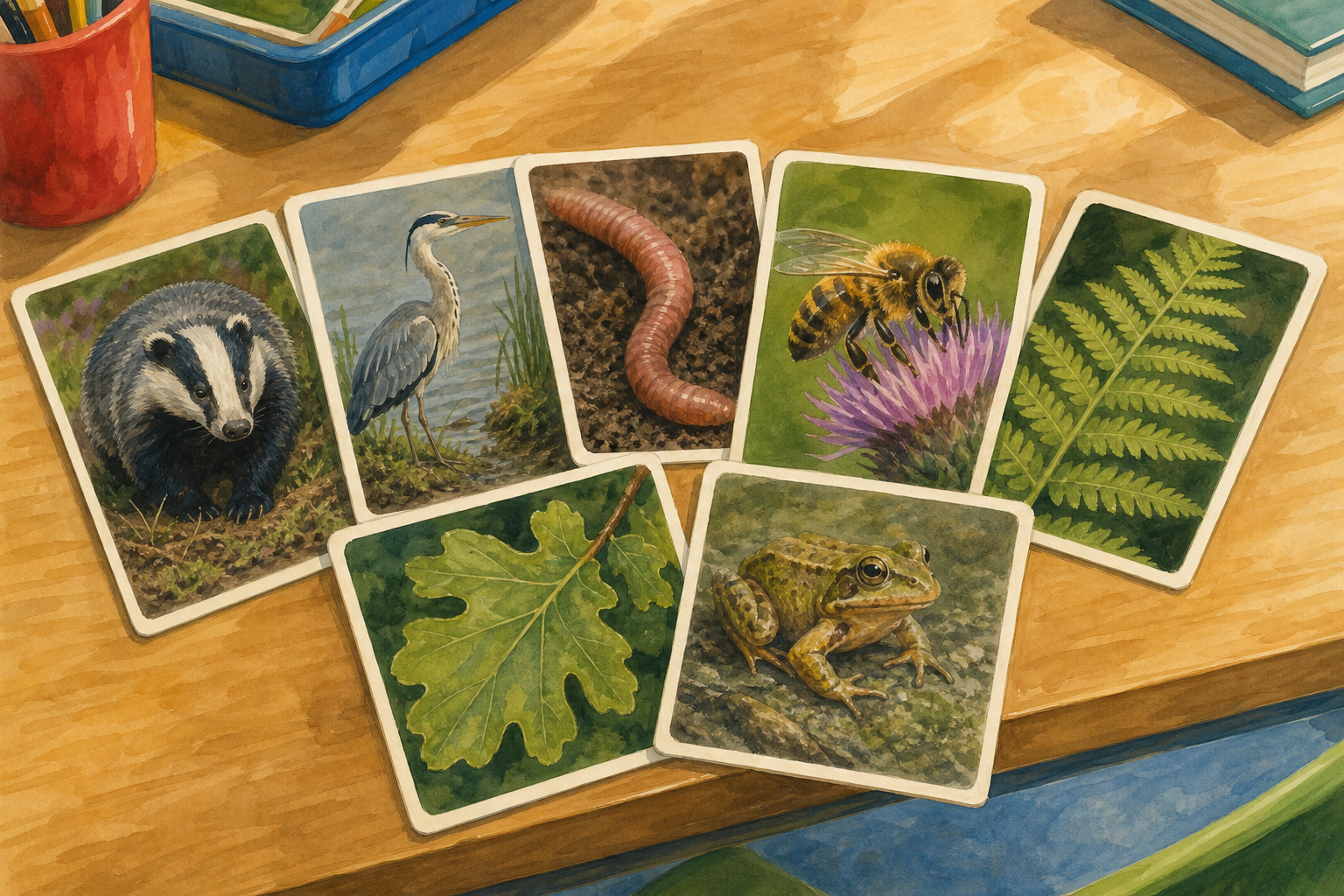 Look at these seven Irish living things: badger, heron, earthworm, bee, fern, oak and frog. They are all different. What features could we use to put them into clear groups?
Show the seven wildlife photo cards on the desk or the IWB. Keep the hook light: one curiosity question only. Do not name the branching key yet and do not hand out templates.
Key questions: What do you notice that is the same about any two of these? What is different? Could we sort them by where they live, by what they eat, or by body parts?
What to expect: pupils will offer habitat, legs, wings, plants versus animals, size. Accept every idea; the lesson will teach which questions split a set cleanly.
2 - What Does Classify Mean? ~7 mins
Look at our seven cards again. When we classify, we sort living things into groups that share a clear feature, and we say why each one belongs.
Try a quick first split with me: plant or animal? Oak and fern go one way; badger, heron, earthworm, bee and frog go the other.
The feature we just used is our criteria: the thing we chose to sort by. Which other feature could split the animal group next?
Teach only two words on the board in this beat: classify and criteria. Hold the name branching key until the tree model in the next step, when pupils can see the path. Keep the board short; the full table is for you.
| Concept | Why it matters | Example |
|---|---|---|
| Classify — to sort living things into groups that share a clear feature, and to say why each one belongs there | Scientists need shared groups so everyone means the same thing when they name a plant or animal | Putting the bee with other insects because it has six legs, and keeping the spider out of that group because it has eight |
| Criteria — the features you choose to sort by, such as habitat, diet, body parts or how something moves | The groups only make sense if you can name the feature that joins them | A group chooses habitat first: lives mainly in or beside water (heron, frog) versus lives mainly on land (badger, earthworm, bee, oak, fern) |
| Branching key — a path of yes-or-no questions that splits a set step by step until each living thing stands alone | A good key lets somebody who has never seen your cards still find the right name | Introduce the name on the IWB tree in the next step; later groups will build keys that end with one living thing on every path |
Board sequence: (1) say classify and do the plant/animal split with the seven cards already on show; (2) name criteria as "the feature we just used"; (3) invite one more pupil idea for a second feature. Do not list three formal definitions in one block.
Misconception to head off: pupils often pick vague questions such as "Is it big?" or "Is it nice?". Big compared with what? Push for features you can check by looking: legs or no legs, plant or animal, lives mainly in or beside water or on land, eats plants or eats other animals.
Nature of STEM weave: people have been naming and grouping living things for centuries. The modern system grew so that a scientist in Cork and a scientist in Galway would put the same creature in the same group. The keys we build later are a simple version of that idea.
3 - Model a Branching Key ~8 mins
Now watch a branching key: a path of yes-or-no questions that splits a set step by step. Five cards appear on the board: worm, ladybird, spider, snail and ant. We will only sort them into clear leg groups for now, so you can see how a clean question works.
Which first question is better: "Does it have legs?" or "Is it colourful?"
Sort the minibeasts
Worked investigation cycle (you model this live before groups work):
I wonder — how can we sort these five minibeasts into clear leg groups using yes-or-no questions?
I predict — "Does it have legs?" will split them cleanly; "Is it colourful?" will not, because people disagree about colour.
I test — drive the sorting-tree on the IWB in explore mode. Cards on screen: worm, ladybird, spider, snail, ant. Questions: Does it have legs? then Does it have eight legs?. Groups: no legs, 6 legs, 8 legs. Ask the class each yes-or-no out loud and drag the cards with their answers.
Name the tool: after the first clean split, say "This path of yes-or-no questions is a branching key. Today we stop at leg groups; later your own keys will keep going until each living thing stands alone."
I observed — worm and snail have no legs; spider has eight; ladybird and ant have six (not eight). The legs questions split the set; the colour question would have left us arguing.
I think — a good branching question has a clear yes or no you can check by looking. That is the rule groups must use on their own seven cards.
Fold the whole class in: "Are they right about the spider? How many legs can you count?" Do not invent a desk task for watchers.
Why this model stays partial: three shared bins (worm+snail; ladybird+ant; spider) are enough to teach the clean-split rule. Groups will push every path to one name when they build their Irish keys.
4 - Choose Criteria and First Groups ~10 mins
Your group has seven Irish living things: badger, heron, earthworm, bee, fern, oak and frog. Choose the criteria you will sort by. Pick from the board menu and use a clear feature you can check by looking:
- Kind of living thing — plant or animal
- Habitat — lives mainly in or beside water, or mainly on land
- Body parts or movement — legs or no legs
- Diet (animals only) — eats plants or eats other animals (use only after you have split off the plants). If it eats both, or eats dead bits of plants and animals, choose a different feature for that pile (legs, habitat, or movement).
Make a first sort into clear groups and be ready to say why each living thing sits where it does. Every card must have a home.
One set of seven wildlife photo cards per group. Criteria are genuinely theirs within the four families named on the board. Keep the pupil wording as kind of living thing (plant, animal, minibeast), not "family", so nobody hears taxonomic family or "my family".
Diet is animals-only on this set: oak and fern do not "eat" in the animal sense. Badgers are omnivores and earthworms are detritivores, so the binary "eats plants or eats other animals" still fails for those two even inside the animal pile. If a group picks diet first, ask "Where do oak and fern go on that menu?" and steer them to plant or animal first. If they hit badger or earthworm on a diet fork, point them to the board half-line and switch that pile to legs, habitat, or movement. A clean animal-only diet example that avoids the snag is heron (eats other animals) versus bee (eats plant food). Do not leave cards stuck with nowhere to sit.
Look-fors:
- Groups name the feature out loud before they move cards.
- Every card has a home; none left in a "not sure" pile.
- They can justify each placement in one sentence.
Differentiation: if a group stalls, offer two starter criteria only (plant or animal; legs or no legs). If a group finishes early, ask them to re-sort the same seven using a different criterion and compare which split felt cleaner.
Common snag: oak and fern both plants but different forms — lead with "Is it a tree?" rather than "Is it green?". (If a group wants a second plant question, "Does it make seeds we can see?" works as a yes/no for oak versus fern; ferns make spores, not seeds — a half-line aside is enough if it comes up.)
5 - Build Our Multi-step Key ~12 mins
You are writing a tool someone else can use — that is real classification work.
Turn your sort into a multi-step branching key on one master A4 sheet for your group. Copy the indented layout from the board (do not invent a new layout):
Worked mini-example (both branches filled — copy this shape):
Criteria: kind of living thing
Q1: Is it a plant?
YES path
Q2: Is it a tree?
→ yes → oak
→ no → fern
NO path
Q2: Does it have legs?
→ no → earthworm
→ yes → (next question for the ones with legs)
How your group builds (in this order):
- Agree Question 1 and split the seven cards into two piles.
- Together, write one full path to named ends on the master sheet (copy the YES-path plant example shape if it helps).
- Then finish the other branch so every card has a named end.
Start floor on the board: two clean steps that already name ends on both the YES path and the NO path. Add more branches if you have time. Write yes-or-no questions only. Another group will follow your key, so every answer must be checkable by looking.
No special platform printable for the key. The Investigation Journal page that ships for this course is a standard investigation layout (question, predict, sort words, criteria table). It does not have YES/NO fork fields. Do not hand it out as the master key and do not ask pupils to draw a tree on it.
What groups actually write on: one plain or ruled A4 master branching-key sheet per group. Leave the full two-branch mini-example visible on the IWB for the whole build (plants resolved to oak/fern; NO path showing earthworm plus a legs continue). Groups copy the indented text layout from the board onto the A4 sheet. Headings to write at the top (show on board): Criteria · Q1 · YES path (Q2 → end names) · NO path (Q2 → end names) · End names checklist.
Optional journal use: if pupils have their Investigation Journal open, they may jot the investigation question and their prediction for which first question will split cleanly. The handoff artifact for the swap is only the master A4 key.
Scaffold the twelve minutes (do not dump seven ends at once):
- Cards first: agree Q1 and physically split the piles (2 min).
- One path together: group writes a complete YES path (or NO path) to named ends, reading it aloud once (4 min).
- Finish the other branch and remaining names on the master A4 (5 min).
- Quick read-through and fix (1 min).
One master key per group: nominate a scribe. Only the master A4 is handed over in Step 6. Others may copy onto spare paper if they wish.
Success floor for the swap: both the YES path and the NO path of Question 1 have at least two yes-or-no steps and end on named living things. A usable master with five or more named ends is the normal goal; all seven is the stretch. Labelled end groups only as a 1-minute emergency scaffold — push to names before Step 6. Thin keys do not enter the mystery follow until one path on each side of Q1 is named (see Step 6 gate).
Coach the question quality:
- Strong: "Is it a plant?", "Does it have legs?", "Does it live mainly in or beside water?", "Does it eat other animals?" (diet only inside an animal branch that fits the binary)
- Weak: "Is it big?", "Is it nice?", "Is it weird?" — send these back for a rewrite.
Circulate and ask: "If I have never seen your cards, can I still follow this?" That is the test of a usable key.
Unlock the full learning experience
You're previewing this lesson. Get full access to this lesson and hundreds more — each one ready to teach, with interactive activities, printable resources and pupil progress tracking built in.
This lesson is copyright of Coding Ireland 2017 - 2025. Unauthorised use, copying or distribution is not allowed.