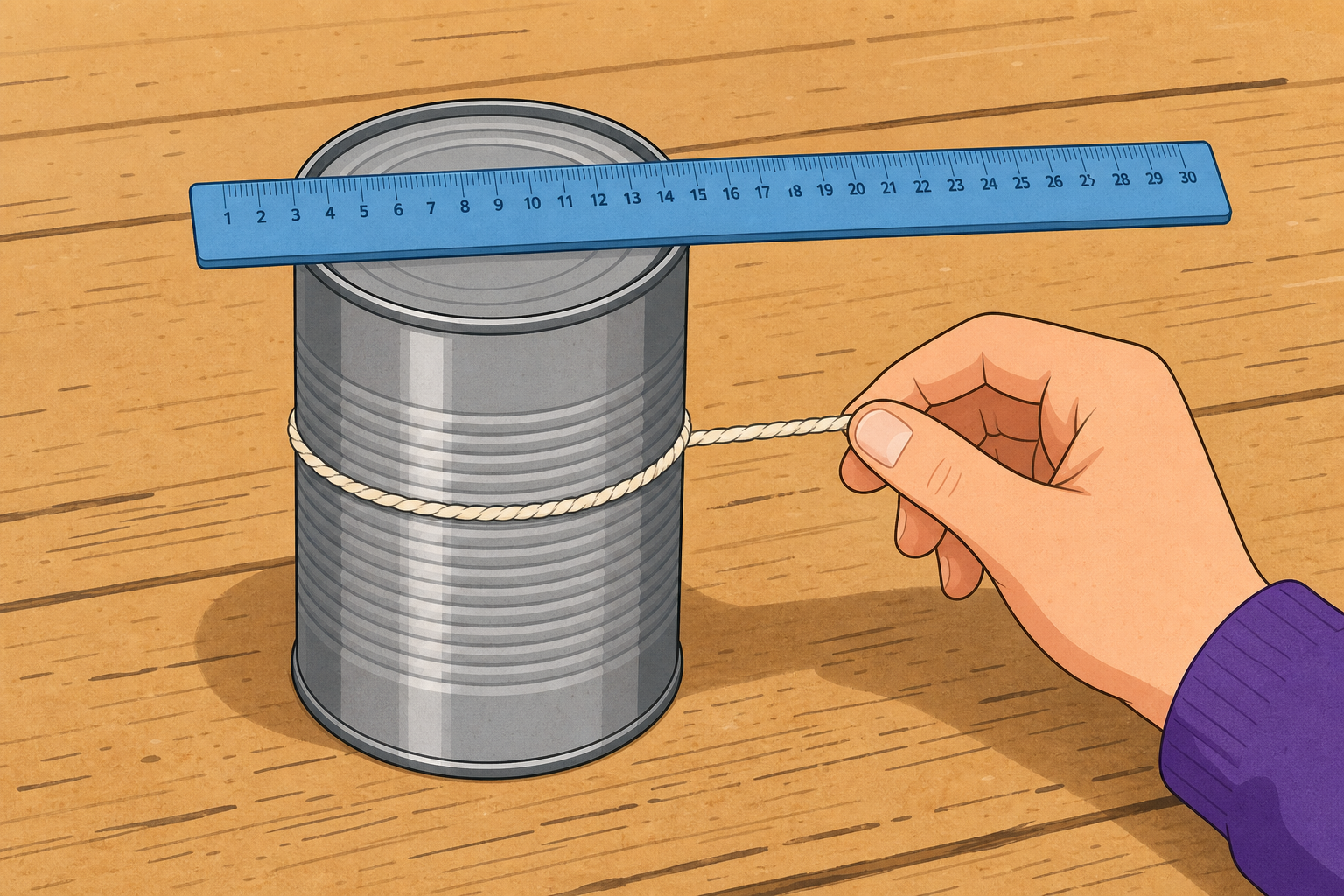
Here is a can of beans with a piece of string wrapped once around its middle.
Think about this: if we straightened out that string and laid it next to the distance straight across the can, how many times longer would the string be? Have a guess in your head, then we will share a few.
Pose the guess and take two or three answers, no more. Do not name the answer yet — the whole lesson is the class discovering the string is always about three-and-a-bit times the distance across.
Watch three circles on the board. Each one shows its diameter and its circumference, and a panel that divides one by the other. Watch what happens to that last number as the circles change size.
Only after the third circle name it: this number is called pi, written π. Do not lead with the name.
If the board tool is unavailable, sketch each circle on the board with its diameter and circumference written beside it, and do the division live: 31.4 ÷ 10, then 12.56 ÷ 4, then 44 ÷ 14, so the class still sees every answer land on 3.14.
Today we drag the radius slider and watch two numbers move together: the distance around (the circumference) and the distance across (the diameter). The ratio panel shows a ratio — that just means the number we get when we divide one length by another. Here it divides the way around by the way across.
We will try three circles. First a radius of 3. Then a radius of 6. Then back to a radius of 4. Before each drag, predict: will the ratio panel change, or stay the same?
Talk this one through together — pupils take turns at the board and the class agrees or corrects out loud.
The 3.14 surprise already landed in Watch and Notice, so keep this lean: one drag per pupil, a quick class prediction before each, and a revoiced answer to close it. Revoice a strong answer: so the way around and the way across grow together, and their ratio stays locked.
If the board tool is unavailable, draw a small circle then a larger one on the board, write the two lengths beside each, and divide the way around by the way across each time so the class sees the ratio stay at 3.14.
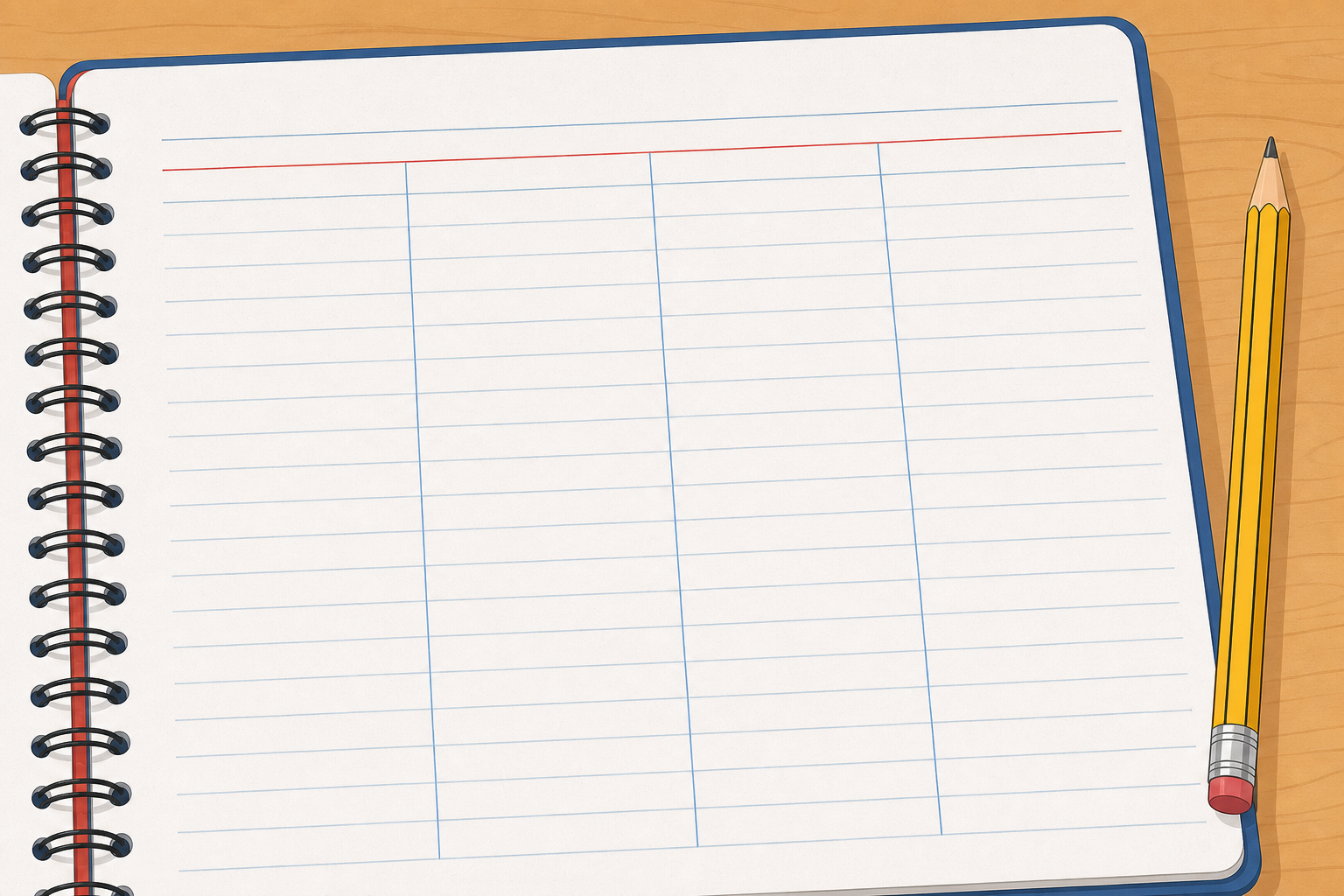
In your maths copy, draw a four-column table with these headings: Object, Diameter, Circumference, C ÷ d.
Now measure three round objects at your station — a tin lid, a CD and a coin. For each one, wrap the string around it to find the circumference, then measure straight across for the diameter. Write both numbers in your own copy with their units (cm), and work out C ÷ d beside each row. At the bottom, underline 3.14 — or whatever number your class average came out to.
Hands-on measuring with real objects at each station; each pupil records their own numbers in their own copy. Circulate and catch the two slips: string not pulled taut (circumference reads short), and the ruler not passing through the centre (diameter reads short). If a group's ratio is 3.10 or 3.18, that is normal measuring wobble — leave it, it makes the maths-talk richer. Glance that units and columns are lined up.
Now we take everything we found to the board. The circle-tool sets you a target each time. Some targets give you the distance around, some give you the distance across, and you set the circle to match.
Use what we discovered: the distance around is always about 3.14 times the distance across. Pupils take turns setting the circle and the class checks each one.
This is the practice round on the board — pupils take turns setting each target and the class confirms aloud. Keep the pass-on rhythm brisk rather than over-explaining.
The last target (a large pizza) links back to real round things pupils know. Draw out that knowing the diameter lets you work out the distance around by multiplying by about 3.14.
If the board tool is unavailable, read each target aloud and have pupils work out the missing length on the board using distance around ≈ distance across × 3.14, then the class confirms.
You're previewing this lesson. Get full access to this lesson and hundreds more — each one ready to teach, with interactive activities, printable resources and pupil progress tracking built in.