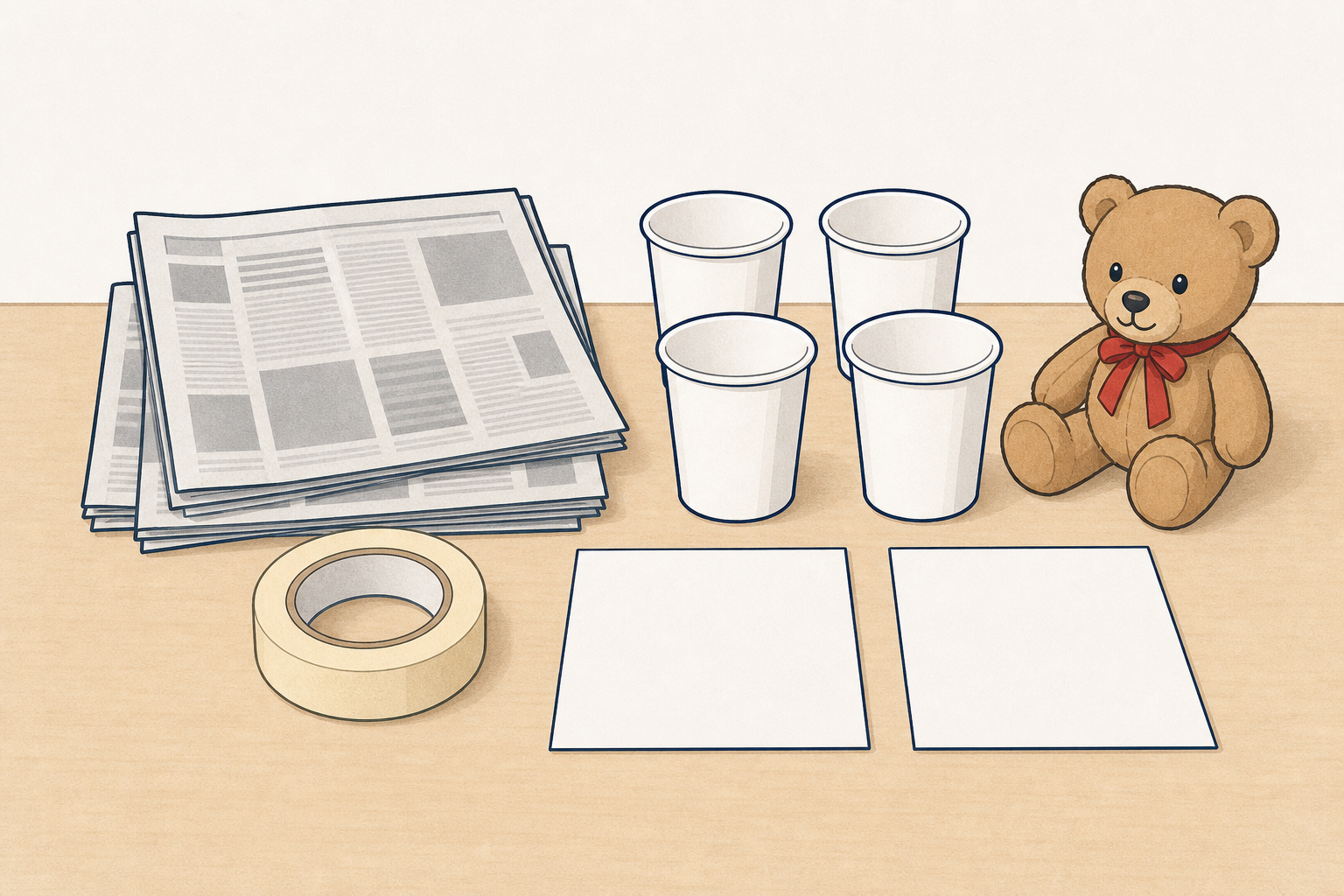
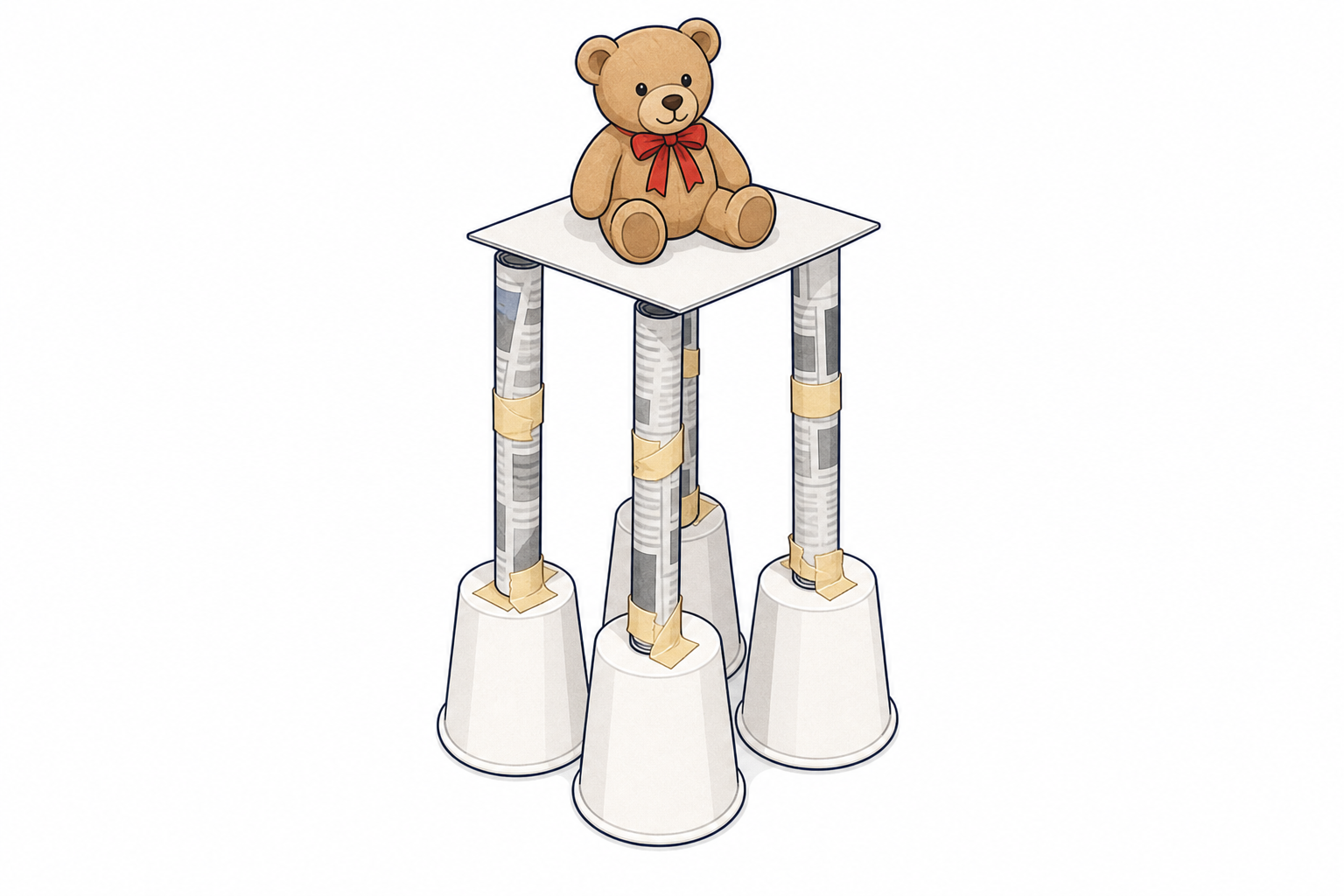
Can you build the tallest tower that stands on its own?
It must hold this little teddy on top, using only the things we will use today.
Before or during this hook, put the children into the pairs they will talk and build with for the whole lesson so everyone knows their partner before Step 2.
Hold up the soft toy and one sample kit so the class can see newspaper, sticky joining rolls, cups and card. Keep the hook light: name the challenge only. Do not take a stability discussion here (that is Step 2). Do not hand out materials or list the full method yet. Say “the things we will use today” while you show the sample kit, not “your kit”, until pairs receive materials at the build step.
STEM eyes: link briefly to tall things children know, such as a church steeple, a crane on a building site, or a water tower near town.
Before the lesson: push desks so pairs have floor or table space; pre-count kits (newspaper, sticky joining rolls, cups, card, one soft toy per pair) and scrap paper for plans. Optionally pre-roll a few newspaper tubes per kit as starter pieces so pairs can spend build time on base and joins rather than only on rolling.
Think with your partner: what helps a tower stand strong and not tip over?
Be ready to share one idea with the class.
If pairs are not already set from Getting Started, pair children now before talk begins.
| Concept | Why it matters | Example |
|---|---|---|
| Free-standing — standing up on its own without anyone holding it | Our tower must stay up so we can put the teddy on top safely | A tower of cups that stays upright on the table by itself |
| Wide base — a broad bottom that spreads the tower’s weight so it is harder to tip | A wide bottom stops the tower tipping when it gets tall | Three cups side by side under a tower hold better than one cup alone |
Optional revoice only (not a third term to learn): sturdy shapes such as rolled tubes or a triangle of cups can stand better than a flat sheet or a single wobbly stack. Use this language if pairs notice it; do not add it to the board word list.
Board words only (after talk, when you revoice): free-standing (stands alone), wide base (broad bottom). Keep the IWB on the open focus question during pair talk; do not list the answers on screen first.
Teacher aside (optional precision): a wide base spreads the tower’s weight so it is harder to tip. Pupil wording stays simple: broad bottom / wide base.
Misconception to head off: taller is not always better if it topples. Strength and balance matter as much as height.
Take three pair ideas. If nobody names a wide base, model it with two quick cup stacks: one narrow, one wide. If nobody mentions sticking pieces firmly, point to a joined sample on the kit and ask how sticky rolls might help. Do not build a finished winning tower for them.
Here is what each pair will use: newspaper, sticky rolls for joining, paper cups, some card, and a small teddy for the top later.
With your partner, draw a quick plan of your tower. Point to where the wide base (the broad bottom) will go. Say which things you will use first.
Before pairs sketch, show the sample kit again (or hold each item up) and name the materials in simple words paired with the object: newspaper, sticky rolls for joining (masking tape), cups, card, teddy. Keep a simple base sketch or the held-up kit in view while pairs draw. On the IWB, pair board words with plain wording: wide base = broad bottom. Kits can stay with you until the build if you prefer, but the class must see and hear the list so they can plan.
Give each pair one scrap of design paper (from the materials list) for a quick sketch. Plans stay simple: base, middle, top for the teddy only, so the beat fits after the kit is reshown. Circulate and ask: Where is your wide base (broad bottom)? What will you roll or stack first?
If a pair freezes, offer two starter choices only: stack cups in a triangle, or roll newspaper into tubes and join them (or use a pre-rolled tube if you prepared some). Do not draw their tower for them.
Success look-fors: both partners can point to the base on their drawing; they name at least one material.
Use only the kit on your table. Build the tallest tower you can that stands on its own. Leave a flat place on top for the teddy.
If it wobbles, stop and fix the base or the places where pieces join, then keep going.
Kit per pair: 4–5 sheets of newspaper (plus any pre-rolled tubes you prepared), one roll of masking tape (sticky joining roll), about four paper cups, a few card offcuts, one small soft toy (held back until the test if you prefer). Hand kits out now.
Board challenge in plain words: tallest tower that stands on its own. You may say the board word free-standing aloud once you revoice, but keep the main instruction as “stands on its own”.
Remind pairs: stand back if it topples; mind fingers and eyes; no running with towers.
Coach with questions, not fixes: Is the bottom wider than the top? Which join feels loose? Could a triangle of cups help?
Differentiation: less confident pairs may aim for a short steady tower that holds the teddy. Confident pairs may go taller once it stands alone. Pre-rolled tubes help pairs who struggle with rolling so they can focus on base and joins.
Call a two-minute warning so pairs can steady the top before testing. If you want a quick modelled predict–try–observe, run it once on a short demo tower in this warning minute, not inside the pair test slot.
Predict first: will your tower hold the teddy without falling? Say yes or no, and why.
Then place the teddy gently on top. Watch what happens. If there is time and it falls, try one quick change and test again.
This is a simple predict–try–observe, not a fair test. Keep language gentle: we are finding out what helps the tower stand.
Any modelled cycle should already have run at the end of the build step. Treat this pair slot as one prediction and one gentle test. A single optional fix and retest only if time remains; collapsing towers will eat the minutes if you stack too much. Do not start the Investigation Journal here; drawing comes next.
If you still need a model (keep it very short): I wonder if this narrow tower will hold the teddy. I predict it will tip because the base is skinny. I place the teddy gently. I observed it lean and fall. I think a wider base would help.
Board stays as the task and question only. Do not print the full cycle for pupils.
Safety: place the teddy gently; stand clear if a tower topples; catch falling cups before they hit faces.
You're previewing this lesson. Get full access to this lesson and hundreds more — each one ready to teach, with interactive activities, printable resources and pupil progress tracking built in.