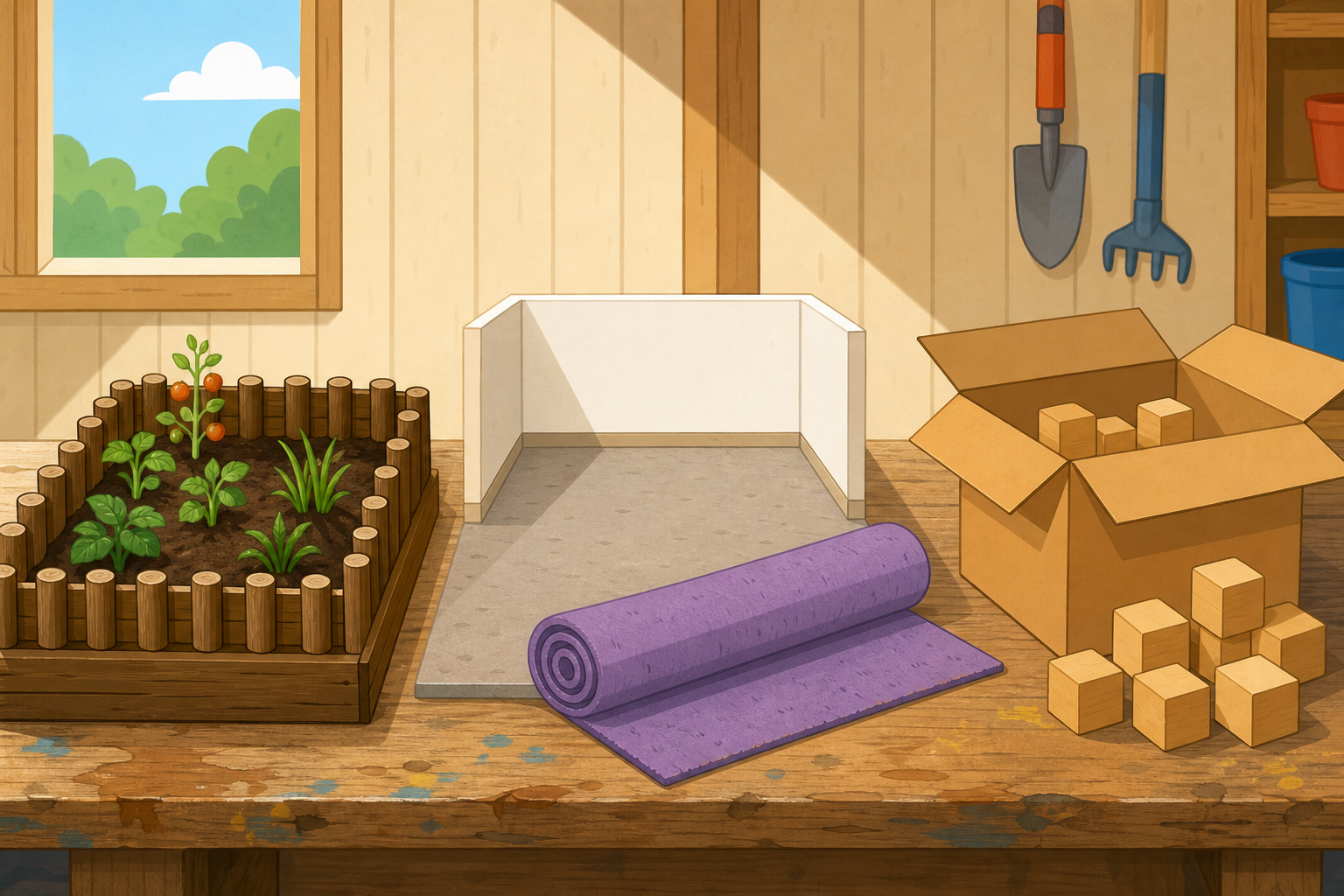
Here are three jobs someone might have to do at home: put a fence around a garden bed, lay a carpet on a floor, and pack a box full of blocks.
They all use maths, but a different kind for each one. Which job is about the distance around the edge? Which is about the flat space inside? And which is about the solid space that gets filled right up?
Take three hands-up answers, one per job. Give five seconds of quiet think-time before any hands go up.
Steer the class toward the three words without confirming yet: fencing means the distance around the edge, carpet means the flat space inside, packing means the solid space filled. Leave the naming to the next step.
Three shapes appear one at a time. Watch how we measure each one, and keep an eye on the units. Same idea, different amounts of space. Then we count the cubes in a box for volume, one layer then the stack.
Perimeter rectangle (6 by 3): distance all the way round. Trace a finger round the edge back to the start. 6 + 3 + 6 + 3 = 18 cm, measured in centimetres.
Area rectangle (5 by 4): flat space inside, squares in rows. Before the answer, hands up to predict the square count, take two. Point one full row of five, then count four rows: 5 x 4 = 20 cm squared. The raised two means we count squares, not distance.
Pentagon (side 4): turn-and-name, ask a pupil what regular means now it is on screen, revoice it. All five sides equal, so add in equal groups: five fours = 20 cm, not five different numbers.
Volume box (3 by 2 by 2): solid space in cubes. Trace one bottom layer, 3 along and 2 across = 6 cubes. Now stack the second layer: 6 + 6 = 12 cubes. Count one layer then stack it, the move they use in the challenge.
Name the units contrast: perimeter cm, area cm squared, volume cubes. 18 and 20 look alike but the measures and units differ.
Today we work through these together on the board, deciding the measure each time before we work it out: first a 7 cm by 3 cm rectangle where we find the perimeter, then the same 7 cm by 3 cm rectangle where we find the area, then a 4 cm by 4 cm square where we find both. Naming the measure first is the tricky part, so we say it aloud before we touch the shape.
This round is for talking it through together. Pupils take turns at the board and the class agrees or corrects out loud.
The order builds a real point: the same 7 cm by 3 cm rectangle gives perimeter twenty centimetres, then area twenty-one square centimetres — almost the same number, completely different measure and unit. Pause on this pair so the class sees the numbers are close by chance, not because the measures are the same.
For the 4 by 4 square (perimeter sixteen centimetres, area sixteen square centimetres) the numbers really do match — a good why is that? moment, but do not let anyone conclude perimeter and area are ever the same thing. Rotate three or four pupils to the board.
In your maths copy, draw a 4 cm by 5 cm rectangle. Work out its perimeter and its area, and write both underneath. Label one answer cm and the other cm² so it is clear which is which.
Walk the row glancing for the two labels — this is the whole point of the beat. Look for pupils writing cm² on the area and cm on the perimeter. Whole-class copybook practice, not marking. If someone labels both the same, ask them quietly which one is the space inside.
Now we take on some real jobs, and each one needs us to pick the right measure and unit first.
A Cork school garden bed is 7 m by 3 m. First we fence around it, then we plant the space inside. Next we pack a hurling-gear box that is 4 cubes long, 3 wide and 2 high, so we count one layer first, then stack the layers. Last we look at a hall floor 10 m by 6 m that needs skirting board around the edge and tiles across the inside.
These are the practice questions. Pupils take turns at the board, check each answer, and the class confirms before moving on. Keep the board work brisk rather than over-explaining.
The build here is deliberate. The two garden-bed problems (perimeter twenty metres, then area twenty-one square metres) sit next to each other so pupils meet the same numbers giving two different measures. Then the box moves from one layer (twelve cubes) to the whole solid (twenty-four cubes) — the pause: we count the layer, then stack the layers. Finish on the hall floor, where the skirting (perimeter) and tiles (area) give the same both-measures contrast.
If time: ask which is bigger for the hall — the skirting distance around or the tile area inside, and why.
Watch for the classic slip: a pupil multiplying when the fencing or skirting question wants adding around the edge. Head it off by asking is this around the edge, or the space inside? before they choose the operation.
You're previewing this lesson. Get full access to this lesson and hundreds more — each one ready to teach, with interactive activities, printable resources and pupil progress tracking built in.