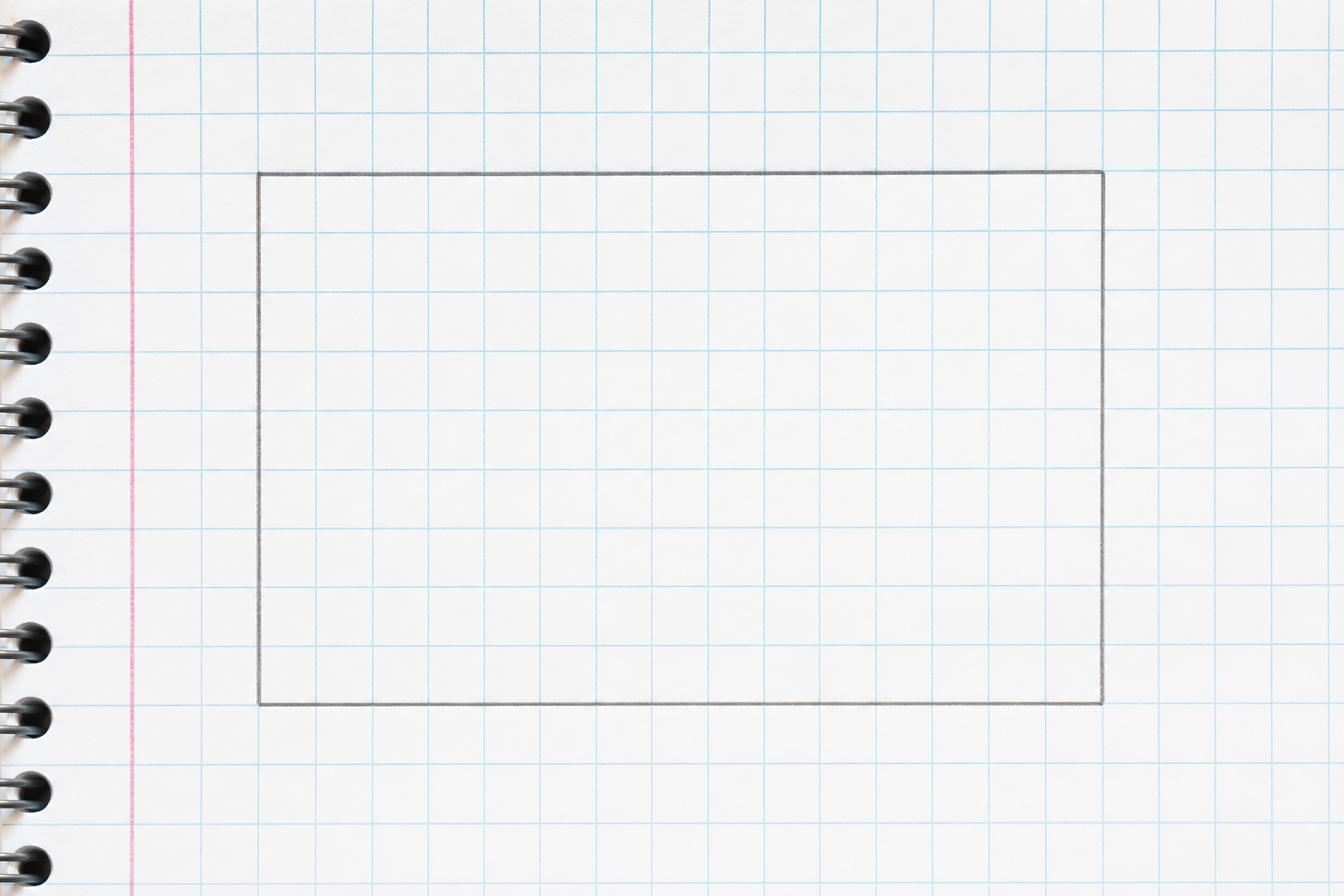
Look at this rectangle made of little squares. There are 4 squares in each row, and there are 3 rows.
Is there a faster way to work out how many squares there are altogether than counting them all one by one?
Display the 4-by-3 grid and give five seconds of quiet think-time before any hands go up. Take three hands-up answers, not open call-outs.
Some will count all twelve; listen for anyone who says "four and four and four" or "four, three times" and hold that idea for later.
Four rectangles made of squares. Read how many squares are in one row, then how many rows there are, and see how the squares add up.
For the last two, say how many squares are in one row before we check the total.
The point to draw out: you never have to count every square, because each row holds the same amount.
We work through four rectangles together, one after another. First 2 rows of 3. Then 3 rows of 4. Then 4 rows of 5. Last, 6 rows of 2.
For each one, one pupil comes to the board and counts the squares in one row, then adds it on row by row to find the total area in squares.
Everyone else watches the board. Once the row has been counted, put your hand up to say what the total area will be.
Talk this one through together — a few pupils rotate to the board across the four rectangles, not the whole class in one lesson. The class agrees or corrects out loud.
The interactive is not pre-queued: set each rectangle by hand in explore mode by choosing the rows and columns before the pupil comes up. A pupil counts one row aloud, then the class skip-counts down the rows with them (four, eight, twelve). Reconcile any disagreement against the filled squares on screen.
Between turns, keep the watching class with you: ask them to predict the total after the row has been counted, then check it on the board. Revoice a strong prediction so the room hears the reasoning.
Watch for pupils who lose the count when the rectangle is tall — the 6 × 2 is the trap, because keeping count across six rows of two is a lot to hold. Prompt: "how many in one row, and how many rows?"
In your squared copy, draw a 3-by-4 rectangle. Then write how many squares are in one row, and how many rows there are. Underneath, write the total area in squares.
Walk the room glancing at whether pupils have drawn equal rows and columns — no marking, this is whole-class copybook practice. Watch that they write the area as a number of squares, not just count silently.
Now we build and read the area of four more rectangles in turn. First 2 rows of 4. Then 3 rows of 3. Then 4 rows of 5. Last, 6 rows of 2.
For each one, count the squares in one row, then read the area by adding it on for the rows.
While a pupil builds each rectangle at the board, everyone else predicts. Once the row is counted, put your hand up to say the total area before the pupil checks it.
This is the practice round — pupils take turns at the board, check each answer, and the class confirms before moving on. Keep the board work brisk rather than over-explaining.
The practice set rises: the 3 × 3 square is a friendly one, the 4 × 5 stretches the count, and the 6 × 2 asks pupils to hold two in a row across six rows. For each target, ask the class to predict the area before the pupil at the board checks it.
You're previewing this lesson. Get full access to this lesson and hundreds more — each one ready to teach, with interactive activities, printable resources and pupil progress tracking built in.