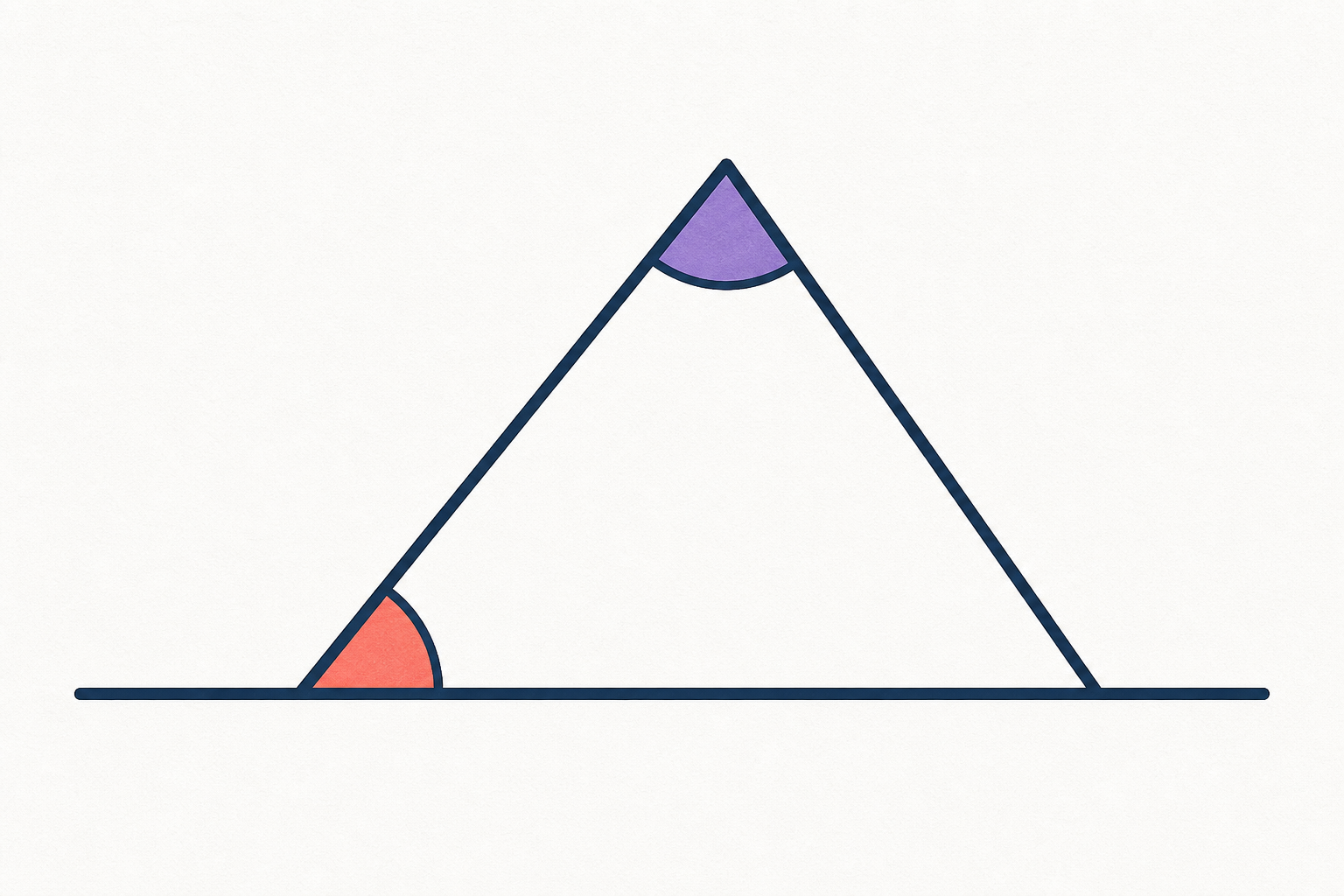
Imagine a triangle sitting on a straight line, with two lines crossing beside it. Some angles are marked; one is missing.
Which angle do you think we could work out first — and why can't we always reach for the one we most want to know?
Take three hands-up answers, not open call-outs. Give a few seconds of quiet think-time first.
Do not confirm an answer yet — the point is only to get pupils noticing that some angles are reachable and some are locked until you find another one first. Revoice a strong contribution: so we can't get that one yet because we don't know its neighbour.
Watch four figures on the board. In each one, an angle is missing. Look for which fact helps:
Be ready to say which fact you would reach for on each figure.
Today we work through one figure together, step by step. A triangle sits on a straight line, and two lines cross beside it. We know two of the triangle's angles: 65° and 40°.
We will find the angles in a set order. First we find the triangle's third angle. Then we find the angle beside it on the line. Last we find the angle vertically opposite that one. Say which fact we are using before each step.
Talk this one through together — one pupil sets the ray at a time and the class agrees or corrects out loud. Before each reveal, put the question to the whole class and take two hands-up answers so the watching majority stays with the board across all three turns; revoice a strong answer each time.
Insist that each pupil names the fact before setting the ray: angles on a line, triangle sum, vertically opposite. The named fact is what you are grading, not just the number. The triangle's third angle is 180° − 65° − 40° = 75°.
Common slip: pupils try to name the vertically-opposite angle before they have found the line angle. Steer them back to the order — you cannot reach a later angle until its neighbour is known.
In your maths copy, solve two of the figures from the board. For each missing angle, write the calculation and, beside it, the angle fact you used, like this:
Ring each final answer.
Walk the room, glance for a named fact beside each line, not just numbers. No individual marking — this is whole-class copybook practice, not assessment.
Look for pupils who write the answer but leave the fact blank; that is exactly the habit this beat builds.
Today we crack a chained figure where each angle we find unlocks the next. We solve them in this order:
Predict each answer before we check it, and say the fact out loud.
This is the practice round — pupils take turns at the board, check each answer, and the class confirms before moving on. Keep the board work brisk rather than over-explaining.
The final challenge sits on its own separate straight line, drawn apart from the triangle. At one point on that line, three angles are all marked in the figure — a right-angle box (90°), an arc labelled 55°, and the blank target. Because the three together lie along the straight line they make 180°, so the missing one is 180° − 90° − 55° = 35°. None of the angles in this last part repeat a value from the triangle part, so there is nothing to confuse — point at the second line on the board so pupils see it is a fresh figure.
Insist the fact is named before the Check: two facts joined here (three angles at a point sharing a straight line, one of them a right angle). Every pupil enters at the triangle sum; the strongest stretch on the final split.
You're previewing this lesson. Get full access to this lesson and hundreds more — each one ready to teach, with interactive activities, printable resources and pupil progress tracking built in.