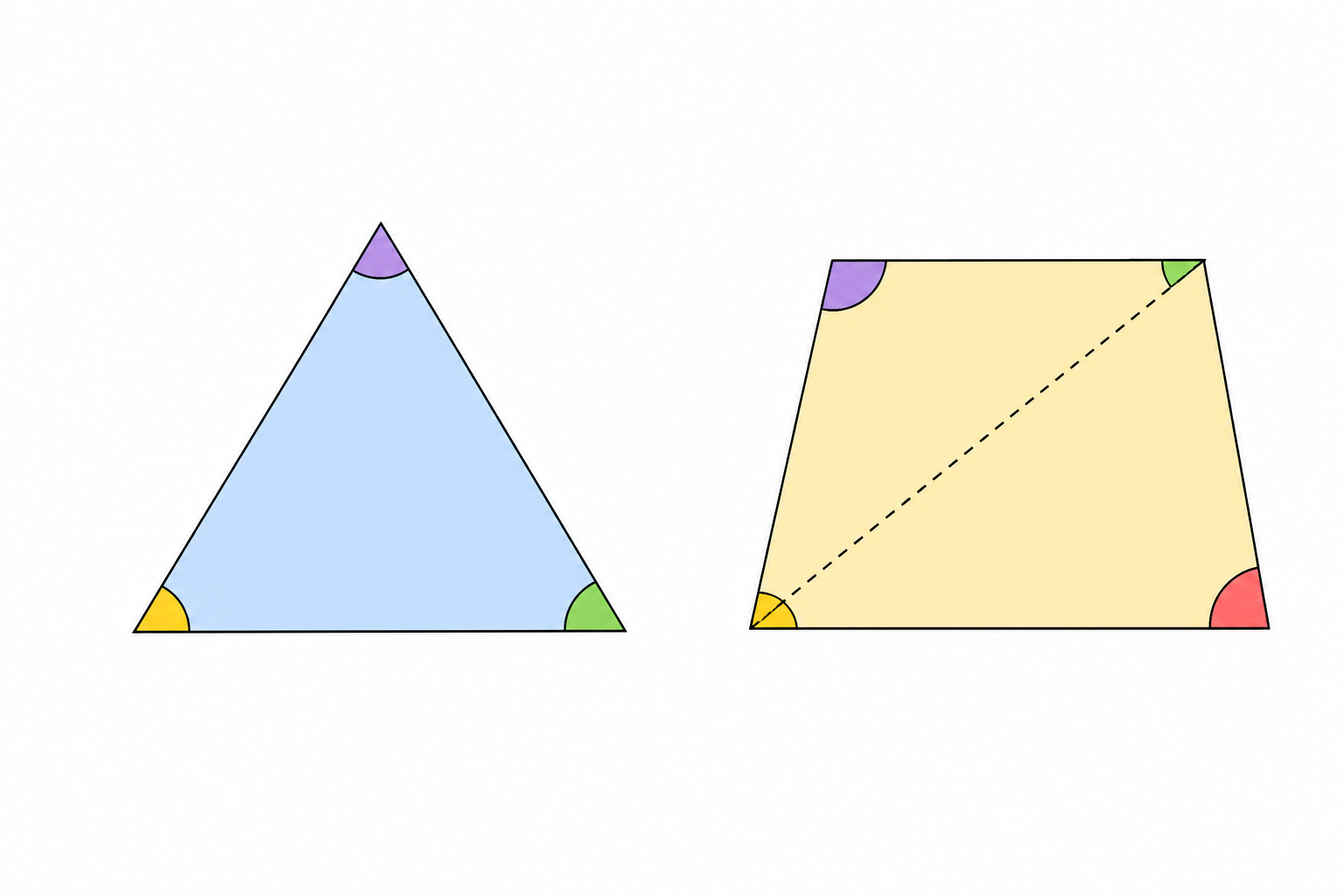
Here is a triangle. Before we work anything out: if I told you two of its angles, do you think you could work out the third one without measuring it? Have a think.
Now look at the four-sided shape beside it, and the dashed line running corner to corner. It splits the shape into two triangles. Keep that in the back of your mind, because it is going to tell us something surprising about the angles of a four-sided shape.
Sketch a triangle on the IWB, then draw a quadrilateral and split it corner-to-corner with a diagonal so the class sees the two triangles appear. Take two or three hands-up predictions on "could you find the third angle without measuring?" — do not confirm or deny yet, that is the whole lesson.
The interactive shows five shapes, one at a time: three triangles, then two four-sided shapes. Keep your eye on the total of the angles each time. What do you notice?
Three triangles first, so the 180° rule lands before quadrilaterals appear.
Equilateral: three equal angles, 60°+60°+60°=180°.
Right-angled: right angle 90°, then 45° and 45°. Get a prediction before totalling: 90+45+45=180°.
Scalene: everything different-looking, still 50°+70°+60°=180°. Point: three different triangles, same total.
Square: four right angles, 90°×4=360°. Draw out that this is two lots of 180°.
Link back to the diagonal from Getting Started that splits a quadrilateral into two triangles, each 180°, so 360°. That is the reasoning, not just the fact.
Irregular quadrilateral: 70°+100°+80°+110°=360°. Point: total stays on 360° even when nothing is neat.
Today we drag the corners of a triangle and watch its angles change on the board. We'll pull one vertex to make it tall and pointy, then squash it flat and wide, then twist it into a shape none of us have seen before. Each time, before the numbers settle, predict what the total of the three angles will do.
The three angles will keep changing as we drag, but keep your eye on the running total. However sharp or squashed the triangle gets, we're checking whether that total ever leaves 180°.
This round is for talking it through together — pupils take turns at the board and the class agrees or corrects out loud.
Dragging a vertex is the only interaction here — there is no type-a-value box in explore mode, so don't ask pupils to hit an exact angle. This is the digital version of ripping the corners off a paper triangle.
Keep the whole class working through the 9 minutes: ask a fresh pupil to predict what the total will do before each drag, take a hands-up answer from the watching class, then let the pupil at the board drag and read the total. Every couple of drags, re-anchor by asking the room to read the total aloud with you. Let four or five pupils take a turn at the board so nobody watches for long. The point is that the total refuses to leave 180° no matter how extreme the triangle becomes.
In your maths copy, sketch one triangle and one quadrilateral. For each shape, write its angles in a column, one under the other. Add them up and underline the total at the bottom — 180° for your triangle, 360° for your quadrilateral.
Walk the room glancing at the two totals — this is whole-class copybook practice, not marking. If a total is off, nudge the pupil to re-add rather than correcting it for them.
First, the paper part. Cut or tear out a paper triangle, tear off its three corners, and line the three points up against a ruler — watch them make one straight line. A straight line is 180°, so that is our rule proved with paper. If your torn corners don't quite make a perfect straight line, that is just our scissors and fingers wobbling — a real triangle can never truly disagree with the rule.
Now put the paper down and look at the board. We work these five triangles together: two angles are given each time and you work out the missing third. We'll go 40° + 80° + ?, then a right-angled one 25° + 90° + ?, then an isosceles one — isosceles means two of the angles are the same size, and we call those two the base angles, so here the base angles are 50° + 50° + ?. Take away the two you are given from 180° to find the last one.
Before we finish, we do one four-sided shape together on the board so you see the same method with 360°. A quadrilateral has angles 85°, 100°, 70°, and one missing. Add the three you know: 85° + 100° + 70° = 255°. Then subtract that total from 360°: 360° − 255° = 105°. So the missing angle is 105°. Same idea as the triangles, just take the known angles from 360° instead of 180°.
Run the paper rip-and-line-up first (triangles_to_tear printable) so pupils have felt the 180° before the board work. Give a clear spoken cue when the class puts the paper down and turns to the board — the two halves of this step are separate and pupils need to know which they are doing.
Then the board work is the practice questions — pupils take turns at the board, check each answer, and the class confirms before moving on. Keep the board work brisk rather than over-explaining. The subtraction strategy is: 180° minus the two known angles.
Quadrilateral worked example (board, after the five triangle challenges): sketch a rough four-sided shape, mark 85°, 100°, 70°, and ?. Steps out loud with the class: (1) known angles add to 85+100+70=255°; (2) missing = 360°−255°=105°. Link back to Getting Started: two triangles make 360°. Slip to watch: pupils subtracting from 180° by habit, or adding only two of the three known angles. The interactive challenges stay on triangles only; this quad example is teacher-led on the board.
You're previewing this lesson. Get full access to this lesson and hundreds more — each one ready to teach, with interactive activities, printable resources and pupil progress tracking built in.