1 - Getting Started ~5 mins
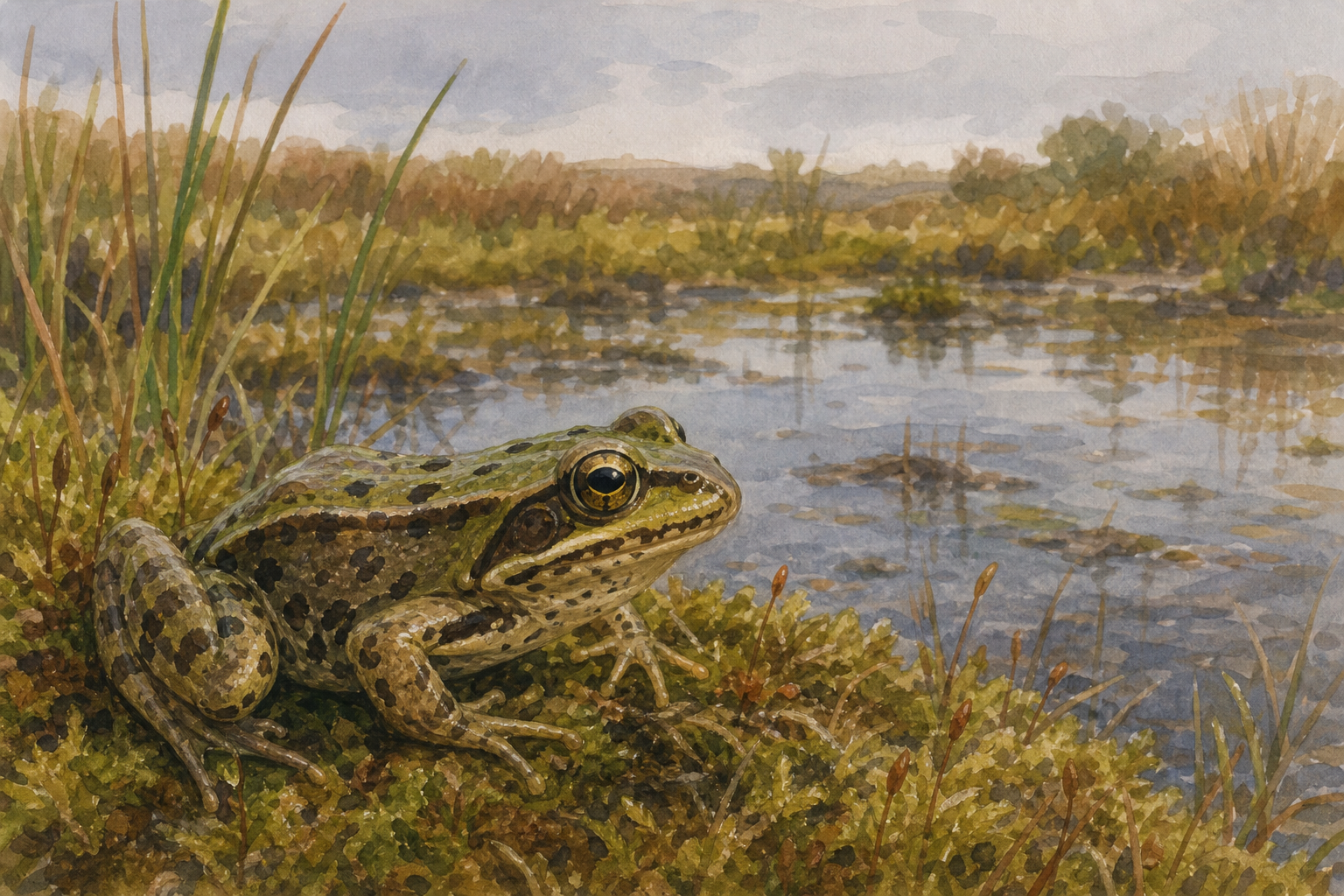 Look at this frog and this seal side by side. One lives in a wet bog. One lives in cold sea water. What do you notice about their bodies that might help them where they live?
Scientists who walk Irish bogs and shores ask this same question.
Show the frog photo card and the grey seal photo card side by side on the IWB (or hold up both printed cards together so the class can see both animals at once). Keep the hook light: one short compare, then hands up.
Key questions: What is different about their feet or bodies? Why might that matter in a bog pool versus the Atlantic?
What to expect: pupils often name colour or size first. Gently steer them toward features that do a job (webbed feet, thick blubber, streamlined shape).
Have the habitat mats face-down for later. Do not hand out the full card sets yet.
2 - Features That Help Survival ~8 mins
 A frog's webbed feet help it live in a wet bog. That helping feature is called an adaptation. The bog is its habitat. Webbed feet are one feature we can notice and name.
Watch me match the frog to an Irish bog and say how each feature helps. Join in when I ask: which feature do you think matters most, and why?
Board stays short: three bold terms with the frog line only. Teach from the table and the worked match below. Fold the class into the model: pause after "I predict" for a 20-second pair talk ("Name one feature you think will matter"), take two quick hands-up answers, then finish the match aloud.
| Concept | Why it matters | Example |
|---|---|---|
| Adaptation — a feature of a plant or animal that helps it survive in its habitat | It explains why living things look and behave differently in a bog, on the coast, or in a hedgerow | A grey seal's thick blubber keeps heat in cold Irish sea water |
| Habitat — the place where a living thing finds food, water, shelter and space | If the habitat changes, the features that once helped may no longer be enough | An Irish bog is wet, soft and open; a rocky coast is salty and windy |
| Feature — a body part or way of living we can notice and name | Naming the feature is the first step before we can say how it helps | Webbed feet, waxy leaves, camouflage colour, spines, a holdfast |
Worked match (model aloud before groups start)
Hold up the frog card. Think aloud the full cycle so pupils hear every beat:
- I wonder: What helps this frog live in a wet Irish bog?
- I predict: Pause here. "Turn to your partner: which feature do you think will matter most?" Take two answers, then continue: I think its webbed feet and moist skin will matter most, because bog pools are wet and soft.
- I check the features: webbed feet for swimming and pushing through water; moist skin that needs damp places; strong back legs for jumping between pools; green-brown colour that blends with moss and reeds.
- I match: these features suit a bog or pond edge, not a dry stone wall or open sandy beach.
- I think: the frog is adapted to wet ground. If the bog dried out, those same features would not help it as well.
Misconception to head off: children may say animals "choose" features or "want" to change. Features are already part of the living thing; over long time, the ones that help survival are the ones we still see. Keep it gentle and age-right: we are matching features to jobs, not teaching evolution in depth.
Nature of STEM: once you look, the same idea shows up all over Irish wildlife. Naturalists walking the boardwalk at Clara Bog, or checking rock pools on a local strand, still match features to habitat when they survey a place — bog plants with waxy or tough leaves, coastal animals that hold heat or grip rock, hedgerow animals that hide or defend.
3 - Match Features to Habitats ~15 mins
In your group you have 8 living-thing cards. Match each one to the habitat it suits best: Irish bog, Irish coast, or Irish hedgerow. For every match, name one feature and say how it helps. You may use the feature reminder cards on your table. Be ready to share one match with the class.
Before the lesson
Print the provided card pack: one set of living-thing cards, feature reminder cards and three habitat mats per group (full card wording is ready below for the print pack). Cut the living-thing and feature cards apart. Store each group's set in an envelope or wallet for reuse. Real feathers or tough leaves are optional extras if you have them safely available.
Printable card content (provide in full for the print pack)
Habitat mats (one of each per group)
- Irish bog: wet, soft ground; pools and moss; few tall trees; often windy and open.
- Irish coast: salty spray; rock pools or sand; strong wind and waves; tide comes and goes.
- Irish hedgerow: mixed bushes and trees along a field edge; insects and berries; shelter and shade; soil that can be damp or dry.
Living-thing cards (print all eight; one set per group)
- Common frog: moist skin; webbed back feet; strong jumping legs; green-brown colour. Lives near water and wet ground.
- Heather: small tough leaves; woody low stems; purple flowers later in the year. Grows on open, poor, often wet or peaty ground.
- Grey seal: thick blubber under the skin; smooth streamlined body; flippers; can close nostrils. Spends time in cold sea water and on rocks.
- Bladderwrack seaweed: tough fronds; air bladders that help it float up toward light; a holdfast that grips rock. Lives on the shore where the tide moves.
- Hedgehog: sharp spines; can roll into a ball; snout for sniffing insects; mostly active at night. Lives in gardens, field edges and hedgerows.
- Oak tree: deep roots; thick bark; broad leaves that catch light; strong wood. Grows in hedgerows and woodland edges with deeper soil.
- Oystercatcher: long strong orange beak for opening shellfish and probing sand or mud; long legs; bold black-and-white feathers. Feeds along the shore.
- Holly: thick waxy leaves with prickly edges; berries on some plants; evergreen through winter. Common in Irish hedgerows and woodland edges.
Feature reminder cards (shared reference, one small set per group)
- Webbed feet — push through water
- Waxy or tough leaves — hold water in or stand up to salt wind
- Camouflage colour — harder for hunters or prey to see
- Thick blubber or dense fur — keeps heat in cold places
- Spines or prickles — put off animals that might eat it
- Holdfast or strong roots — stay fixed when wind, water or soft ground pulls
- Long beak or snout — reach food others cannot
- Streamlined body — move easily through water
How to run it
Groups of three or four. Give 10 minutes to sort, then 5 minutes of whole-class shares. Circulate and push for the how it helps sentence, not just the habitat name. Point groups to the feature reminder cards if they stall on naming how a feature helps.
Look-fors: every card has a habitat; pupils name a real feature; they link feature to a condition of that habitat (wet, salty, cold, sheltered).
Differentiation: offer a sentence stem on the board — "This feature helps because…". Confident groups can split a living thing across two habitats if they can justify both (e.g. heron-type birds at bog edges and wet fields) — for this set, keep oystercatcher on coast and frog on bog.
Suggested answers (flexible, accept good justifications): frog and heather → bog; grey seal, bladderwrack, oystercatcher → coast; hedgehog, oak, holly → hedgerow.
If you have real feathers or leaves, pupils may touch them gently, then wash hands before the next step.
4 - Mystery Creature: Where Does It Live? ~8 mins
Here is a mystery living thing. Its features are on the board so you can re-read them. With your group, decide its most likely Irish habitat: bog, coast or hedgerow. Be ready to say why, using at least two features you can point to on the list.
Display-only discussion with a clear evidence beat. There is no on-screen interactive on this step: project Mystery Creature A's feature list on the IWB (or pin the prompt card where every group can see it) so pupils can re-read and point at evidence while they decide. Read the list aloud once, then leave it visible. Give groups two minutes to decide before hands up. If time allows, swap the board to Mystery Creature B with a different group leading the reasons.
Mystery Creature A (use first — leave this list on the IWB)
Features:
- a hard outer shell that clamps tightly to wet rock
- a rough tongue for scraping tiny plants off stone
- can seal a little water inside when the tide goes out
- lives where waves splash and salt spray hits
Most likely habitat: Irish coast.
Reasons to draw out: clamping shell and salt spray point to rocky shore, not soft inland bog or a dry hedgerow; sealing water inside fits the tide going out.
Mystery Creature B (extension or second round — swap onto the IWB)
Features:
- long thin legs that spread its weight on soft wet ground
- a long thin beak for probing soft mud for worms
- mottled brown colour that blends with reeds
- nests in damp grasses beside shallow pools
Most likely habitat: Irish bog (or wet bog edge).
Reasons to draw out: soft wet ground and shallow pools rule out open dry stone walls; long legs and probing beak fit mud and reeds, not a windy salt rock face alone.
Optional stretch mystery (if a group finishes early — show on board or hand a prompt card)
Features:
- large eyes for seeing in dim light
- soft quiet feet for moving without a sound
- hides in thick bushes by day
- hunts small mammals and beetles at night along field edges
Most likely habitat: Irish hedgerow.
Prompts: Which two features convinced you? Which habitat would be hardest for this living thing, and why? Could any feature fit more than one place?
Misconception: one feature alone is rarely enough. Model weighing two or three features together. These mysteries are not the same animals from the card sort, so groups must reason from features rather than name a card they already held.
Fold the whole class in while one group speaks: "Do you agree? What evidence would change your mind?"
Focus question: Which Irish habitat does this mystery living thing most likely live in, and which features are your evidence?
5 - Build a Best-suited Living Thing ~12 mins
Your group gets one Irish habitat. Together, design one living thing that would be well suited to live there. Choose at least three features and say how each one helps. Draw and label your group's design on one shared sheet of plain paper.
Paper design task only: there is no on-screen interactive on this step. Deal one habitat mat per group (bog, coast or hedgerow) so the room has a mix. Groups invent one shared living thing — it can be plant-like or animal-like — but every feature must earn its place. One labelled drawing per group keeps the task inside 12 minutes. Use the board only for the success criteria and focus question.
Success criteria to say aloud (and leave on the board)
- At least three labelled features
- Each feature linked to a real condition of that habitat (wet, salty, windy, sheltered, cold, soft ground)
- No magical powers — keep it grounded in the kinds of features we matched earlier
Focus question
Which three features would help a living thing survive in your assigned Irish habitat, and how does each one help?
Quick model (30 seconds)
"If my habitat is coast, I might give mine a holdfast or strong grip for rocks, a tough outer covering against salt spray, and a way to trap or find food when the tide goes out. I would not give it thin dry-only leaves that need calm woodland shade."
Materials on tables
One sheet of plain paper per group, pencils, colouring pencils or crayons. Scissors and glue only if groups want to cut simple shapes from scrap paper — optional, not required.
Support and stretch: every group can draw and label three features. Groups that finish early can add one trade-off ("this thick blubber helps in cold water but would make moving on land slower") or design a plant instead of an animal.
Watch for: features copied from the wrong habitat with no link; decoration with no survival job. Ask: "How does that feature help on a windy salt shore / in soft wet bog / under a thick hedge?"
Prompts while circulating:
- Name three features and say how each helps in this habitat.
- Is every feature linked to a real condition (wet, salty, windy, sheltered, cold, soft ground)?
- Would any of these features struggle in this habitat, and why?
In the last two minutes, two or three groups hold up their shared design and name one feature only — save full reasons for the journal and the make-sense step.
Unlock the full learning experience
You're previewing this lesson. Get full access to this lesson and hundreds more — each one ready to teach, with interactive activities, printable resources and pupil progress tracking built in.
This lesson is copyright of Coding Ireland 2017 - 2025. Unauthorised use, copying or distribution is not allowed.