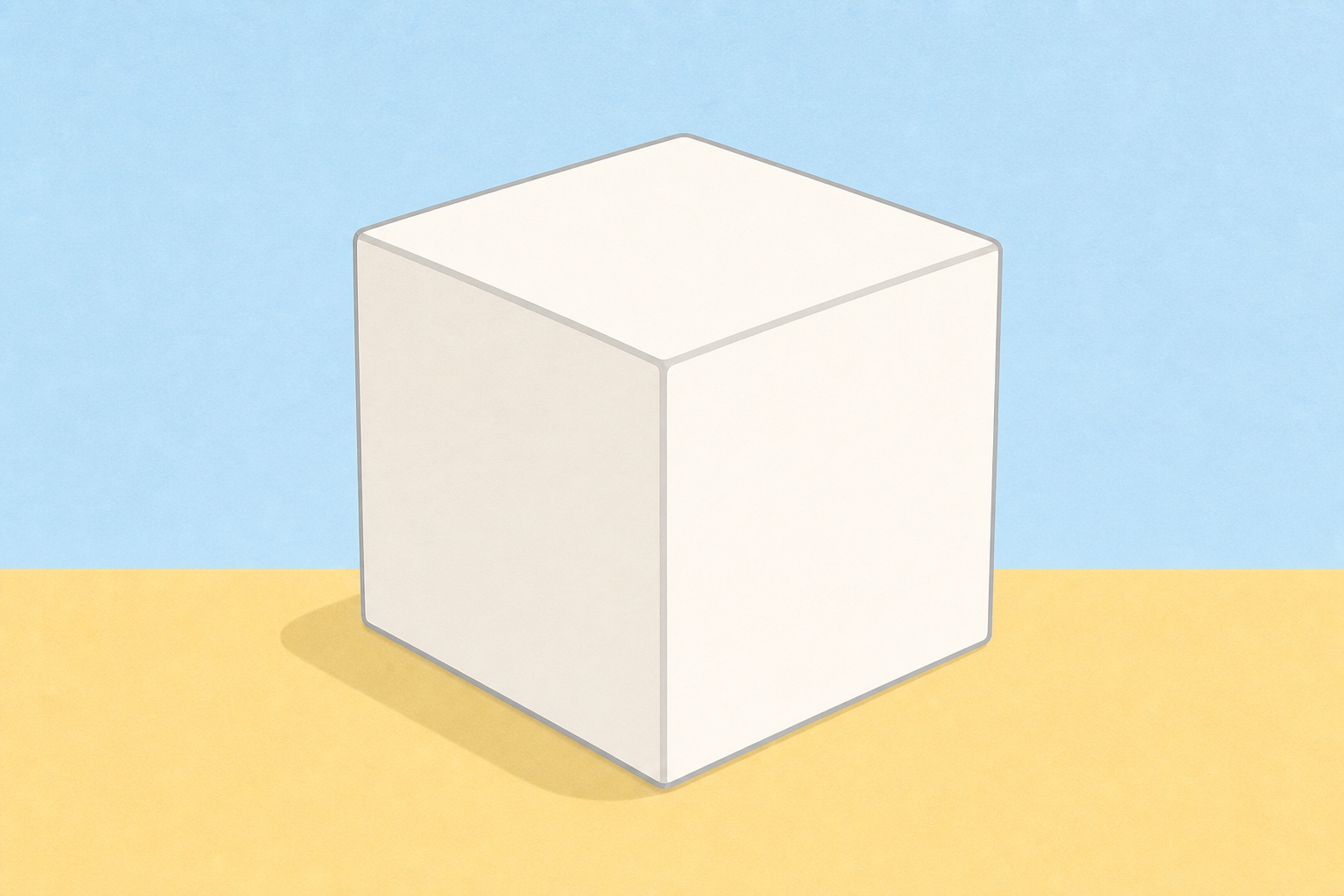
Hold a dice in your hand. Can you point to a flat part? Now find a line part. Now find a pointy part. Every solid shape is made of these three things, and today we are going to name them.
Hold up a real dice (or a cube) and run your own finger over a flat side, then along a line where two sides meet, then onto a corner. Take two or three hands-up answers pointing at each part before naming anything.
Look at each solid on the board. A face is a side of the solid, flat or curved. An edge is the line where two faces meet. A corner is the point where edges meet. Watch how many of each the cube has, then the cuboid, then the cylinder, then the cone. The last two catch people out.
Today we work through these solids together on the board: first the cube, then the cuboid, then the cylinder, then the cone. For each one, a pupil taps every face, then every edge, then every corner to tally how many there are. As the group's solid is passed round, check the count against it, or against the shape shown on the board.
Talk this one through together — pupils take turns at the board, the class agrees or corrects out loud, and no marking yet.
Rotate a pupil for each solid. As one pupil taps to tally on the board, the group's real solid is passed round for the others to check against. Between solids, keep the watching class working: ask the room to predict the next count before the board pupil taps, take two hands-up answers, and revoice a strong one. Listen for pupils double-counting an edge or missing the hidden back faces — have them turn the solid right round before deciding they are finished.
In your maths copy, rule a simple table with three columns headed faces, edges and corners. Then fill in the row for a cube, counting from your group's dice in turn.
Walk the room glancing that the three column headings are ruled and the cube row is being filled from counting a real dice (shared round the group) or the cube on the board, not from memory — this is whole-class copybook practice, not marking.
Answer each question on the board in turn. The last one, how many corners a cone has, is the tricky one. Before checking, the pupil at the board says what counts as an edge and the class agrees. Then that pupil taps the answer on the board and presses Check.
This is the practice round — pupils take turns at the board, the class agrees each answer aloud, and the board pupil presses Check before moving on. Keep the board work brisk rather than over-explaining.
The cone corner is the make-or-break: it has only one, at the point. When the class reaches it, ask them to explain why a cone has a corner but a cylinder does not before the answer is checked.
You're previewing this lesson. Get full access to this lesson and hundreds more — each one ready to teach, with interactive activities, printable resources and pupil progress tracking built in.