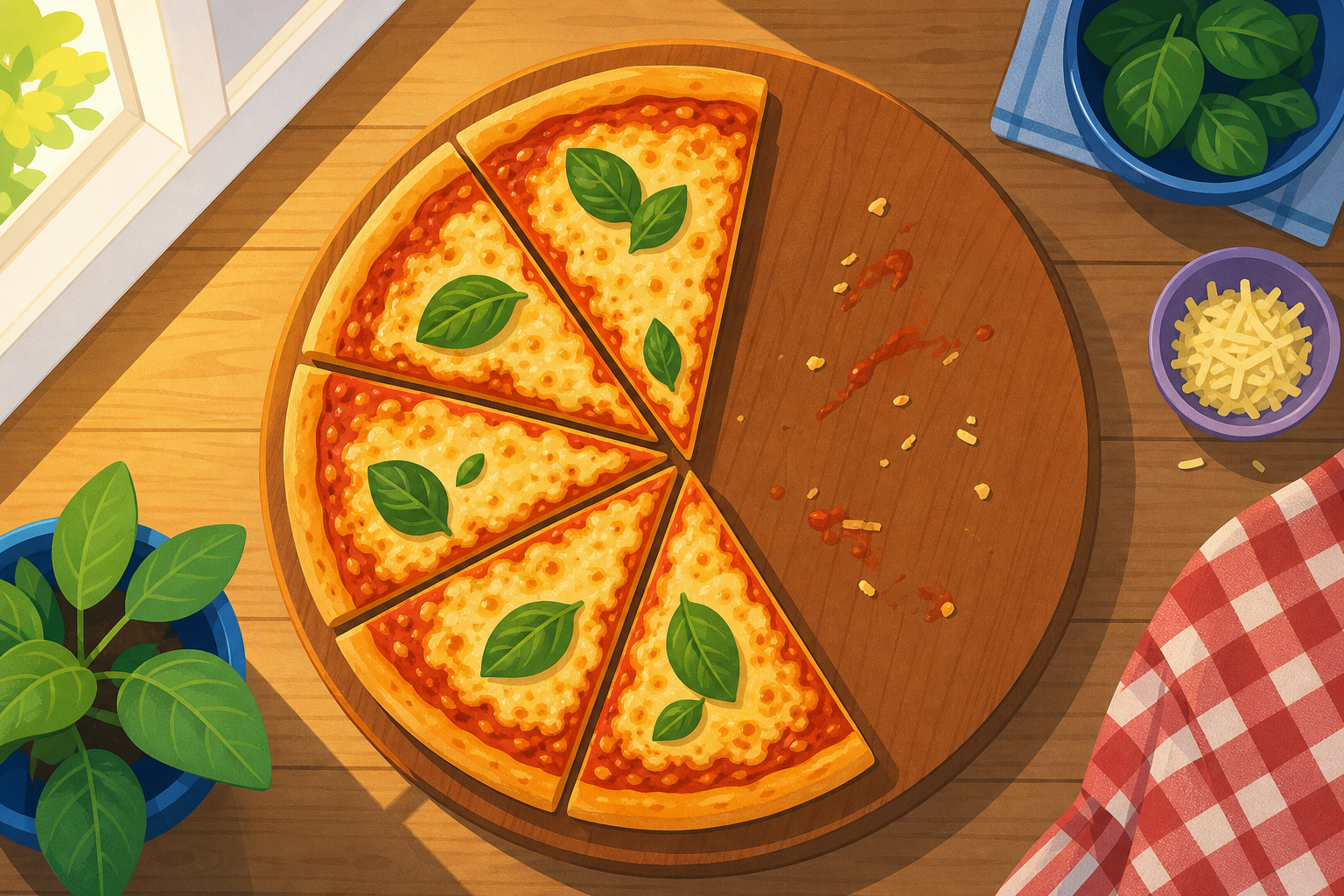
Look at this pizza. It was cut into eight equal slices for a family dinner, and three slices have already been eaten. What fraction of the pizza is left? What fraction is gone? Hands up.
Display the pizza image on the IWB as pupils settle. Take three hands-up answers, not open call-outs.
Keep the talk on 'how many slices total' (8) and 'how many gone vs how many left' (3 gone, 5 left). The fraction language (5/8 left, 3/8 gone) will emerge in Watch and Notice — don't push for it here.
Watch four pizza fractions in turn. For each one, notice the bottom number first — how many equal slices the whole pizza was cut into — then count the shaded slices to read the fraction.
Walk the four examples in order, one at a time.
Do not move on from 7/12 until the class can name it aloud: 'twelve equal parts, seven shaded — seven twelfths.'
Now we explore the pizza slicer together. Three pupils will take a turn at the board — one each for 1/3, 2/5 and 3/7. The watching class has a job on every fraction:
Three short engagement beats per fraction — ask the class to name the denominator, thumbs for equal slices, ask the class to name the fraction. This keeps the watching class active without crowding the pupil at the board.
Three different denominators to walk: 1/3, 2/5, 3/7. Each time, ask the class on the thumbs beat: 'are all the slices the same size?' — this is the bottom-number-equals-size-of-parts rule we will revoice at the wrap.
Rotate three pupils to the board, one per fraction. The 3/7 example is the trickiest — seven slices don't fall into a neat clock-face pattern. Narrate this slowly: 'seven equal slices, three of them shaded — that's three sevenths.'
This round is for talking it through together — no marking yet; pupils start checking their own answers in the Class Challenge that follows.
In your maths copy, sketch each pizza fraction as a circle divided into the right number of equal slices and shade it. Label each fraction underneath.
Walk the room glancing at the three sketches — this is whole-class copybook practice, not marking. The 5/8 circle is the one to check; pupils often crowd the eight wedges on one side. A quick tip aloud: cut the circle into quarters first, then halve each quarter, and you have eight roughly equal slices in seconds.
The 7/12 example stays on the board only — twelfths are tricky to draw freehand, and we have already done them together in Watch and Notice.
Today's challenge is at your seats with paper strips. You will work on two strips.
Take a fresh strip. Hold it up at eye-line and mark roughly where one-third would fall. Fold there, then check by eye that all three pieces look the same size. Refold and try again until they do.
This round is the practice bank — pupils work the folding tasks at their seats; circulate and check each fold lands on equal parts before they shade. Keep the folding brisk rather than over-explaining.
Hand out three paper strips per pupil from the fraction_strips printable (Strip 1, Strip 2, plus a spare). The thirds fold is the deliberate stretch — pupils estimate, fold, check, refold, refine. The message is 'thirds are harder than halves and quarters', which sets up Lesson 32 on equivalence.
Look for the misconception: an uneven fold ('three pieces but one is bigger'). The fraction name only works if the parts are equal — head this off out loud the moment you spot it. Quick fix: open the strip back out, refold along the existing crease as a reference, then re-attempt.
The labelling convention is deliberate: unit fractions (1/2, 1/4, 1/8) name the SIZE of each section; the '3/8 shaded' note names HOW MUCH is shaded. Pupils should see both ideas living together on the same strip.
You're previewing this lesson. Get full access to this lesson and hundreds more — each one ready to teach, with interactive activities, printable resources and pupil progress tracking built in.