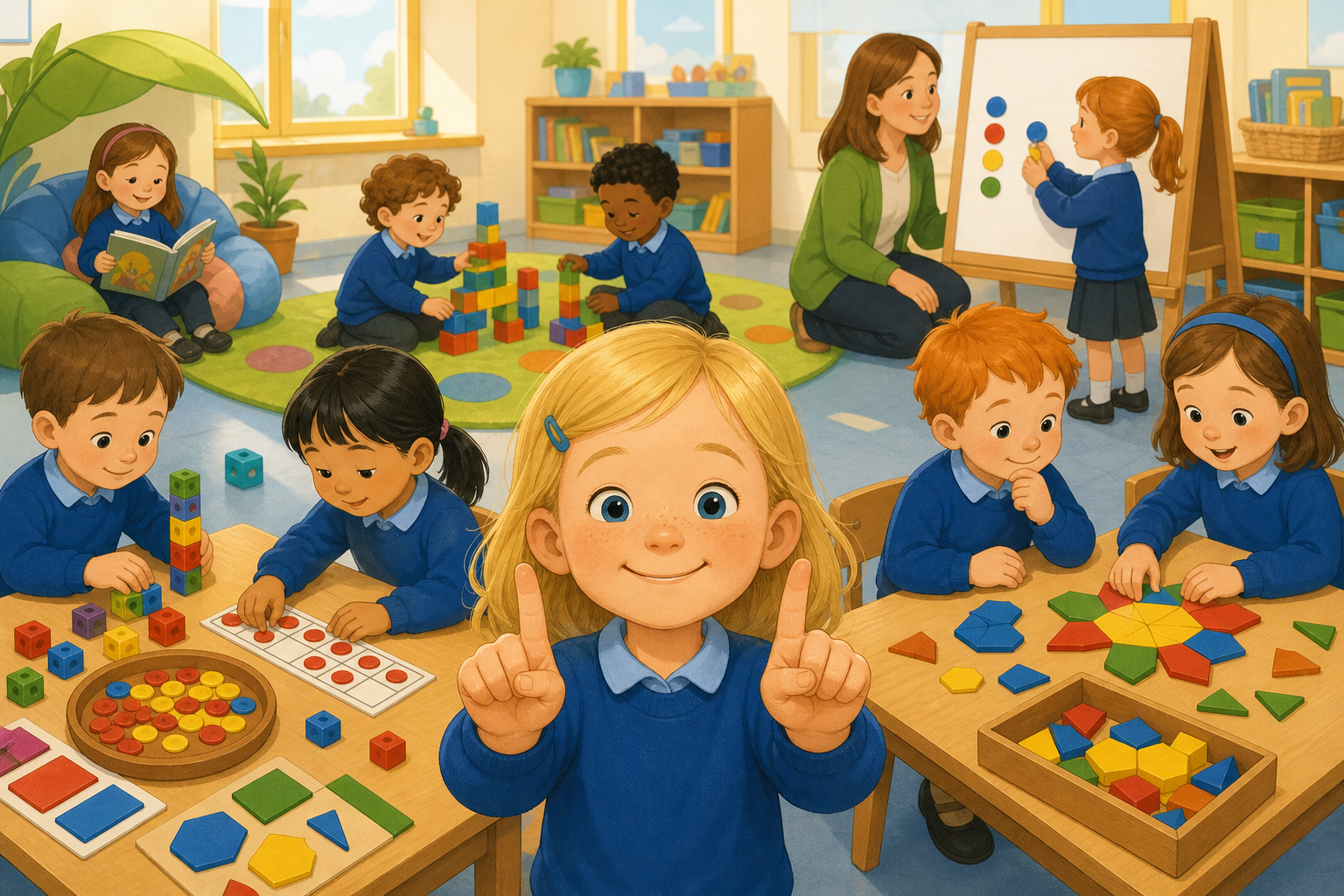
 Let's sing "Two Little Dicky Birds". Hold up one finger on each hand: they are the two birds.
Two little dicky birds, sitting on a wall,
One named Peter, one named Paul.
Fly away, Peter! Fly away, Paul!
Come back, Peter! Come back, Paul!
Where do you have two of something on your own body?
Watch the ten-frame. First there is one counter, all by itself.
Now one more comes along, and there are two. Count with me: one, two.
Show me two fingers.
Today we build two on the frame together: first one counter, then one more makes two.
One person comes up to drag the counters into the frame. Everyone else watches the board, counts out loud with me, one, two, and shows me two fingers.
Build two on the frame
A pair is two things that go together.
This is your pair mat, with two spaces on it. Go on a pairs hunt at your table.
Put two things on your pair mat: two cubes, two beads, two lolly sticks.
Show me your two.
Hands-on Task
Unlock the full learning experience
You're previewing this lesson. Get full access to this lesson and hundreds more — each one ready to teach, with interactive activities, printable resources and pupil progress tracking built in.
This lesson is copyright of Coding Ireland 2017 - 2026. Unauthorised use, copying or distribution is not allowed.