Look at this: 73 − 28.
If you had to do it in your head right now, would you count up from 28 until you reach 73, or would you start at 73 and take 28 away?
Hands up — which feels easier? There is no wrong answer. We will meet both ways, and a third way, before the end of the lesson.
Take three hands-up answers, not open call-outs. Give five seconds of quiet think-time before any hands go up. Resist explaining yet — the rival strategies are the whole lesson; this is just to make pupils notice that subtraction has more than one route.
Watch three subtractions on the number line. The same subtraction can be done two different ways — and a bigger subtraction tells us when one way fits better than another.
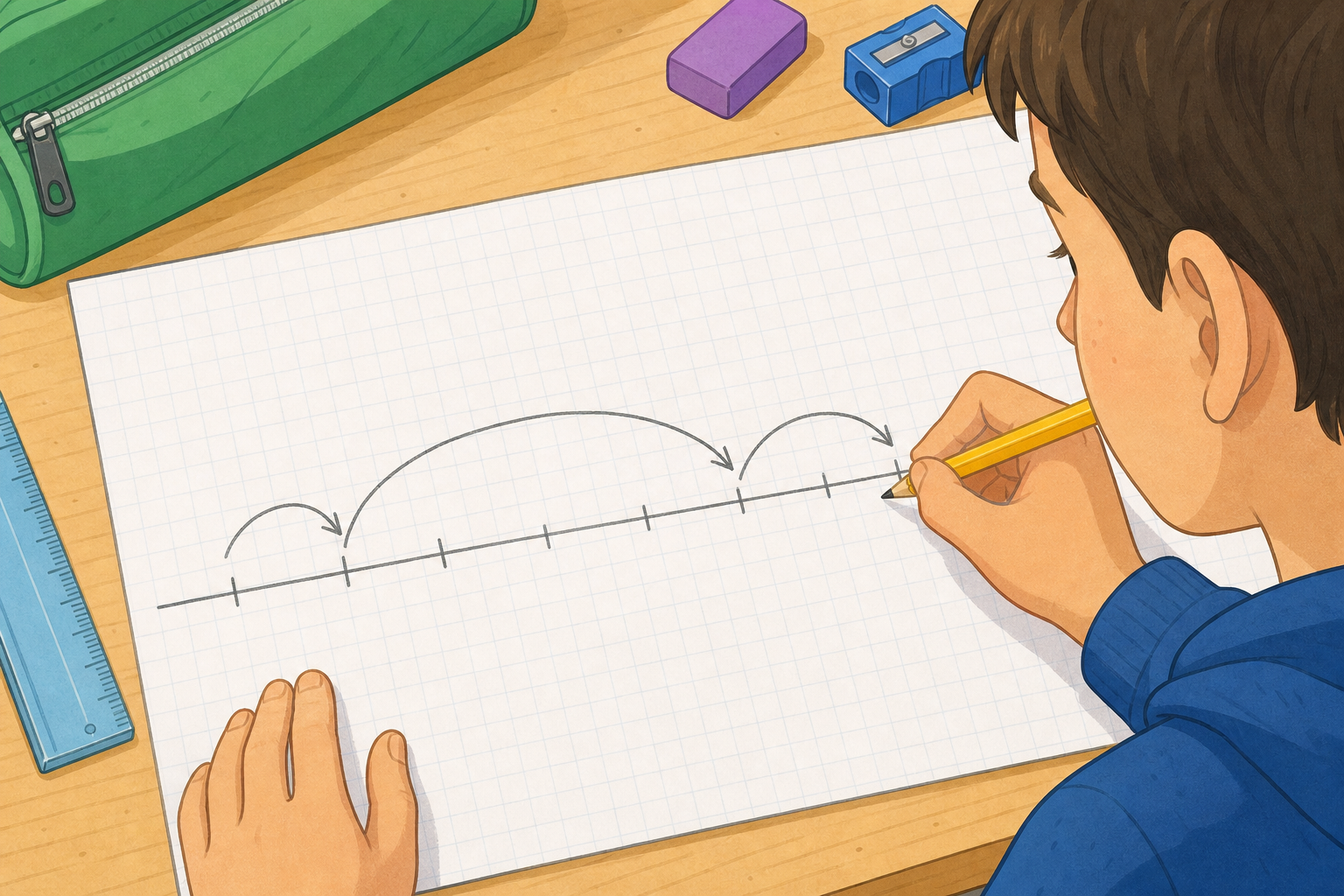
Start at 28. Jump forward to 30 (+2), then to 70 (+40), then to 73 (+3). The forward jumps total 45 — that is the answer.
Counting-on works best when the two numbers are close together — the gap is small enough to hop across in a few friendly jumps.
Start at 73. One single back-jump of 28 lands you on 45. Same answer, completely different picture.
Take-away works best when the number you are subtracting is small and easy to hold in your head as one back-jump.
Now the numbers are bigger. Break 178 into 100 + 70 + 8 and take each chunk away in its own back-jump.
Decomposition works best when the numbers are bigger or messier — breaking the subtraction into place-value chunks is friendlier than one massive back-jump.
Walk the three snapshots in order, one at a time. Pace yourself — pupils need to see each jump arc land before the next one fires, and they need the short 'works best when…' line landing in plain English after each one.
Today's exploration on the number line: for each subtraction called out, pick a strategy that you think fits — counting-on, take-away, or decomposition. Sometimes more than one works, and that is fine — be ready to say why you chose yours.
One pupil at a time comes to the board, names their chosen strategy out loud, and drags the jumps. Before they touch the screen, think which strategy you would choose — you might pick a different one.
Starters to work through: 65 − 39, 84 − 27, and 412 − 246.
This round is for talking it through together — pupils take turns at the board and the class agrees or corrects out loud.
Before each board pupil drags, take a quick prediction from the class — which strategy would you choose here, and why? Hear one or two, then let the pupil at the board show their route.
Force the board pupil to name their strategy first before they touch the screen. The naming is the thinking — if they jump straight to drawing, pause them and ask 'which strategy?'
In your maths copy, work each subtraction below using a different strategy (count-on, take-away, decomposition) and label which strategy you used next to your answer.
Walk the row glancing at the strategy labels — this is whole-class copybook practice, not marking. The label matters as much as the answer; if a pupil writes the answer with no label, point at the empty space and move on.
Six minutes is roughly two minutes per subtraction, which gives weaker pupils breathing room for the labelled decomposition of 305 − 178. If most of the class is finished early, ask the room 'which one felt easiest? which felt hardest?' — that lands the strategy-choice point one more time before the Class Challenge.
Today's bank: subtraction-bonds fact-race. Four rounds, one minute each. One pupil at a time comes to the board to type the answer; the rest of us call out the answer together before they type.
This round is the practice bank — pupils take turns at the board, check each answer, and the class confirms before moving on. The same 4-round bank reruns at home as tonight's homework, so keep the board work brisk rather than over-explaining.
Run the rounds in order. Between rounds, ask one quick question: 'which strategy fits these best?' — bonds-to-20 lend themselves to counting-on, bonds-to-100 to take-away from a hundred, and mixed two-digit subtractions to whichever feels efficient. Don't let any round drag past sixty seconds.
Strategy talk over score: if a pupil gets a fact wrong, ask the class which strategy might have worked — not just what the answer is. The fluency is downstream of the strategy choice.
You're previewing this lesson. Get full access to this lesson and hundreds more — each one ready to teach, with interactive activities, printable resources and pupil progress tracking built in.