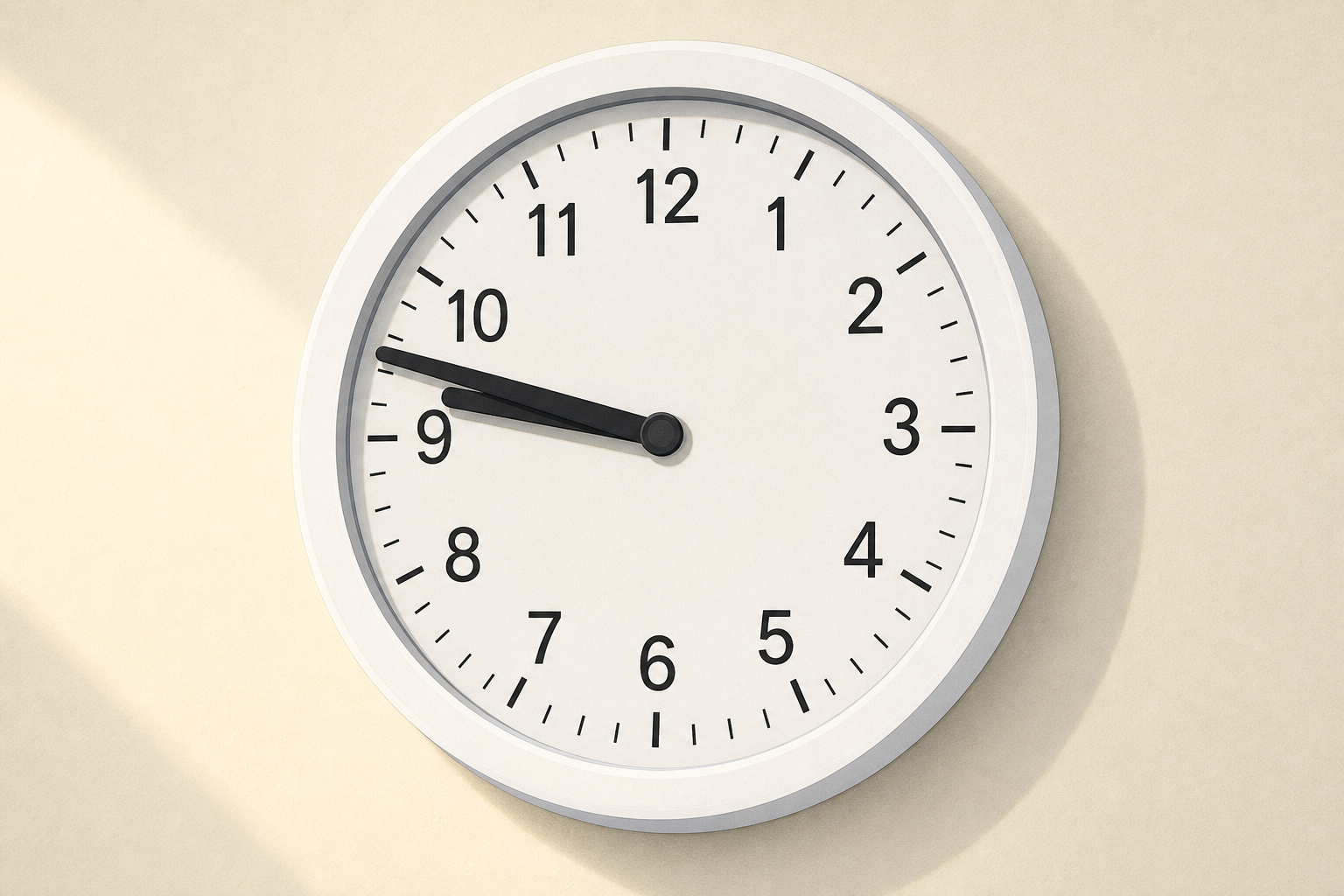
Look at the clock above. What time does it say? How can you tell?
A quick glance might say nearly ten. A careful look might say something else. Today we are going to read every minute of every hour, including the trickier 'almost-the-hour' times that can trip us up.
Hold the question open for about two minutes before any reveal. Take three or four readings from the class first, and listen specifically for the common error: a pupil who glances and says 'ten o'clock' or 'nearly ten'. Do not correct yet; let the class hear the disagreement.
Then name the time aloud yourself: 'It is nine forty-seven.' Do not explain why the hour is still 9 at this point. That is what the next step is for. The whole lesson hinges on the hour does not turn over until the minute hand reaches 12; you will return to this every step.
Now we will read three more times together. Watch each clock face and listen for which detail tells you the hour and which detail tells you the minutes past.
The minute hand points at the 3 of the face. Three fives counted from the 12 makes fifteen minutes past the hour. The hour hand has only just crossed the 3 and barely moved.
This is the trickiest read. The minute hand sits just before the 11 of the face, at fifty-three minutes past. But look at the hour hand: it is so close to the 8 that a quick glance might trick you into saying eight o'clock. It is not eight yet. The minute hand has not reached the 12.
The minute hand has only just left the 12. The hour hand still points at the 12 too. Both hands look almost the same, but only one minute has passed.
Walk each clock face aloud, one at a time, and pause before each reveal.
Do not move on until the class can articulate the hour-hand rule in their own words — it carries the whole lesson.
Now we set times on the clock together. The teacher will call a time like 'twenty past four' or 'five to nine', and one pupil will come up to drag the hour and minute hands into place.
The watching class has a job too. Before each pupil drags the minute hand, think where it should land. Then the teacher will ask one named pupil where the hour hand should sit — between which two numbers — before the pupil at the board moves it.
Today's bank: 4:20, then 8:55, then 6:42, then 11:30, then 2:05. Rotate five pupils.
This round is for talking it through together — pupils take turns at the board and the class agrees or corrects out loud.
Call each time in words (not in digits) so pupils have to translate before they touch the hands: 'twenty past four', 'five to nine'. Run each round in the same rhythm:
Watch especially for the 8:55 round, where some pupils will pull the hour hand all the way back to the 8 instead of leaving it near the 9 (since five to nine is still in the eight o'clock hour ending). Revoice with the rule: 'the hour hand only moves because the minute hand is moving — it never jumps on its own.'
If the pupil at the board places the hands quickly, thank them, keep the round moving, and ask the next named pupil to predict the next time silently while their classmate comes up. Do not break the IWB flow.
In your maths copy, sketch four small clock faces. Each one is just a circle with a 12 written at the top. For each of today's four times, mark the hour hand and the minute hand on one clock, and write the time digitally underneath. The four times are:
Take your time on 12:01: both hands look very similar, but they tell different stories.
Walk the room glancing at the hour hand on each sketch — this is whole-class copybook practice, not marking. Look for pupils drawing the hour hand still pointing at the 7 on 7:53; gently remind them the hour hand has crept nearly all the way to the 8 by then. On 12:01 watch for pupils sketching both hands in identical positions; nudge with 'where exactly is the minute hand pointing?'
Now we set six times on the clock together as a class challenge. The teacher sets the first time with the class, then pupils take turns at the board to set each remaining time while everyone reads and checks.
Today's bank runs from easy on the hour up to a 'hour-hand halfway' stretch at the end:
This round is the practice bank on the board. Set the first time (2:00) with the class to model reading the target and placing both hands, then send pupils up one at a time for the rest while the class predicts each placement before the reveal. The on-screen homework practice that follows this lesson uses a different set of times, so pupils can practise reading on their own at home.
Walk the class through these traps as they come up:
If a pupil sets a time quickly, ask the next named pupil to read the displayed time back before you move on to the next challenge.
You're previewing this lesson. Get full access to this lesson and hundreds more — each one ready to teach, with interactive activities, printable resources and pupil progress tracking built in.