Quick shopping puzzle. A shop sells two bottles of water side by side. One label says 0.5 litres. The other label says 0.50 litres. A customer thinks she's being tricked — one must hold more than the other. The shopkeeper says they hold the same amount. Who is right? And while we're at it: a price tag reads €1.05. What would happen if we rubbed out that little zero?
Pose the bottle puzzle first, then the price-tag question. Take two or three hands on each; don't settle the argument yet. Tell the class 'hold your verdict — we'll know for sure by the end of the lesson.' If a pupil claims €1.05 and €1.5 are the same, revoice without correcting: 'interesting — let's see by the end whether that zero is doing any real work or not.'
Look at four numbers already on the place-value mat. The columns at the top are U for units, t for tenths and h for hundredths. Each big flat is 1, each rod is one tenth, each small cube is one hundredth. Read each number aloud as you look at it.
Three rods in the tenths column. No flats, no small cubes.
Two rods and seven small cubes. Two tenths and seven hundredths together make twenty-seven hundredths.
One whole flat, no rods, five small cubes. The empty tenths column is doing important work: it holds the place.
Two flats and three rods. The hundredths column is empty — and 2.30 is the same number as 2.3.
Walk each example aloud, one at a time, pausing for pupils to predict before you confirm.
Your turn at the board. We'll build a few more decimals together: when a number is called out, one of you comes up to drag the blocks into the U, t and h columns, and the rest of us check the build out loud before we agree.
This round is for talking it through together — pupils take turns at the board and the class agrees or corrects out loud.
Call four to six decimals in a deliberate sequence — for example 0.6, then 0.45, then 1.02, then 0.80. After each build, ask 'is that right? how do you know?' before confirming. Listen especially for pupils naming 0.45 as 'naught point forty-five' instead of 'naught point four five' or 'forty-five hundredths'; revoice every single time. The 1.02 build is your chance to lock in the lesson 2 takeaway: the zero in the tenths column is holding the place.
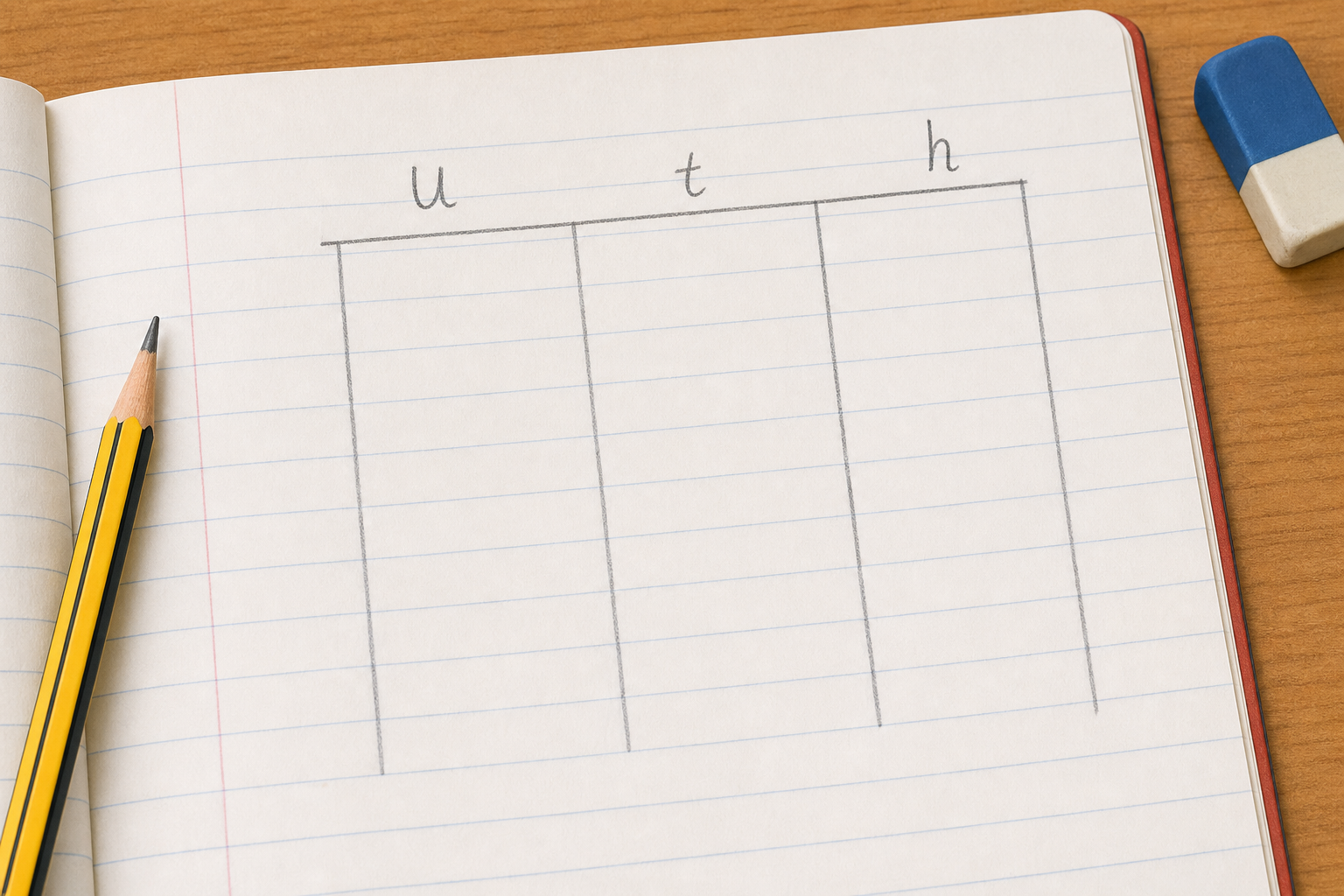
In your maths copy, sketch three place-value columns and label them U, t, h at the top. Then write each of these decimals into the columns, one number under the other, with the digits in the matching columns:
Read each one aloud to yourself after you write it.
Walk the row glancing at column alignment and the U/t/h labels — this is whole-class copybook practice, not marking. If a pupil writes 1.05 with the 5 sitting under the tenths column rather than the hundredths column, point at their U/t/h headers and ask 'where does the 5 go?' rather than fixing it for them.
Today's bank: 0.06 → 0.4 → 0.43 → 1.07 → 2.50. The zeros catch people out — say what each one means before you check it.
This round is the practice bank — pupils take turns at the board, check each answer, and the class confirms before moving on. The same 5-problem bank reruns at home as tonight's homework, so keep the board work brisk rather than over-explaining.
Watch for zero handling on every one:
You're previewing this lesson. Get full access to this lesson and hundreds more — each one ready to teach, with interactive activities, printable resources and pupil progress tracking built in.