1 - Introduction
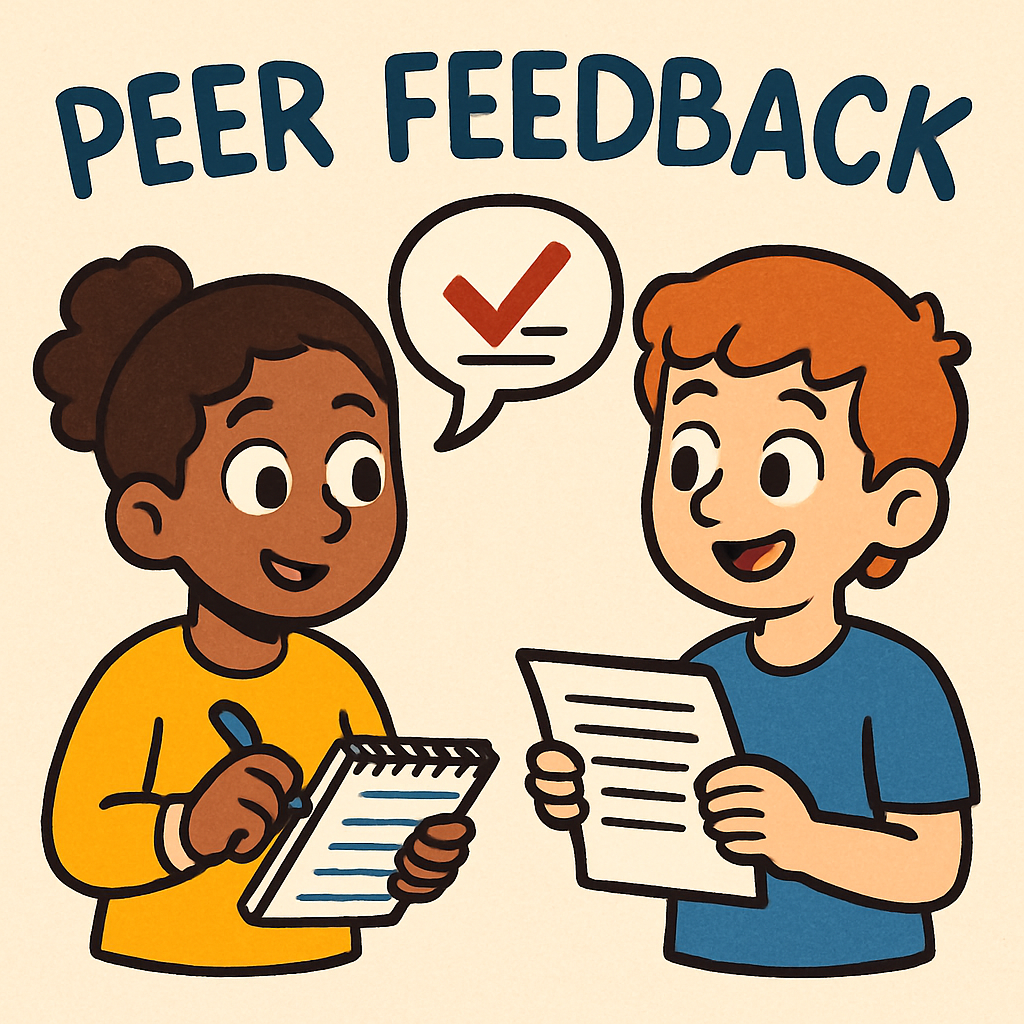 Understanding the Purpose of Peer Feedback
In this lesson, you will explore the process of giving and receiving peer feedback on your Classroom-Based Assessment (CBA) projects. Peer feedback involves classmates reviewing each other's work to provide helpful insights. The primary objective is to enhance the quality of your digital media project by identifying strengths and areas for improvement, rather than merely highlighting errors. Through respectful exchange of ideas, you can refine your project to achieve a higher standard.
It is important to recall that your CBA project will be assessed according to the Features of Quality. These criteria encompass several key areas:
- Research and Source Evaluation: Ensuring your information is accurate and sources are critically assessed.
- Application of Digital Media Tools: Demonstrating effective use of tools to create your project.
- Communication and Design: Presenting information clearly and engagingly.
- Creativity and Originality: Incorporating unique ideas and innovative approaches.
- Reflection and Digital Citizenship: Considering ethical aspects and responsible online behaviour.
Feedback should be directed towards these areas to assist you in reaching descriptors such as 'Above Expectations' or 'Exceptional'.
Guidelines for Providing Effective Peer Feedback
To ensure feedback is beneficial, adhere to these formal guidelines:
- Be specific: Clearly identify what is effective and what requires enhancement, supported by relevant examples. For instance, instead of saying 'This is good,' explain 'The use of images effectively illustrates the topic of digital ethics.'
- Be respectful: Direct comments towards the project content, avoiding any personal remarks about the creator.
- Be constructive: Provide actionable suggestions for improvement, rather than simply noting issues. For example, suggest 'Consider adding a section evaluating the reliability of your sources to strengthen the research criterion.'
During this lesson, you will utilise a Peer Feedback Worksheet to document your written feedback. This worksheet is designed to align directly with the Features of Quality, ensuring your comments are structured and relevant.
Receiving Feedback Gracefully
When receiving feedback, approach it with an open mind. Consider it as an opportunity for growth. Reflect on the suggestions and how they relate to the Features of Quality, then decide which changes to implement in your project.
By engaging in this peer feedback process, you will not only improve your own work but also develop skills in collaboration and critical thinking, which are essential in digital media creation.
2 - Exchanging Projects
 Peer Feedback Activity
In this step, you will engage in a structured peer feedback process. If you are working in a classroom setting, pair up with a classmate. If you are working independently, consider reviewing a sample project from previous lessons as if it were a peer's work. Exchange your current drafts of the Classroom-Based Assessment (CBA) projects. Utilise the Peer Feedback Worksheet provided below to record both written and verbal feedback, ensuring that all comments are aligned with the Features of Quality.
Remember to maintain a formal and respectful tone throughout this activity. Focus on providing constructive insights that will help enhance the project's quality in areas such as research, application of digital tools, communication, creativity, and reflection on digital citizenship.
Instructions for Exchanging and Reviewing
- Exchange your project drafts securely, either in person or through a designated digital platform if working remotely.
- Take time to thoroughly review your peer's project, considering each aspect of the Features of Quality.
- Complete the worksheet with specific, respectful, and constructive feedback.
- After completing the written feedback, engage in a verbal discussion with your partner for approximately five minutes each, elaborating on your comments and listening attentively to their responses.
Peer Feedback Worksheet (Copy this table into your notebook and complete it accordingly):
| Category (Linked to Features of Quality) | Your Feedback |
|---|---|
| Strengths: Identify what is effective in the project thus far (for example, robust research or innovative design elements). | |
| Suggestions: Propose areas for improvement and specific methods to achieve them (for example, incorporate additional evaluation of sources to enhance credibility). | |
| Features of Quality Check: Specify which criteria are well-met and which require further development (refer to Research and Source Evaluation, Application of Digital Media Tools, Communication and Design, Creativity and Originality, Reflection and Digital Citizenship). | |
| Next Steps: Recommend one precise action for the student to undertake next (for example, refine the reflection section on digital citizenship). |
Once the worksheet is filled, proceed to the verbal discussion. If working independently, verbalise your feedback aloud as practice and note any additional thoughts.
3 - Applying Feedback
 Implementing Peer Feedback for Project Enhancement
In this phase of the lesson, you will systematically apply the peer feedback received to refine your Classroom-Based Assessment (CBA) project. This process is essential for elevating the quality of your work in alignment with the established Features of Quality. Begin by retrieving your Peer Feedback Worksheet and carefully examining the comments provided. Reflect on how these insights relate to key criteria, including Research and Source Evaluation, Application of Digital Media Tools, Communication and Design, Creativity and Originality, and Reflection and Digital Citizenship.
Approach this task methodically: Prioritise feedback that addresses areas where your project may fall short of 'Above Expectations' or 'Exceptional' descriptors. For instance, if a suggestion highlights the need for enhanced source evaluation, incorporate detailed explanations of your sources' reliability and relevance. Similarly, if creativity is noted as an area for improvement, introduce original elements such as unique visual metaphors or innovative storytelling techniques.
To maintain an organised record of your refinements, utilise the Refinement Log provided below. This tool will assist you in documenting the feedback addressed, the specific modifications implemented, and your planned subsequent actions. Copy the log into your notebook and complete at least two entries during this step to demonstrate active engagement with the feedback.
Refinement Log
(Copy this table into your notebook and expand as necessary):
| Feedback Acted On | Changes Made | What I Plan to Finish Next |
|---|---|---|
| (e.g., Suggestion to strengthen research by evaluating source credibility) | (e.g., Added a dedicated section analysing the reliability of each source used) | (e.g., Enhance the creativity aspect by incorporating original graphics) |
| (e.g., Recommendation to improve communication through clearer design) | (e.g., Reorganised content layout for better flow and added headings for readability) | (e.g., Refine the reflection on digital citizenship to include ethical considerations) |
Ensure your entries are specific and directly linked to the Features of Quality. This log will serve as a valuable reference for tracking your project's evolution.
4 - Focused Refinement
 Revisiting Key Guidelines
Begin by reviewing the Creation Checklist to ensure your project incorporates the following essential components:
- Robust research and critical evaluation of sources for accuracy and reliability.
- Effective application of digital media tools to construct and present your content.
- Clear and engaging communication through thoughtful design and structure.
- Creativity and originality, demonstrated through innovative ideas and unique approaches.
- Reflection on digital citizenship, including ethical considerations and responsible online practices.
Conduct a self-assessment utilising the Detailed Features Breakdown table referenced in prior lessons. Identify any areas that may require strengthening to achieve descriptors such as 'Above Expectations' or 'Exceptional'. For example, if your reflection on digital citizenship lacks depth, enhance it by incorporating insightful connections to real-world ethical issues in digital media.
Structured Activities for Refinement
Proceed with the following steps to make productive use of this time:
- Examine your Refinement Log and prioritise two to three key improvements based on the peer feedback received.
- Implement specific enhancements, such as introducing original graphics to boost creativity or reorganising your content layout for improved readability and audience engagement.
- Verify that each modification directly contributes to one or more of the Features of Quality.
5 - Lesson Reflection
 Reflecting on Peer Feedback and Refinement
In this final step, you will engage in a structured reflection on the peer feedback and refinement process. Reflection is a key component of learning, as it allows you to consolidate your understanding, evaluate your progress, and identify connections to broader concepts such as digital citizenship. This exercise will assist you in recognising how the feedback has contributed to the enhancement of your Classroom-Based Assessment (CBA) project, particularly in alignment with the Features of Quality.
Take a moment to consider the following questions to guide your thoughts:
- How has the peer feedback process helped you identify strengths and areas for improvement in your project?
- In what ways have the suggestions received enabled you to refine your work to better meet criteria such as Research and Source Evaluation, Application of Digital Media Tools, Communication and Design, Creativity and Originality, and Reflection and Digital Citizenship?
- How does this activity relate to principles of digital citizenship, including respectful communication and ethical collaboration?
In your notebook, compose a formal reflection of approximately 150-200 words. Structure your response to include:
- One aspect of the feedback that surprised you and why it was unexpected.
- One specific change you implemented based on the feedback, and how it improved your project in relation to the Features of Quality.
- An explanation of how this process connects to digital citizenship, for example, through practising respectful and constructive online interactions.

Unlock the Full Learning Experience
Get ready to embark on an incredible learning journey! Get access to this lesson and hundreds more on our learning platform.
This lesson is copyright of Coding Ireland 2017 - 2025. Unauthorised use, copying or distribution is not allowed.