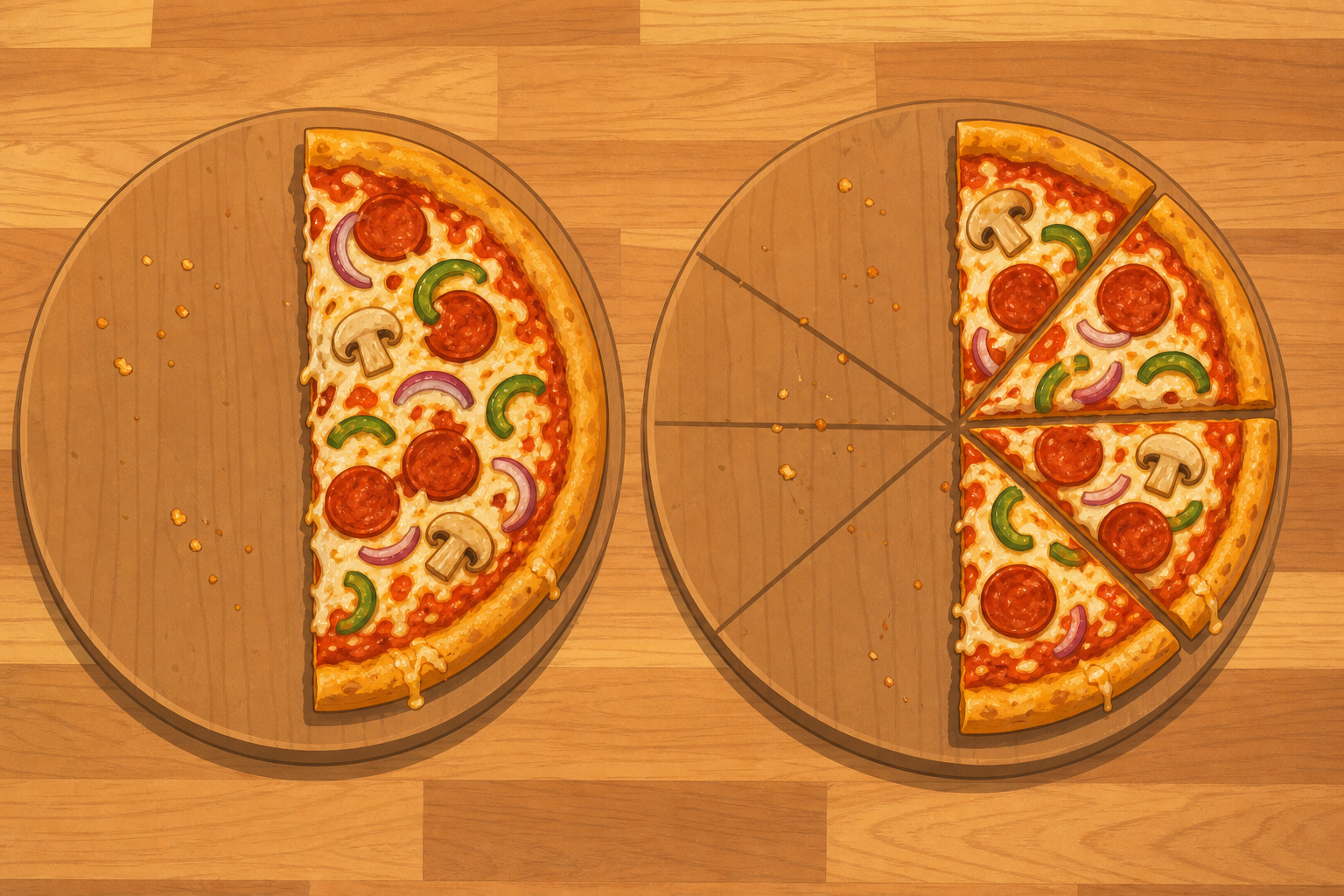
Look at the two pizzas in the picture below. The first one is cut into two big halves, and one half has been taken. The second one is cut into eight small slices, and four slices have been taken. Are these the same amount of pizza, or are they different?
Take three hands-up answers before revealing anything. Pupils often split on whether the two pizzas show the same amount; hold the disagreement for ten seconds before moving on. That tension sets up the whole lesson.
Watch as the same amount of pizza appears different ways. The first three pizzas below all show one half: as two slices, as four slices, and as eight slices. The next three all show one third: as three slices, as six slices, and as twelve slices. The shaded amount stays the same size each time. Only the slice count changes.
Work through the chain a pizza at a time, naming each one aloud as it appears: one half, two quarters, four eighths; then one third, two sixths, four twelfths. At every transition use a predict-then-reveal beat so the back rows stay active: before clicking from 1/2 to 2/4, ask the class to predict aloud, we doubled the slices to four, how many should we shade to keep it half? Take three voices, then click and confirm. Run the same predict-then-reveal beat between 2/4 and 4/8, and again across the thirds chain (1/3 → 2/6, 2/6 → 4/12).
Pause after each chain and ask the class to state the rule before you do: each time we doubled the slice count, we also doubled the shaded count. Multiplying the top AND the bottom by the same number keeps the fraction equivalent.
Anchor the visual point at the end of each chain: the shaded pizza is exactly the same size in all three pictures. We did not eat more or less. We just chopped the same amount into smaller pieces.
Today we explore equivalent fractions on the pizza-slicer. The pizza starts at 2/4, which is one half. Take turns at the board: change the slice count, then change how many slices are shaded, to find new fractions that name the same amount of pizza as one half.
This round is for talking it through together — pupils take turns at the board and the class agrees or corrects out loud.
Start with the slider on slices = 4, shaded = 2 (the widget reads it as 1/2). The rule for every rotation: before the board pupil drags, the class predicts the shaded count and the teacher takes a quick answer. Name this rule out loud at rotation one and keep enforcing it on rotation two, rotation three, every rotation. The 23 watching pupils have a job — they predict the number and the teacher hears a couple.
Run the halves chain first. Rotation 1: slide slices to 6 (class predicts three), pupil at the board drags shaded to three. Rotation 2: slice to 8 (class predicts four). Rotation 3: slice to 10 (class predicts five). Each time, the board pupil drags only after the class has predicted and the teacher has taken an answer. Then switch the starter to thirds (slices = 3, shaded = 1) and rotate four more pupils through equivalent thirds (2/6, 3/9, 4/12) under the same predict-first rule.
Listen for the rule emerging in pupil language: whatever we did to the slice count, we did the same to the shaded count. Revoice it back to the class so everyone hears the formulation. If a pupil suggests changing only the slice count and not the shaded count, pause and ask the class to look at the pizza — the shaded amount has gone down, so the fraction has gone down too.
In your maths copy, write each of these equivalences as a row, then underline the fraction with the smallest numbers on each row (next lesson we'll learn how to make a simpler fraction ourselves):
Walk the room glancing at each row — this is whole-class copybook practice, not marking. The thing to check at a glance is the underline on the leftmost fraction of each chain (the one with the smallest numbers). If a pupil has underlined the wrong one, point at the row and ask which has the smallest numbers? without telling them the answer.
This is a spot-by-eye task in this lesson. The term simplest form is in pupil language today; the procedure for simplifying any fraction (dividing top and bottom by a common factor) arrives in the next lesson. Don't pre-teach the procedure here.
Today's bingo runs in three rounds. Each pupil has a paper bingo card on their desk and a pencil ready. When the caller reads a prompt, mark any cell on your card that names that amount. First to a full line wins the round.
Round 1 is pure fraction equivalences (so '1/2' and '2/4' both win when the caller says 'one half'). Round 2 brings in decimals (so '1/4' and '0.25' both win when the caller says 'one quarter'). Round 3 adds percentages, and by then '1/2', '0.5' and '50%' are all really the same thing, so any of the three wins when the caller says 'one half'.
This round is the practice bank — every pupil plays on their own paper card while the IWB shows the prompts, and the class confirms each call before moving on. Keep the calling brisk rather than over-explaining.
Each pupil has a printed bingo card from the lesson page's "Bingo cards" download, handed out before the lesson started. Call each prompt from the IWB; pupils mark any cell that names the equivalent amount. First to a full line wins the round. The on-screen Check / grading is for at-home homework only — in class this is paper play.
Run all three rounds back-to-back. Between rounds, pause for ten seconds and ask the winning pupil to read out one of the equivalences they marked. That surfaces the why does this match? reasoning for the rest of the class. Watch for pupils who mark a non-equivalent cell (e.g. marking 1/3 when you called "one half"); pause, ask the class to check, and correct in public so the misconception does not quietly persist.
If Round 1 over-runs, the must-keep round is Round 3 — it is where the fraction-decimal-percentage trio lands. Better to run Round 1 short than to skip Round 3.
You're previewing this lesson. Get full access to this lesson and hundreds more — each one ready to teach, with interactive activities, printable resources and pupil progress tracking built in.