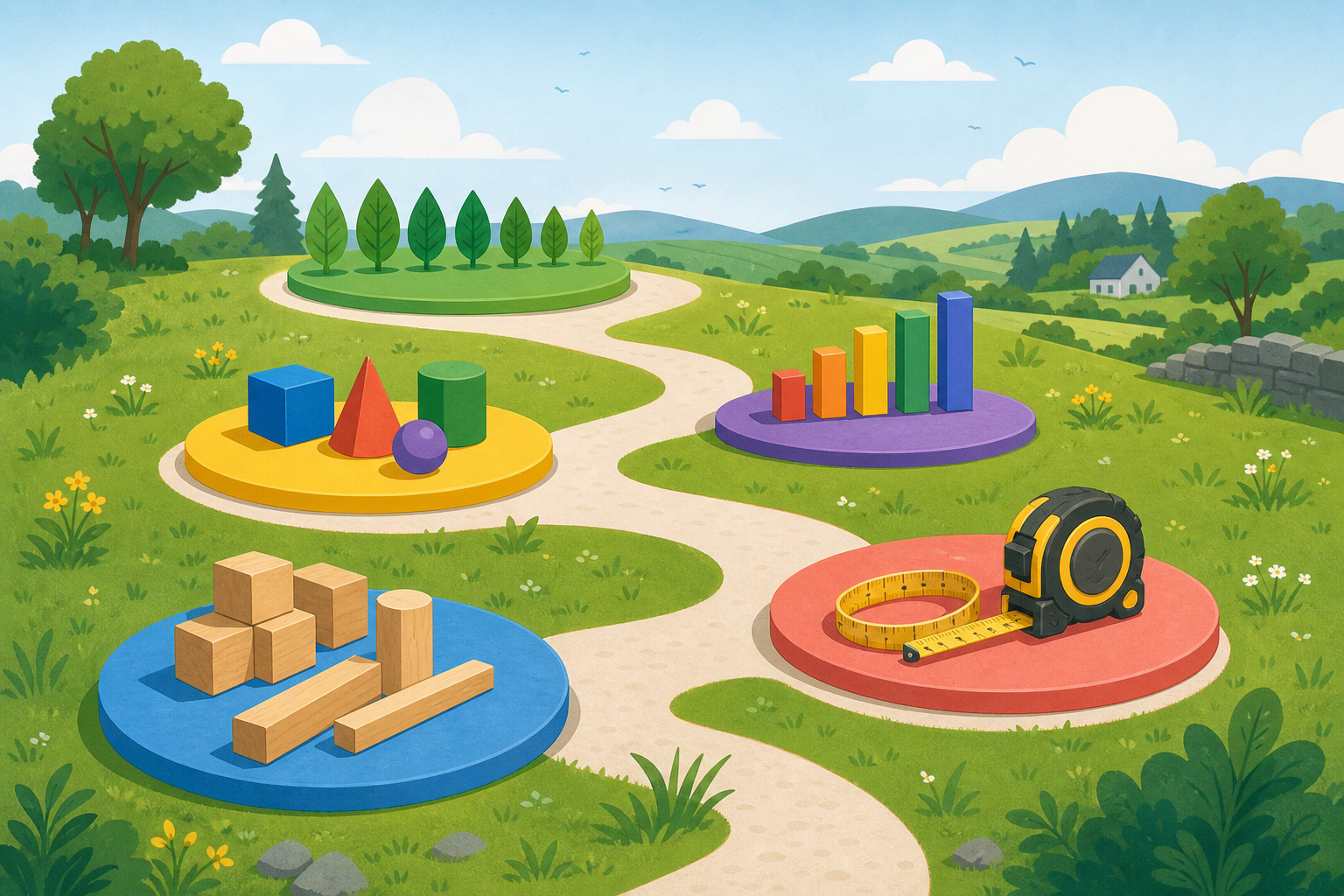
You have spent a whole year (and the year before that) building up your maths. Today we take one last tour through the five big areas of maths: Number, Measures, Shape and Space, Data and Chance, and Patterns and Rules.
Here is the question to hold in your head for the whole lesson: where does the very same idea show up in two different areas?
Keep this short — one minute. Name the five areas of maths on the board and leave them up as a running map for the tour. Take two or three hands-up on which area felt easiest this year, then move on. The 'same idea in two areas' question is the thread pupils return to at the journal beat, so plant it here and don't answer it yet.
One big idea from each maths area, side by side on screen. Read each snapshot and be ready to say which area it belongs to. Watch closely — two of them turn out to be the very same idea.
Work the tour live, one snapshot at a time. Ask which area each belongs to, take two hands, then confirm.
Fraction strip three-quarters (Number) — ask what percentage this is; hold out for 75%.
4,073 in blocks (Number) — the zero is the point; ask what is holding the hundreds place.
Same three-quarters again, now as a class share (Data) — this is the two-area moment. Note the same three-quarters again as a class share: Number and Data, because Data shows a share of the whole. Name it out loud so pupils have seen a two-area link before the challenge.
Ruler at 45 cm (Measures) — a ruler is a number line; ask a pupil to read the length off it.
Grid points A and B (Shape and Space) — along the corridor then up the stairs; ask a pupil to read an address.
Pattern 2, 4, 6, 8 (Patterns and Rules) — ask for the next number (10) and the rule (add 2 / count in twos).
Today we plot together on the grid. We will place four points in the order they were called: (2, 5), then (5, 5), then (5, 1), then (2, 1). Predict what shape those four points will make before we join the last one.
Talk this one through together — pupils take turns at the board and the class agrees or corrects out loud.
The four points make a rectangle 3 wide and 4 tall — but do not say so. Plot the first three, then ask the class to predict the fourth corner before a pupil places it. Revoice a good answer: so the bottom two share the same up-number, and the left two share the same along-number. Connect back to the tour: this is Shape and Space, but the counting of the sides (3 and 4) is Number, and the rectangle's area is Measures. One picture, three areas.
Now an idea-spotting investigation. On the board is one real classroom situation: planning a small class treat. Your job is to spot which area of maths each question below belongs to, and to notice the one idea that lives in two areas at once.
For each question, name the area of maths. Then find the question whose idea belongs to two areas, and say which two.
Which area of maths does each question in the class-treat plan belong to, and which idea belongs to two areas at once?
Read each of the five questions in turn. For each, name the area of maths it belongs to. Then find the question whose idea lives in two areas and name both.
Ways to start:
Stretch:
Record: written summary — one line per question naming its area, then one sentence naming the two-area idea
Share back: whole-class board discussion, teacher records the area beside each question
This is the practice round — pupils take turns at the board, check each answer, and the class confirms before moving on. Keep the board work brisk rather than over-explaining.
This is a paper/seat investigation, not an on-screen tool. Run it as a whole-class sorting task on the board, area by area.
The key one to spot: the fruit-and-crisps question is the one clean 'two-area' question — a fraction-of-the-whole (Number) is exactly what a pie chart shows (Data). Hold out for a pupil to name both. Circulate and prompt any pupil who is stuck on where to start.
Turn to a fresh page in your maths journal. Draw the five areas of maths as five headings: Number, Measures, Shape and Space, Data and Chance, Patterns and Rules. Under each, write one idea from this year you now feel sure about. Then, in one sentence at the bottom, name the area you think needs a little more practice — and why.
Under each of the five area headings, write one idea from this year you feel sure about. Then name the one area that needs more practice, and why.
Record: written page with five area headings and a closing self-assessment sentence
This is the journal beat, on paper — do not have pupils type. Give five quiet minutes; circulate and glance for a genuine idea under each heading, not just the area name repeated. This is not marked. Encourage the 'needs more practice' sentence to be honest — that self-assessment is the real point of the lesson.
Support printable: for any pupil who cannot start from a blank page, hand out the five-area map template (five headings pre-drawn with one worked example each); they add one idea of their own under each heading and choose the area to revisit.
You're previewing this lesson. Get full access to this lesson and hundreds more — each one ready to teach, with interactive activities, printable resources and pupil progress tracking built in.