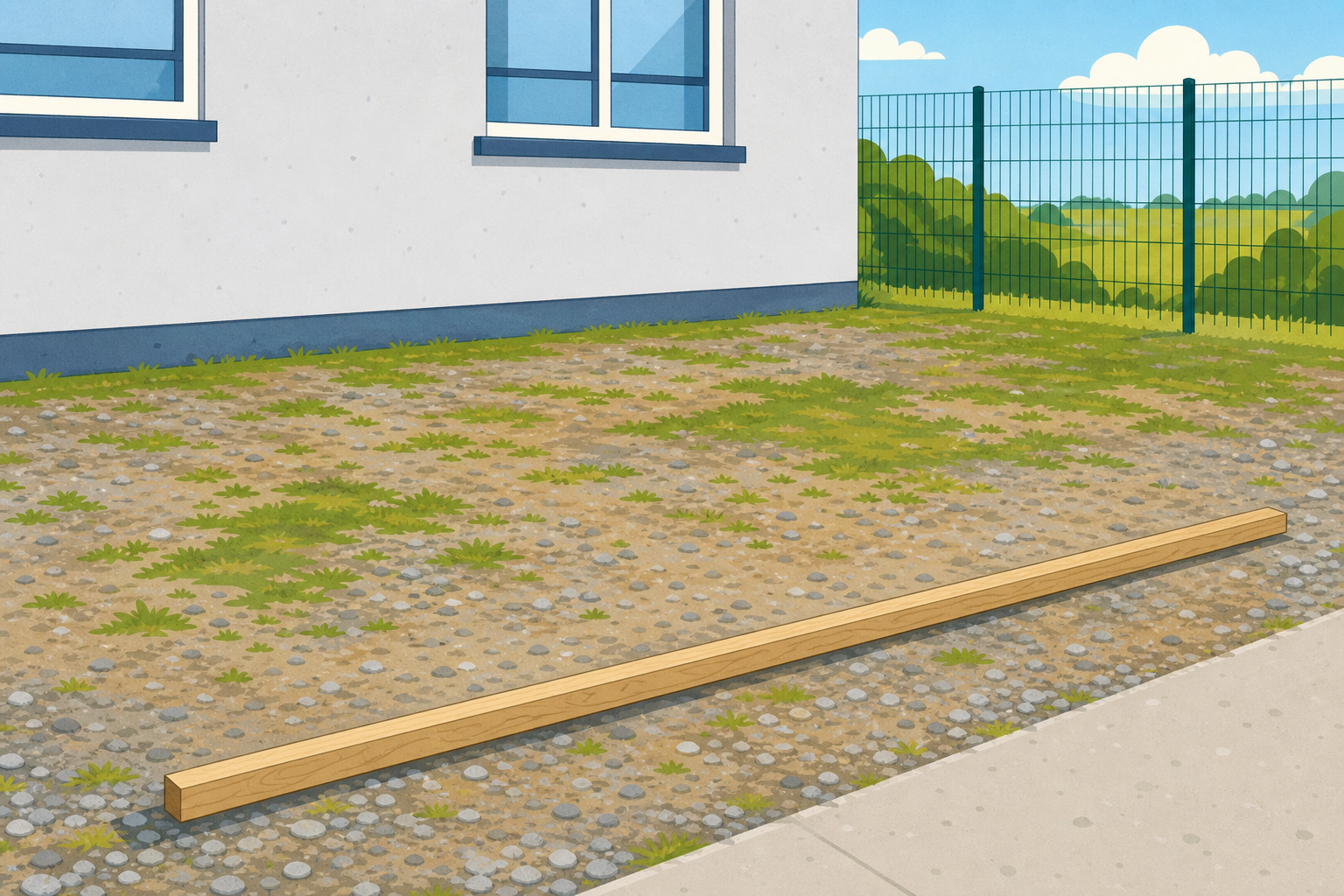
Here is the corner of the school grounds where we could build a class garden bed.
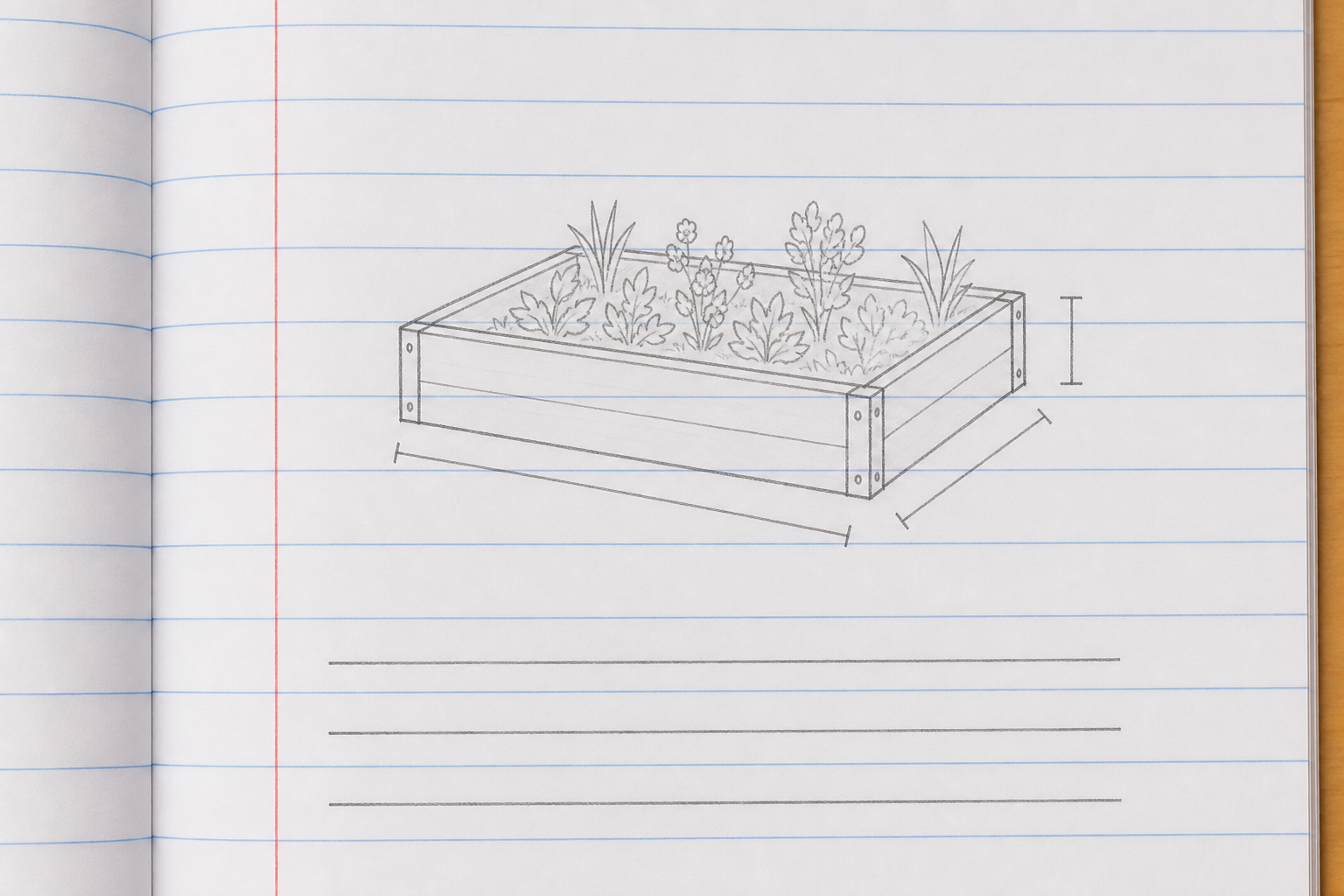
If we wanted to build a bed 2 metres long and 3 metres wide, what three different things would we need to measure or work out before we could actually build it and fill it with soil?
Take three or four hands-up ideas, not open call-outs. You are fishing for the three measures the module has covered: the length of edging round the outside (perimeter), the growing space inside (area), and the soil needed to fill it (volume). Don't name them yet — let the class surface them in their own words and hold the vocabulary for Watch and Notice.
Watch two garden beds on the board. The first is a plain 2 m by 3 m rectangle. To find the edging, add the four sides: 2 + 3 + 2 + 3 = 10 m. To find the growing space inside, multiply length × width: 2 × 3 = 6 m².
Now watch the same bed shown as a solid, filled to a depth of 0.3 m. The soil is the growing space × the depth: 6 × 0.3 = 1.8 m³.
Some beds are not simple rectangles. Here is an L-shaped bed. We can draw one straight line to split it into two rectangles you already know how to measure, and the two areas add together to give the whole.
Three demonstrations, worked live on the board — don't read a paragraph over each.
Keep the L light: it is not a fourth new idea, just the same length × width used twice and added. The point to draw out, not announce: the same bed can be measured three ways, and each answer needs its own kind of unit.
Today we design one garden bed together and measure it three ways. We'll work through these on the board:
Talk this one through together — pupils take turns at the board and the class agrees or corrects out loud.
Work the numbered steps in order so each one adds something. 4 m × 2 m: edging 12 m, growing space 8 m². Switch to the 3D view and set the depth to 0.3 m — soil is 8 × 0.3 = 2.4 m³. Ask the class to predict what happens to each number before you stretch it to 5 m × 2 m. Watch for pupils reading the area figure but forgetting the m² unit — that is the slip to catch.
In your maths copy, sketch your own garden-bed design and label the length of every side along its edge.
Underneath the sketch, work out the three measures on separate lines and underline each answer:
Walk the row glancing at whether every side is labelled and whether the units (m, m², m³) are written on each answer line — this is whole-class copybook practice, not marking. The most common slip is a missing or wrong unit rather than wrong arithmetic.
Now design your own garden bed and prove it works, one design at a time. We'll work these together on the board.
First, a straight 3 m by 2 m bed. Then a 4 m by 3 m bed. Then we learn the L-shape edging move with one worked example on the board: an L made from a 3 m by 2 m rectangle joined to a 2 m by 2 m rectangle. Label every outer side, walk right round the outside only (the join inside gets no edging), and add those lengths for the perimeter. Add the two areas for the growing space, then multiply by a depth of 0.3 m for the soil. For the stretch, design an L-shaped bed with exactly 12 m² of growing area made from two rectangles that add together. For each one we find the edging, the growing space, and the soil at 0.3 m deep.
Practice round: pupils take turns at the board, class confirms, keep it brisk.
Rectangles first (use the interactive): 3 m × 2 m → edging 10 m, area 6 m², soil 6 × 0.3 = 1.8 m³. Then 4 m × 3 m → edging 14 m, area 12 m², soil 3.6 m³.
L-edging worked example (board only, interactive cannot build an L): draw the L from a 3 m × 2 m and a 2 m × 2 m, flush at one end. Draw the split line. Outer sides walking round: 3 + 2 + 1 + 2 + 2 + 4 = 14 m edging. Area: 3 × 2 + 2 × 2 = 6 + 4 = 10 m². Soil: 10 × 0.3 = 3 m³. Point to stress: the shared join is inside, so it is not counted in the edging.
Stretch: L with exactly 12 m² (e.g. 3 × 2 + 3 × 2, or 4 × 2 + 2 × 2). Same three measures each time.
Slip to catch: counting the inner join in the perimeter, or dropping the unit (m, m², m³) on any answer.
You're previewing this lesson. Get full access to this lesson and hundreds more — each one ready to teach, with interactive activities, printable resources and pupil progress tracking built in.