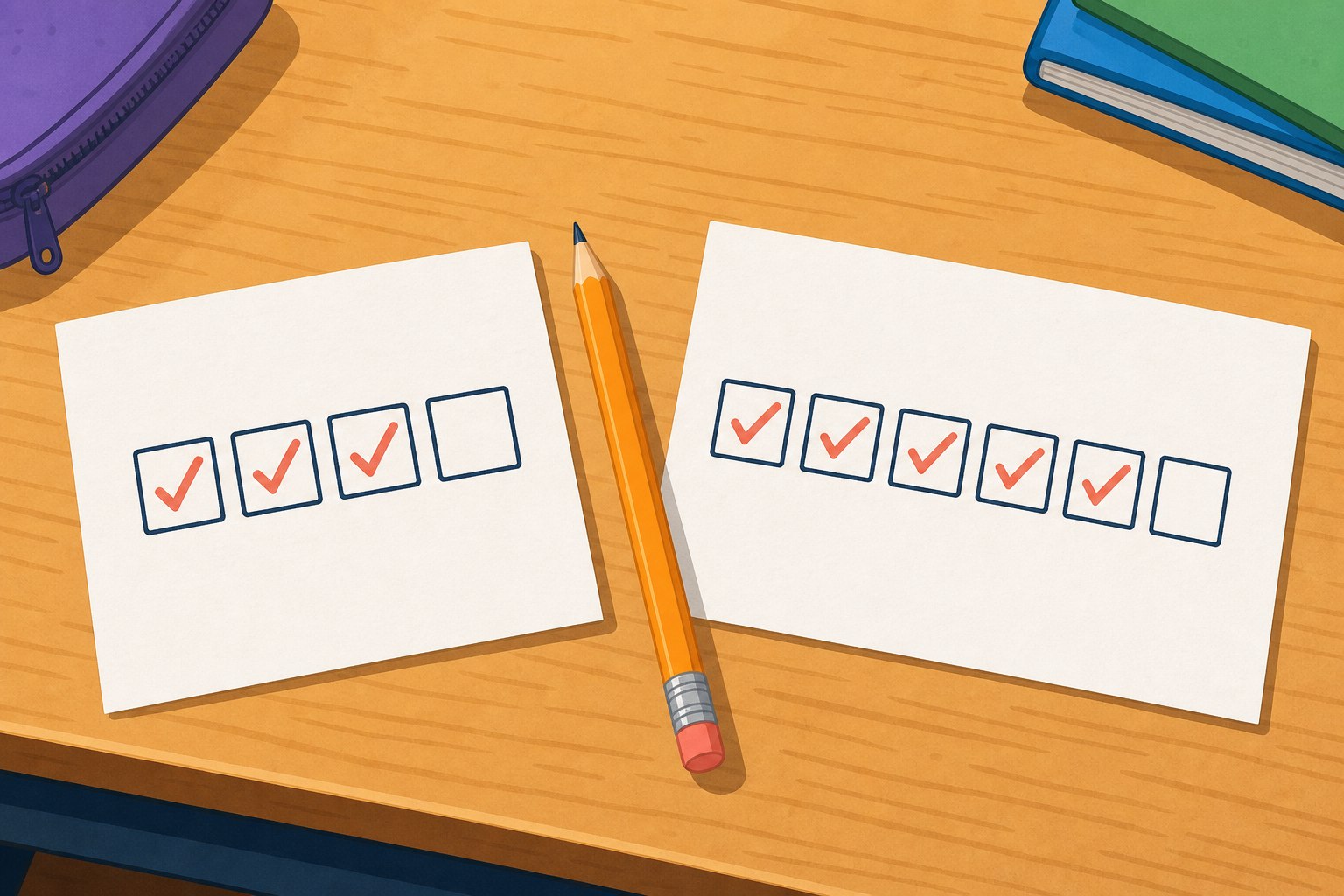
Two players are racing through a board game. The first has filled in three of the four boxes on her scorecard. The second has filled in five of the six boxes on his. Three quarters versus five sixths. Who is closer to finishing, and how would you know quickly, without staring at the picture for a long time?
Take three hands-up answers and acknowledge each without confirming which is right. Hold the question open: the lesson is going to give the class three different strategies for settling it.
Today's lesson works the comparison question three different ways. Watch closely. The fraction strips show what the maths is doing.
Quickest case of all. If two fractions already share the same bottom number, you don't need any strategy at all — just compare the tops. 5/12 versus 7/12: seven pieces beats five pieces. Done. But most pairs aren't that easy. The four examples below show what to do when the bottoms don't match.
Look at the two strips. The 3/4 strip and the 5/6 strip are very close in length. We cannot quite tell from looking. Rewrite both over a common denominator of twelve: 3/4 becomes 9/12 and 5/6 becomes 10/12. Now it is clear: 10/12 is one twelfth more, so 5/6 is bigger than 3/4.
A common denominator of fifteen turns 2/3 into 10/15 and 3/5 into 9/15. The strips confirm it: 2/3 is the bigger of the two, even though 3/5 looks bigger at first.
This time, notice that 2/7 is shaded less than half its strip, while 5/9 is shaded more than half. No common denominator needed. One sits below the half mark; one sits above. 5/9 wins.
The tops are the same. Four pieces each. But ninths are bigger pieces than elevenths, so four of them takes up more space. 4/9 is bigger than 4/11. When the top numbers match, the smaller bottom number always wins. Notice this is the opposite of Examples 1 and 2: there we had to rewrite because the bottoms didn't match; here, we don't rewrite at all, because the tops already match.
Spend roughly two-and-a-half minutes per example, with a short pause between each. The point is for the class to see the strategy in the strips, not just take notes from the board.
Now the class drives. Today's pair to compare: 5/8 versus 2/3. Before computing anything, run the spotting protocol: do the tops match? Is one above one half and one below? If neither shortcut fits, common denominator is the move. A pupil at the board shades 5/8 and 2/3 on the strips so the class can read off which is bigger.
One comparison, talked through together. A pupil comes to the board and shades 5/8 on the eighths strip and 2/3 on the thirds strip while the class calls each shaded count.
Run the spotting protocol first. Ask: 'do the tops match?' (No — 5 and 2.) 'Is one above half and one below?' (No — both above one half: 5/8 is just over, 2/3 is well over.) So the shortcuts are ruled out and common denominator (24) is the move. Work the rewrite on the IWB pen alongside the widget: 5/8 = 15/24 (multiply top and bottom by 3) and 2/3 = 16/24 (multiply top and bottom by 8). The class reads 15/24 vs 16/24 and confirms 2/3 is the slightly bigger fraction. The strips on screen are the visual sanity check; the rewriting work is on the board.
Listen for the 'longer-shaded strip is the bigger fraction' revoice — that's the visual proof the maths is doing.
In your maths copy, work each comparison below by re-writing both fractions over a common denominator. Then place the correct < or > sign between the two fractions.
Walk the room glancing at how pupils are choosing their common denominator — this is whole-class copybook practice, not marking. Eighteen and twenty are the smallest workable choices; if a pupil picks a bigger multiple they still arrive at the right answer, just by a longer road. Both are valid; nobody needs correcting in real time.
Today's bank: five comparison problems in escalating order of trickiness. Build each pair of fractions on the strips, call out which is bigger, then name the strategy you used to see it. Use the Check button to confirm each one before the next pupil takes the board.
This round is the practice bank — pupils take turns at the board, check each answer, and the class confirms before moving on. Keep the board work brisk rather than over-explaining.
You're previewing this lesson. Get full access to this lesson and hundreds more — each one ready to teach, with interactive activities, printable resources and pupil progress tracking built in.