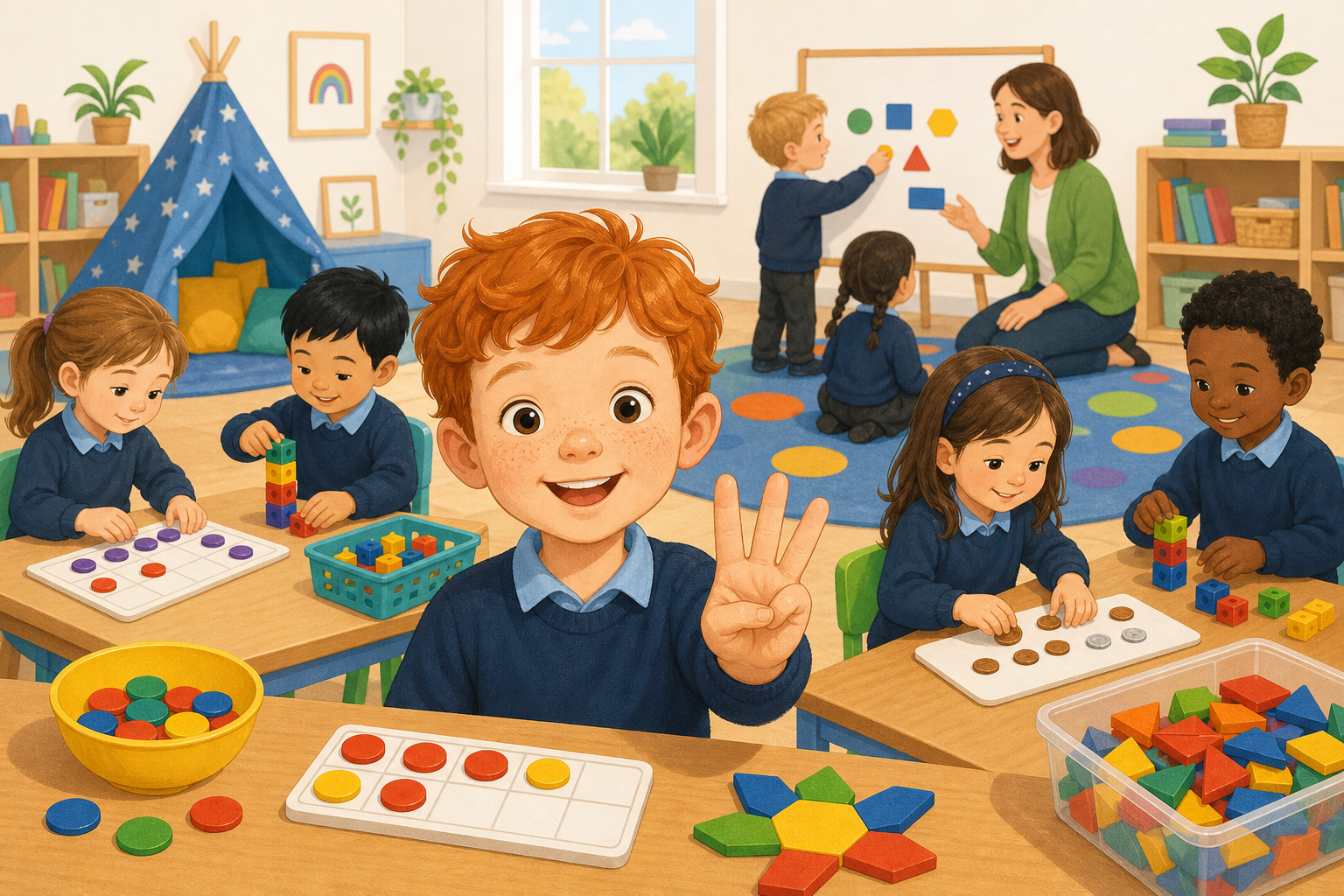
Show me five! Now hide some. Which fingers are up? Which fingers are down?
Keep this light and quick. Call show me five, then now hide some, and let the class peek at each other's hands. Take two or three hands-up answers, not open call-outs. Don't name the parts yet — that lands in the demonstration.
Watch our five break into two parts. Here is 4 and 1. Here is 3 and 2. Say it with me: three and two make five.
Point at each part circle as you say it aloud: four here, one here — four and one make five. Then show three and two make five, and hold up three fingers and two fingers to match. Show the fingers version at the same time so the hand and the diagram tell the same story. Do not proceed until the class can say a full sentence with you — the sentence is the lesson.
Take a train of 5 cubes. Snap it into two bits. Lay one bit on each plate. Say your way out loud: how many here, how many there?
Every child needs a 5-cube train and two part-part plates. Circulate and listen for the sentence — four and one make five, three and two make five. When a child finds a new way, ask them to show it on their fingers too: fingers up for one part, fingers down for the other. Prompt any child who is stuck: snap it anywhere — now count each bit. This is whole-class play, not marking.
One of us comes to the board to break five: first 4 and 1, then 3 and 2, then 5 and 0. Everyone else watches and says the sentence out loud with the class before we check.
This round is for talking it through together. One pupil at a time comes to the board and drags the counters into the two parts; the watching class's job is to say the full sentence aloud and to agree or correct.
Work the ways in order — 4 and 1, then 3 and 2, then 5 and 0. Pause on 5 and 0: ask what does the empty part mean? — all five stayed together, none went across. The class says the full sentence each time before you reveal.
Which way of making five do you like best? Show it on your fingers.
Listen for children saying a full sentence — three and two make five — not just naming one number. Revoice a strong answer: so five didn't get bigger or smaller, we just moved it into two parts. Head off the idea that a different-looking hand means a different number of fingers — it is still five altogether.
You're previewing this lesson. Get full access to this lesson and hundreds more — each one ready to teach, with interactive activities, printable resources and pupil progress tracking built in.